Local
Building a Family Charging Station That Handles Every Device
A Roundtable is a way to meet new people and discuss this article in person at a local coffee shop or other venue.
Roundtables are designed for groups of four, with a shared subject and room for everyone to speak. Come for discussion, with no dating expectation.
Source: Blog Daily
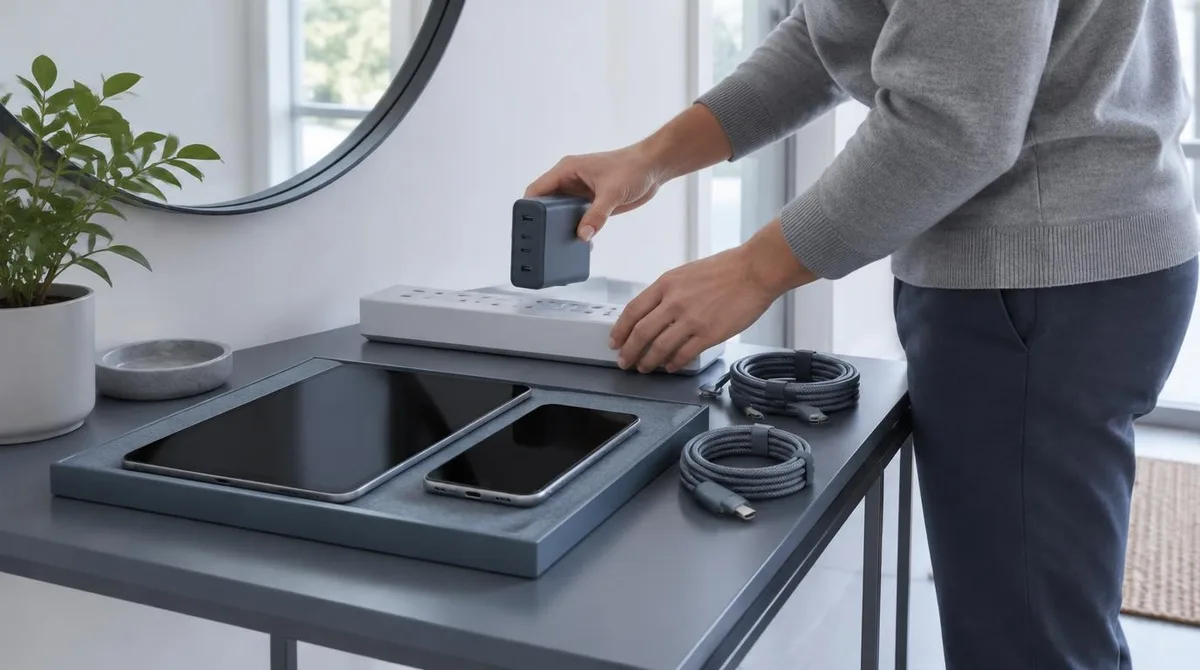
A family charging station handles every device when the wattage math happens before anything gets plugged in. The recipe per the published specs: a USB Power Delivery charger sized to the household's devices, cables rated for the power in play, and a surge protector rather than a plain power strip, per UL's consumer guide. Apple's documentation shows why sizing matters: the iPhone 18 Pro fast charges to 50 percent in around 15 minutes only with a 40W Dynamic Power Adapter or a 60W-capable USB-PD 3.2 adapter. The catch: the spec ties each power level to a cable rating, per USB-IF, so the wrong cable quietly limits the speed. Everything below traces to three documents: the USB-IF's USB Power Delivery specification pages, Apple's fast-charge support article with testing dated July 2026, and UL's guide to power strips and surge protectors. This connects to our earlier piece, How to Set Up a New iPhone and Transfer Everything From Your Old One.
This excerpt comes from the named source. Read the original for the full reporting.
Read the original at Blog Daily



