Local
Patriots’ Gravestones Get Much-Needed Care
A Roundtable is a way to meet new people and discuss this article in person at a local coffee shop or other venue.
Roundtables are designed for groups of four, with a shared subject and room for everyone to speak. Come for discussion, with no dating expectation.
Source: The East Hampton Star
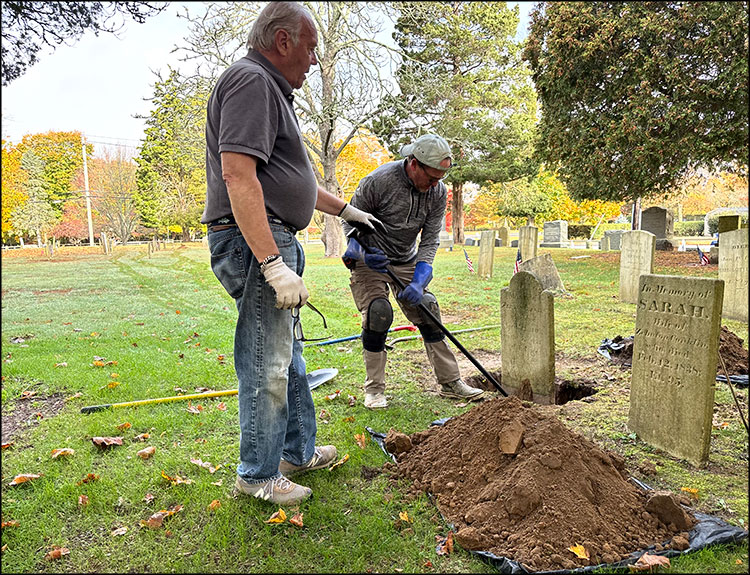
Share on Facebook Share on Twitter Share through email Published 4 days ago Last updated 4 days ago Zach Studenroth and Joel Snodgrass of the Burying Ground Preservation Group partially excavated this headstone in Amagansett, righted it, and then tucked it back in with soil. Christopher Gangemi By Christopher Gangemi November 19, 2026 Zach Studenroth says he can tell the age of a gravestone from a half-mile away. As he helped Joel Snodgrass — his partner in something called the Burying Ground Preservation Group — realign and reattach the cracked headstone of Samuel Conklin in the East End Cemetery on Atlantic Avenue in Amagansett, Mr. Studenroth explained that Mr. Conklin’s gravestone was made of brownstone, common in the 18th century. (Mr. Conklin died in 1802.) By the early 1800s, marble began replacing brownstone. “Brownstone is very vulnerable,” said Mr. Studenroth. “Marble was discovered in Dorset, Vermont, in 1790,” he continued. “A large mountain of it that was very accessible.
This excerpt comes from the named source. Read the original for the full reporting.
Read the original at The East Hampton Star