Local
W. Bradley Wendel, scholar of legal ethics, dies at 57
A Roundtable is a way to meet new people and discuss this article in person at a local coffee shop or other venue.
Roundtables are designed for groups of four, with a shared subject and room for everyone to speak. Come for discussion, with no dating expectation.
Source: Cornell Chronicle
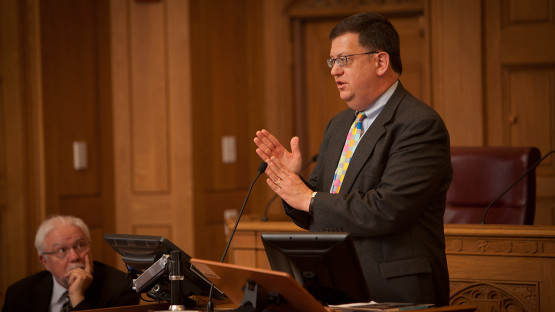
Credit: Jason Koski/Cornell University W. Bradley Wendel, the Edwin H. Woodruff Professor of Law in the Cornell Law School, speaks in 2015 at an event celebrating his book “Ethics and Law: An Introduction.” W. Bradley Wendel, the Edwin H. Woodruff Professor of Law, died Nov. 18 at age 57. A member of the Cornell Law School faculty for more than two decades, Wendel was an internationally recognized scholar of legal ethics, a mentor and a teacher who brought the questions that animated his scholarship into the classroom. “Brad was the model of what a great legal scholar should be,” said Jens David Ohlin, the Allan R. Tessler Dean and Professor of Law. “He was focused on the big questions about the role of lawyers in our democratic system, but he was also a brilliant lawyer himself. “He could talk about Kant and then pivot to parsing the language of a statute, the Model Rules of Professional Conduct or a torts case.
This excerpt comes from the named source. Read the original for the full reporting.
Read the original at Cornell Chronicle


