Meet In CommonNews

Local

WATCH: Dense fog drops visibility to 1/16 of a mile in South Florida

A Roundtable is a way to meet new people and discuss this article in person at a local coffee shop or other venue.

Roundtables are designed for groups of four, with a shared subject and room for everyone to speak. Come for discussion, with no dating expectation.

Source: NBC 6 South Florida
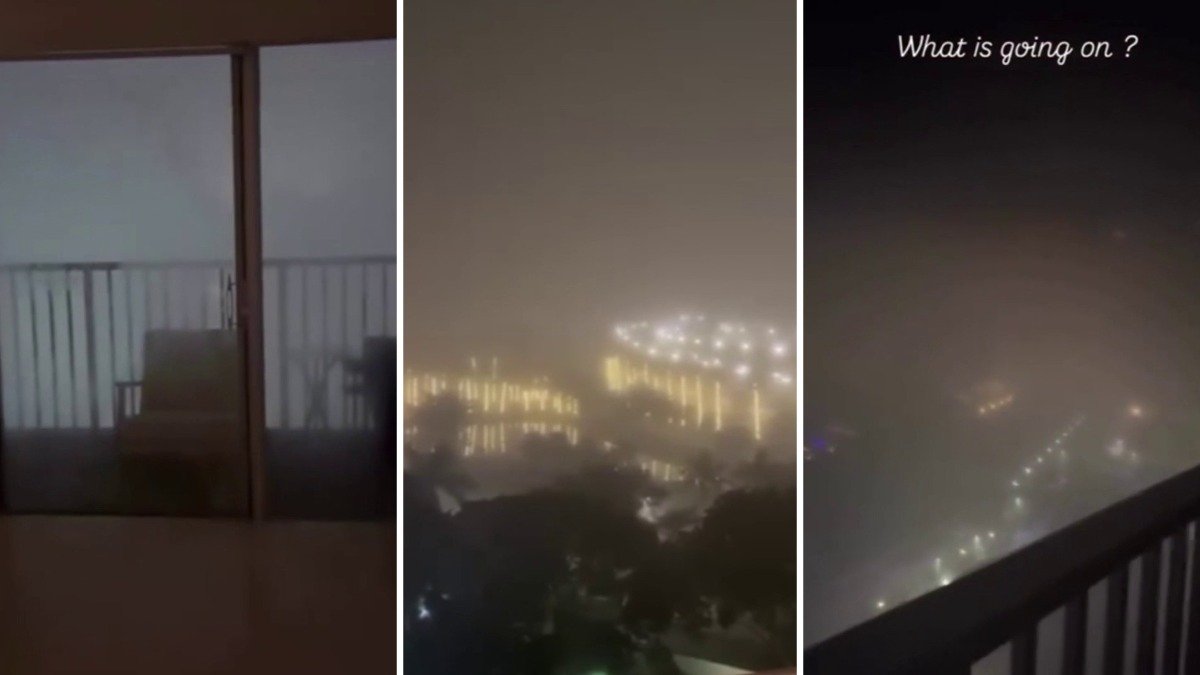
Did you notice the dense fog on Thursday night? Visibility at Miami International Airport fell from 10 miles just before 10 p.m. Thursday to one-sixteenth of a mile two hours later. Visibility dipped to half a mile at Fort Lauderdale-Hollywood International Airport as well. Watch NBC6 free wherever you are The change came as a “fog bank” rolled into parts of Miami-Dade and Broward, showing up on satellite imagery that the National Weather Service in Miami shared at 11:40 p.m. The heavy rain earlier in the week helped set the stage. With the ground still wet and plenty of moisture in the air, it took very little cooling after sunset for fog to form. Only In Dade videos captured that intense fog cover, prompting people to wonder: what is going on? At Miami International Airport, the temperature and dew point both measured 73 degrees just before midnight. At that point, the air near the ground was saturated, and water vapor was condensing into the tiny droplets we see as fog.

This excerpt comes from the named source. Read the original for the full reporting.

Read the original at NBC 6 South Florida

Featured places to meet in Miami, FL

Explore these places and arrange a conversation through ThinkMatch.

City guide for Miami, FL

Related coverage

Florida Tech News · Princeton, FL

Florida Tech Named (Again) to Princeton Review Mental Health Services Honor Roll - Florida Tech News+

For the second straight year, Florida Tech has been named to The Princeton Review’s Mental Health Services Honor Roll, one of only 76 institutions nationwide and one of just four in Florida on the 2027 edition. The accolade goes to institutions that show commitment and dedication to the mental health and well-being of their students. The 76 schools that made the honor roll represented just over 10% of the 739 that participated in last year’s Campus Mental Health Survey from The Princeton Review in collaboration with the Ruderman Family Foundation, which works to end the stigma associated with mental health. The Review also surveyed more than 56,000 students at 300 institutions about their awareness of their schools’ mental health services as part of its data collection for the Honor Roll.

The Miami Times · Miami, FL

Miami-Dade removes Black-specific mandate from Economic Advocacy Trust amid Florida DEI ban

The Miami-Dade Board of County Commissioners on Tuesday approved an overhaul of the Miami-Dade Economic Advocacy Trust, removing references to the Black community from its governing mandate and eliminating requirements for a majority-Black board. The Miami-Dade Economic Advocacy Trust (MDEAT) was formed following the 1980 McDuffie riots, which ensued after six white police officers were acquitted for the death of Arthur McDuffie, a Black Miami man. Since its inception, MDEAT’s focus has been on addressing the socioeconomic disparities within the community, specifically for Black families, neighborhoods and businesses across Miami-Dade County. The ordinance approved on Nov. 17 will remove all mention of the words “Black” or “African-American” from the code that established the organization, in addition to removing the requirement that most of its board be made up of Black members.

Community Poll

Businesses should explain substantial price increases to their customers.

Share your view, then see how readers voted. No sign-in required. This poll is shared across stories.

Do you agree or disagree?

Choose one answer

Common Quandary

A Common Quandary to discuss

Another conversation to explore, separate from this news story.

The stadium can ban violent fans by scanning every face at the gate. Would you walk in?

A stadium can use facial recognition to identify people banned for violence and shorten security lines. Every visitor would be scanned, error rates are not zero, and the resulting biometric data could become useful to police or advertisers.

How much privacy may a crowd be asked to trade for collective safety?

Explore this quandary