061 | Retiring With A Pension? This One Decision Can Change Everything
56 min
Listen through the publisher, then discuss the episode here or arrange an in-person Roundtable. Your city determines where to meet.
Roundtables are designed for groups of four, with a shared subject and room for everyone to speak. Come for discussion, with no dating expectation.
On episode 61 of Retirement Unpacked, Gord Manzer and Steven Arnott discuss the key factors when deciding between taking the defined benefit pension or its commuted value, how OAS and OAS clawback fit into your overall taxable income, whether it makes sense to unlock your locked-in account before retirement, should you delay OAS to do a larger RRSP meltdown, and much more. Later in the episode, Mathieu Huneault joins the show to discuss tax-loss harvesting, when it may make sense, and some important cautions to keep in mind. Chapters 0:00 Intro 0:40 Monthly payments vs. commuted value: What's the best option? 7:54 How does OAS clawback affect your taxable income? 12:32 Should you unlock your locked-in RRSP before retiring? 18:35 Delaying CPP: What happens if one spouse dies early? 24:29 Which jurisdictions allow you to base LIF maximum on last year's returns? 29:00 How CPP survivor benefit fits into your own CPP calculation 32:46 When does it make sense to contribute to an RRSP in retirement? 36:44 RRSP vs. TFSA contributions when you're close to retirement 40:54 Should you delay OAS to do a larger RRSP meltdown? 43:21 Tax-loss harvesting at year end 48:05 Should you contribute to RRSP if you have a pension?
Episode information is provided by the publisher. Listening takes place on the publisher’s service.
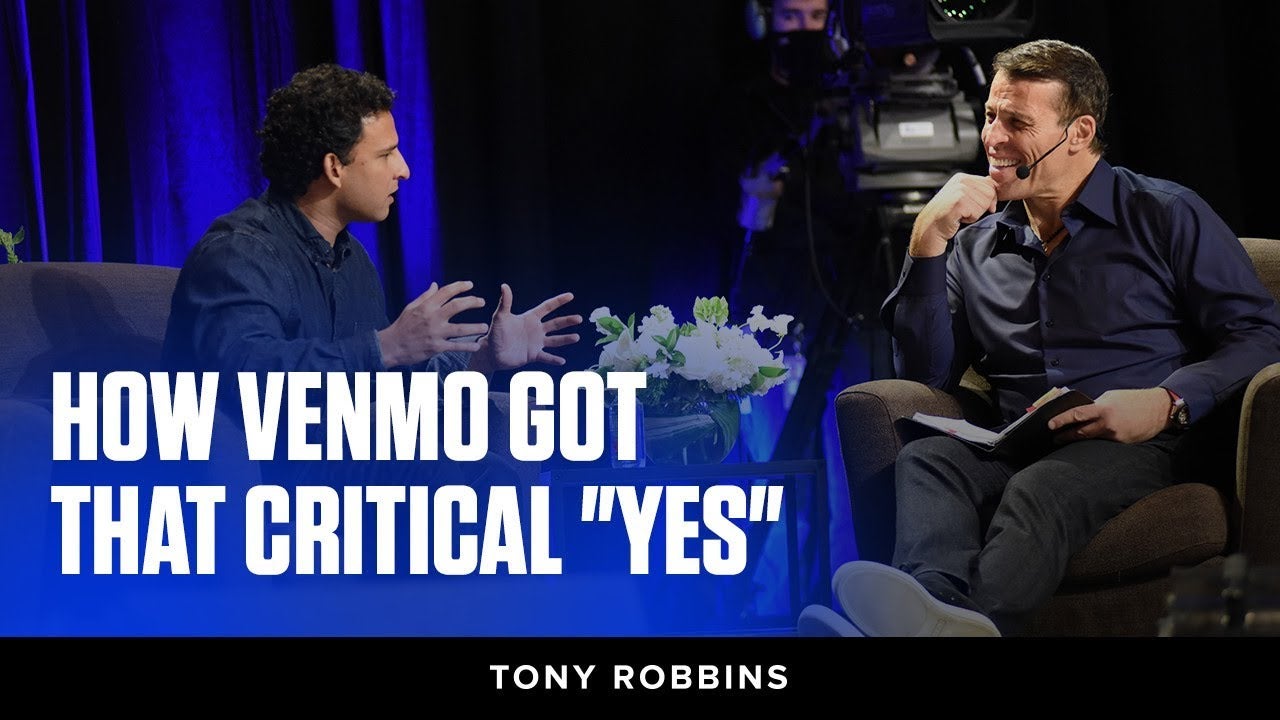
In this episode of the Tony Robbins Podcast we’re continuing our Business Mastery Panelist series with an exclusive interview between Tony and Iqram Magdon-Ismail, the co-founder of the digital payment platform, Venmo. Uploaded 29-10-19 In case you’re not familiar with Venmo, the premise is simple: you connect the app to your checking account and you can send and receive payments to anyone with just a tap and a swipe of your smartphone. It’s the ideal solution for splitting bills and paying your friends back – especially for anyone who doesn’t like carrying around cash. Venmo makes exchanging money incredibly simple, and it takes the awkwardness out of asking someone to pay you back. Paying for everything from cab rides to dinners to rent and utilities is streamlined. Venmo was acquired by Braintree in 2012 for $26.2 million, which in turn sold to PayPal for $800 million. And now, Venmo processes more than $6.8 billion in payments per quarter. Yet as ubiquitous as Venmo is today, it wa
You've gotten very good at pretending you don't feel it. Uploaded 21-08-26 Maybe it's a conversation with someone you love. Someone you work for. A partner, a parent, a friend who's been quietly taking more than they give. Or the hardest one of all — a conversation with yourself, the one where you finally admit something you've refused to say out loud for years. You know exactly which one I'm talking about. You felt it the moment I said the word. A name came up, or a face, and your stomach did something small and unpleasant, and you pushed it back down where it's been living. That flinch is the most honest thing that's happened to you all day. Here is the truth: the life you say you want — the freedom, the peace, the relationship, the income, the respect — there's a very good chance it's on the other side of one conversation you keep refusing to have. Not ten. One. This seminar unpacks the single mechanic behind a stuck life: the necessary conversation you keep treating like a locked d
Should you pay off your mortgage early (https://www.biggerpockets.com/blog/pay-off-mortgage) or buy more rental properties (https://www.biggerpockets.com/guides/how-to-buy-rental-property)? The first option gives you peace of mind, while the other allows you to build wealth much faster. In this episode, we’re fleshing out both strategies so you can make the right choice! Welcome back to another Rookie Reply! What’s better—a debt-free property or a larger real estate portfolio (https://www.biggerpockets.com/blog/building-scaling-real-estate-portfolio)? The answer depends entirely on the investor, but we’ll help you determine the best path for you. As a new landlord (https://www.biggerpockets.com/blog/what-is-a-landlord), it’s only a matter of time before you’ll need to make repairs to your property. But what if that “repair” is something major, like replacing an HVAC unit? We’ll show you how to prepare for the worst before you buy! Finally, how do you know if you’re analyzing a rental p
There is a point where cutting expenses stops working and you have to change something bigger. Andrew lays out the full catch-up plan, from the five places money actually leaks to the one move that could be worth seven figures over a career. Want personalized help from Andrew? Join Master Money Academy athttps://www.skool.com/mastermoneyacademy/about What You'll Learn in This Episode Whether you are truly behind, measured against real net worth data instead of your friend’s new house The single order to attack emergency savings, debt, and investing so you stop making progress on nothing Where $750 a month in recovered spending ends up after ten, twenty, and thirty years How much interest a $15,000 credit card balance costs you, and how fast it disappears at different payment levels What skipping your employer match quietly costs over a thirty-year career Why chasing a single stock or crypto bet to catch up usually sets you back further How to reverse-engineer your monthly investing num
You know the work is useful. Then it is time to name the price, and you start apologizing. What would change if you treated the conversation as a fair exchange? In this episode of The Level Up Podcast, Paul Alex breaks down how to present a useful offer clearly while respecting both your work and the customer’s decision. Paul draws on the communication and sales skills he began developing at Ecolab. Explaining value is something you can learn, even if being outgoing does not come naturally to you. Begin with the person’s needs, what you provide, and what it costs. Give them room to consider the offer and say no. Feeling uncomfortable does not require pressure or an apology. It gives you a specific part of the conversation to practice. In this episode, you’ll learn: • How to connect an offer to the need the other person actually has. • Why stating a price clearly supports an informed decision. • How to respect a customer’s choice without minimizing your work. • What to practice before a
Most people spend more time researching a new TV or a pair of running shoes than they spend looking at the retirement portal they log into on their first day at a new job — and that gap costs W-2 employees tens of thousands of dollars. Stephen and Andrew translate workplace benefits into plain English: the power of compounding, the employer match that doubles your money on day one, and the difference between a traditional and a Roth account. They also run the numbers most people never see: the 2026 contribution limits, why money sitting unallocated in a money market account is a slow leak, and how a 0.85% fee versus a 0.04% fee turns into more than a hundred thousand dollars over thirty years. The challenge at the end is simple — log into your benefits portal this week, make sure you're getting the match, and make sure your money is allocated where you want it. What You Will Learn The employer match is a 100% return on day one — no investor, not even Warren Buffett at 25% a year, earns
On episode 62 of Retirement Unpacked, Adam Bornn and Brett Martinson discuss what you should do if your RRIF continues to grow after retiring, potential withholding tax issues you'll run into in the first few years of retirement, when it makes sense to take the commuted value of your pension, how to utilize your TFSA in retirement, and much more. Later in the episode, Paul Grenier joins the show to discuss planning considerations when you enjoy what you do and are choosing to work longer. Chapters 0:00 Intro 0:17 My portfolio keeps going up, what should I do? 7:44 Considerations when gifting a rental property 13:58 Withholding tax issues in retirement 19:30 Should I take the commuted value? 26:13 Why shouldn't I drain my TFSA first? 30:46 How do I find my adjusted cost base? 34:56 Considerations when moving to another province 39:55 How do workplace non-registered accounts work? 42:11 Can you carry forward RRSP deduction past 71? 45:03 Planning considerations when you want to continue
Residents' quality of life can justify caps on tourism even when businesses lose income.
Share your view, then see how readers voted. No sign-in required. This poll is shared across stories.
Do you agree or disagree?
Common Quandary
A Common Quandary to discuss
Another conversation to explore, separate from this news story.
The company printer sits idle all day. Can you print two hundred wedding invitations?
Your office has a fast color printer that is rarely used, and supplies are ordered automatically. Printing your wedding invitations after hours would save substantial money. Personal use is technically prohibited but routinely ignored for small jobs.
When does an insignificant workplace perk become taking?