200. Nitin Nohria: CEOs - The best way for boards to manage the manager
41 min
Listen through the publisher, then discuss the episode here or arrange an in-person Roundtable. Your city determines where to meet.
Roundtables are designed for groups of four, with a shared subject and room for everyone to speak. Come for discussion, with no dating expectation.
Nitin was the 10th dean of Harvard Business School, from 2010 to 2020. He co-authored “Seven Surprises for New CEOs”, and his new book, The CEO: The Role, The Reality, The Responsibility, is out now. Listen to this episode to know more about: Why new CEOs find their board so hard to read (01:21) Questions a new CEO should ask every director in the first 100 days (04:22) A small tell that shows whether the CEO can delegate (06:09) The diary advice Nitin offers all his CEOs (09:07) What Nitin’s board said about his priorities as dean of HBS (12:42) How a top hospital board responded to bottom-quartile results (17:47) When should a board push management for higher targets? (24:41) The three patterns Nitin sees in fired CEOs (28:14) When a CEO exit turns political (32:39) ⚡The Lightning Round⚡(34:16) Host: Oliver Cummings Producer: Will Felton Editor: Penelope Coumau Music: Kate Mac Audio: Nick Kold Email: [email protected] Web: https://www.nurole.com/nurole-podcast-enter-the-boardroom
Episode information is provided by the publisher. Listening takes place on the publisher’s service.
These 4 standards measurements have the potential to change your life in very impactful ways. What standards are you setting for yourself? Is it a should or a must? Tony Robbins speaks on raising the bar and quality of your life by raising your standards. Uploaded 07-07-24 Watch more videos like this These 3 Questions Will Change How You Do EVERYTHING!: https://youtu.be/43RL-kSEEyQ The #1 Most Important Skill for Improving Your Life: https://youtu.be/8joX6mdOVcE Prime Your Brain to STOP Stress, Anxiety and Fear INSTANTLY: https://youtu.be/60ROjGMqXUQ The Tony Robbins Podcast: https://www.youtube.com/playlist?list=PLYTXvUDQT5pWkFiK1Yal1WtPcMrVbmjzA Tony Robbins is a #1 New York Times best-selling author, entrepreneur, philanthropist, and the nation's #1 Life and Business Strategist. For more than four and a half decades, more than 100 million people from 195 countries have enjoyed the warmth, humor, and transformational power of his business and personal development events. Mr. Robbins
Gianni Agnelli is the head of the family that controls Fiat, and the vast business empire beyond the carmaker that helped shape modern Italy. Charming, charismatic and powerful, he's regarded by many as Italy’s unofficial king, and his family de facto royalty. When he dies the country is plunged into mourning and fear for its economic future. But Gianni’s death also triggers an inheritance dispute that will shake his family to its core. Inheritance tells the story of the family dramas that shape some of the world's biggest businesses. Search for Inheritance wherever you get your BBC podcasts. Host: Sofia Bettiza Series Producer: Simon Tulett Producer: Bob Howard Fact-checkers: Adriana Urbano and Randa Darwish Music: Thomas Ross Fitzsimons Mixing and sound design: Richard Hannaford Series Editor: Matt Willis With special thanks to Jennifer Clark, Michele Masneri, Rachel Sanderson, Andrea Colli and Octavia Woodward. Senior Commissioning Producer: Sarah Green Commissioning Editor: Jon Man
There are questions you can ask yourself that will tell you more about your future than any prediction ever could. Not questions about what you want. Not questions about your dreams. Questions about what you're actually doing, right now, in the small hours nobody sees. Uploaded 18-08-26 The person you'll be in ten years isn't waiting somewhere in the future for you to arrive. That person is being built today. In the choices you make this morning. In the way you spend the next hour. Most people ask "what do I want," which is easy, feels good, and changes nothing. What they never ask is "who am I actually becoming, based on how I'm living right now." That's the harder question. That's the one that tells you the truth. Here is the truth: who you're becoming isn't determined by your intentions or your goals or the vision board on your wall. It's determined by your patterns. And your patterns are visible, if you're willing to look at them honestly. This seminar walks through ten questions y
Now Mark wants to help you become financially free as well. Follow the podcast and turn on notifications! This Podcast is fan-made. No copyright infringement intended. ------ ------ Keywords: lottery strategy, investing tips, money management, entrepreneurship, passive income, frugal living, job interview
Get the 200+ Page Optimal Living Daily Workbook (PDF) - Free. Want to turn today's episode into an actionable plan? Episode 3778: Liz Greene explains why introverts get overstimulated in busy spaces and need time alone to recharge. She shares six simple ways to manufacture that alone time when you can't leave the room, from headphones and a good book to small crafts and a few minutes of guided breathing, a useful toolkit heading into a season full of crowded gatherings. Read along with the original article(s) here: https://introvertdear.com/news/alone-introverts-crowded-room/ Quotes to ponder: "Headphones are the introvert's best friend." "The good news is that it is possible to manufacture alone time even when you're fenced in." Airwallex is a financial technology company, not a bank. Services in the US are provided by Airwallex US, LLC, a licensed money transmitter (NMLS ID 1928093) in most states. In some states, services are provided by Evolve Bank and Lead Bank, member FDIC. Terms
Bitcoin doesn't excite Ran Neuner anymore, and the Crypto Banter founder explains where he sees the real opportunity in crypto now. Ran tells me why he took profits at $84K, how he's deploying that cash now that sentiment has hit extreme fear, and the two tests he's watching to tell whether the bull market is still on. He explains why he thinks tokenized stocks and AI agents will run on blockchain rails, how he values tokens on "pressure" instead of FDV, why he thinks the old Bitcoin crowd is moving to Zcash, and how worried he really is about quantum. We also get into the midterms, World Liberty Financial, Solana Breakpoint and STRC. Recorded Thursday, November 19. In this episode: 00:00 Intro 01:10 Is the bull market still on? 02:17 What a correction is supposed to do 03:28 Two tests for the bull market 04:12 Why Bitcoin excites Ran less now 05:11 Trading tokenized Anthropic before the IPO 07:24 How AI agents will move your money 09:31 Why agents will settle on blockchain rails 13:25
Amy C. Edmondson is a Professor of Leadership & Management at Harvard Business School. Ranked #1 management thinker in the world by Thinkers50, Amy has written seven books, including Right Kind of Wrong and the fearless organization. Tune in to hear her thoughts on: What is psychological safety and why does it matter for board members? (1:44) Can we overcome our fear of what others think of us, even if we’re aware of it? (4:02) Isn’t psychological safety just a grandiose term for inclusion? (5:12) As board members, what should we be looking at to assess our organisation’s psychological safety? (7:24) Are there predictable events that trigger drops in psychological safety? (10:16) How can organisations mitigate the impact of remote work on psychological safety? (13:10) How can boards increase the quality of their conversations through psychological safety? (14:14) Can you talk about “setting the stage” and specific tactics boards can use to have more candid conversations? (17:02) How do
Jacqueline de Rojas is Chair of the Bletchley Park Trust. Throughout her career she has championed greater inclusion in technology and leadership. Listen to this episode to hear about: The search firm call that led to her first board seat (01:40) What she noticed when she met the board in separate rooms (04:31) Going from knowing things to asking things (10:24) The one question she’s dropped from her vocabulary (13:57) Questions worth stealing for your next board meeting (14:43) The question to ask yourself before joining a board (17:06) Tapas or a full English: deciding to go plural (20:08) Lipstick on a pig: what boards get wrong about AI transformation (25:45) When the board gave AI a seat at the table (30:31)⚡The Lightning Round⚡(35:27) Host: Oliver Cummings Producer: Will Felton Editor: Penelope Coumau Music: Kate Mac Audio: Nick Kold Email: [email protected] Web: https://www.nurole.com/nurole-podcast-enter-the-boardroom
Alexander S. Hoare is an eleventh-generation partner and director of C. Hoare & Co, the oldest privately owned bank in the UK. Listen to this episode to hear about: What it’s like to govern a bank when your own house is the collateral (01:25) The non-exec who stepped into a family war, and the question that ended it (06:22) How many non-execs is enough, and the dining table that sets the limit (08:49) A weekly hour with the chair, and splitting the bank from the family (12:27) Two handovers: from the 10th generation, and to the first non-family CEO (15:22) When a CEO should go, and when to plan your own exit (19:33) Unwinding a business he built himself (23:05) The legacy-system decision most bank CEOs leave to their successors (25:15) Where a small bank finds its edge as AI spreads (30:04) ⚡The Lightning Round⚡(33:22) Host: Oliver Cummings Producer: Will Felton Editor: Penelope Coumau Music: Kate Mac Audio: Nick Kold Email: [email protected] Web: https://www.nurole.com/nurole-podcast
Public funding for a small group can be justified when the wider community also benefits.
Share your view, then see how readers voted. No sign-in required. This poll is shared across stories.
Do you agree or disagree?
Common Quandary
A Common Quandary to discuss
Another conversation to explore, separate from this news story.
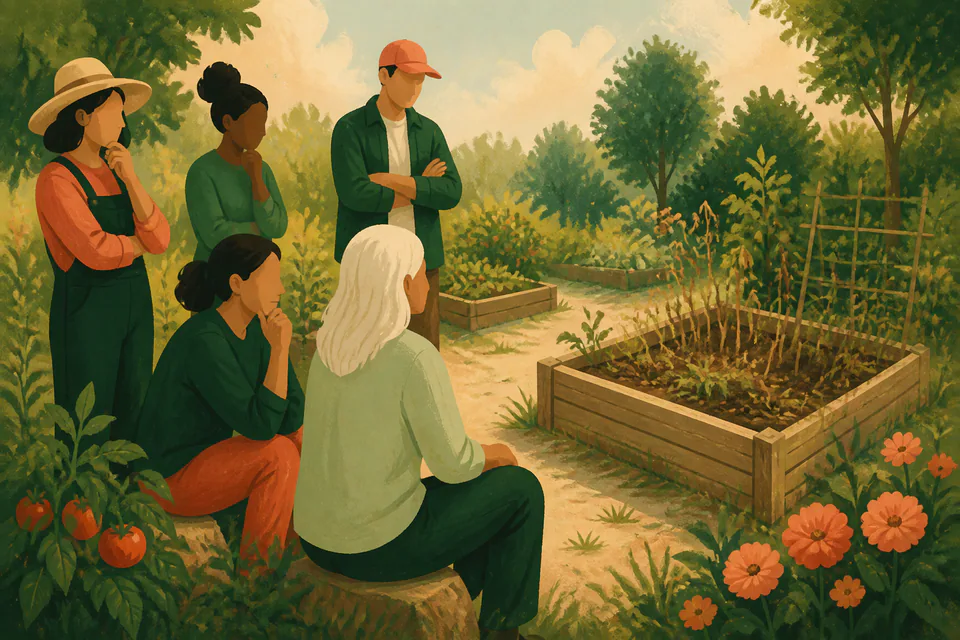
The best garden plot has been abandoned for months. Who gets to take it?
Garden plots have a three-year waiting list. One member's plot has gone untended for months and messages go unanswered, but other gardeners know they recently faced serious health problems.
How long should a shared resource remain reserved out of compassion?