Listen through the publisher, then discuss the episode here or arrange an in-person Roundtable. Your city determines where to meet.
Roundtables are designed for groups of four, with a shared subject and room for everyone to speak. Come for discussion, with no dating expectation.
Hello, friend! What does it look like to pursue peace when relationships get hard? In this Encouraging Word, we turn to Philippians 2 to explore how the humility of Jesus offers a path toward reconciliation and unity. Through Christ’s example, we’re reminded that healing conflict often begins when we surrender our rights, take responsibility, and choose love over blame. Whether in our marriages, families, friendships, or faith communities, we can follow Jesus by choosing humility and trusting Him to work in our relationships.
Episode information is provided by the publisher. Listening takes place on the publisher’s service.
Embryo Research in the Netherlands: Sean and Scott reflect on the Dutch Senate narrowly passing legislation allowing scientists to create human embryos (https://www.medicalbrief.co.za/netherlands-approves-embryo-creation-for-research/) specifically for research, such as gene-editing experiments. They critique this move as an erosion of human dignity from conception that treats unborn lives as disposable commodities. Major U.S. Tech Outages: Following widespread disruptions across airlines, banks, and Microsoft Outlook, the hosts weigh whether foreign cyberattacks, AI vulnerabilities, or fragile legacy code are to blame. They challenge listeners to resist conspiracy theories through "epistemic humility" while reflecting on how biblical truth-telling underpins the trust our economy and communities rely on. The Youth Sports Industrial Complex: From kids missing school for travel tournaments to families spending fortunes on F1 racing academies, the $40 billion youth sports industry is reac
What does progress mean in Islam? Dr Ahmed Paul Keeler joins Muhammad Jalal on The Thinking Muslim to discuss Mizan, the Qur’anic principle of balance and justice, and what it might mean to restore it today. What did Moorish Spain and Mughal India share? How did European colonialism shape the way Muslims understand their own history? Keeler argues that Mizan helped give Islamic civilisation its coherence across different cultures. He traces how the Western idea of progress took hold and asks what happens when technological advancement becomes the measure of a good society. What would it look like for Muslims to put Mizan into practice in their own communities? Find Ahmed Paul Keeler here: IG: https://www.instagram.com/ahmedpaulkeeler Become a member here: Or give your one-off donation here: Listen to the audio version of the podcast: Spotify: https://open.spotify.com/show/7vXiAjVFnhNI3T9Gkw636a Find us on: X: https://x.com/thinking_muslim LinkedIn: https://www.linkedin.com/company/the-
- - - - - - - P.S. Fall Harvest We are officially kicking off our seven-week Ordinary Sowing, Extraordinary Seeds: Fall Harvest Campaign for Seedbed! Over the coming weeks, we'll be sharing stories of how Jesus is multiplying your generosity through the Wake-Up Call, Bands, and New Room. We’d love for you to join us on this journey. You can learn more about the campaign or sow your gift here: https://givebutter.com/fallharvest2026 - - - - - - - - - - - - - - - - - - - JD Walt contrasts the Old Testament’s shepherding imagery with the New Testament’s “massive fishing expedition,” where the church becomes a net made of strong, loving relationships. He argues that these close, covenantal bonds—not simply attracting people to church—are how believers help others encounter Jesus. “Our relationships are the mission,” he says, encouraging listeners to build small groups, or “bands,” where people grow together in faith. JD and his father, David, sing “God Will Take Care of You” and talk about
Christians often talk about the atoning death of Christ when in conversation about spiritual things. It is often mentioned regarding its relation to salvation. However, is it possible that it could mean even more? What is the impact it is supposed to have on the rest of one’s life? In this sermon on Ephesians 5:2 titled “The Atoning Work of Christ,” Dr. Martyn Lloyd-Jones instructs on how this verse and Christ’s atonement apply to the lives of believers even after they are saved. The Scriptures are never satisfied with a mere general statement about the love of God— as this verse demonstrates, God’s love is specifically written about in the Bible because the specific acts of God demonstrate His love. A person’s conduct is determined by their doctrine. Dr. Lloyd-Jones reminds that “as a man thinks, so is he.” Thus, one’s view of the doctrine of Christ’s atonement will have consequences for the Christian walk. In Christ’s atonement, one gains a clear example of the love of God. Dr. Lloyd
Why does Allah allow good people to suffer? When hardship enters your life, does it mean Allah is displeased with you, or could your struggles be bringing you closer to Him? Every believer experiences moments of pain, loss, uncertainty, and heartbreak. But in Islam, suffering is not necessarily a sign of Allah's anger, and experiencing sadness does not mean your faith is weak. In this powerful and comforting Islamic lecture, Ustadh Reece explores the deeper wisdom behind life's difficulties, the true meaning of Sabr, and how Muslims can remain connected to Allah ﷻ during their hardest moments. Through lessons from the Qur'an, authentic Hadith, and the lives of the Prophets, this reminder explores: - Why Allah tests those who believe in Him - How hardship can become a means of spiritual growth - What Prophet Muhammad ﷺ taught us about grief and sadness - The patience and beautiful du'a of Prophet Ayyub (AS) - How the story of Prophet Yusuf (AS) reveals Allah's wisdom - Why both blessing
(Job 42:11-15) In this final special-edition video lesson of Enjoying the Journey, Scott Pauley examines Job chapter 42 and draws practical principles for making the end better than the beginning. After the repentance, the humility, and the hard choice to forgive, learn how God always saves the best for last! If you are nearing the end of a hard season and wondering whether anything better still lies ahead, this message will remind you why the God of Job is still the God who turns captivity, multiplies grace, and finishes what He starts. The best is yet to come. Finish strong! Continue your study of Job with ourStudy Job (https://enjoyingthejourney.org/study-job/) at https://enjoyingthejourney.org/study-job/ (10278261120) FOLLOW, COMMENT, SHARE Would you take a moment to share this podcast with others? Explore now at ETJ.Bible (https://enjoyingthejourney.org/). Extend the Work
Hi, friend! I’m so glad you’re joining me for today’s Encouraging Word. As we explore Philippians 4:4–7, we’ll discover how gratitude, gentleness, and prayer can bring peace even when life’s storms don’t subside. God doesn’t always change our circumstances, but He can steady our hearts in the middle of them. Whatever you’re facing today, you can trade worry for prayer, choose gratitude over grumbling, and trust that God is greater than the storm.
Hi, friend! On today’s Encouraging Word, we’re exploring why salvation comes through faith in Christ alone, not our own efforts or religious performance. Through Philippians, we’re reminded that Jesus’ finished work on the cross is enough. Let go of the pressure to earn God’s grace, embrace the freedom of His forgiveness, and remember: you don't add to His grace—you simply say thank you!
Customers should receive compensation for prolonged failure of essential paid online services.
Share your view, then see how readers voted. No sign-in required. This poll is shared across stories.
Do you agree or disagree?
Common Quandary
A Common Quandary to discuss
Another conversation to explore, separate from this news story.
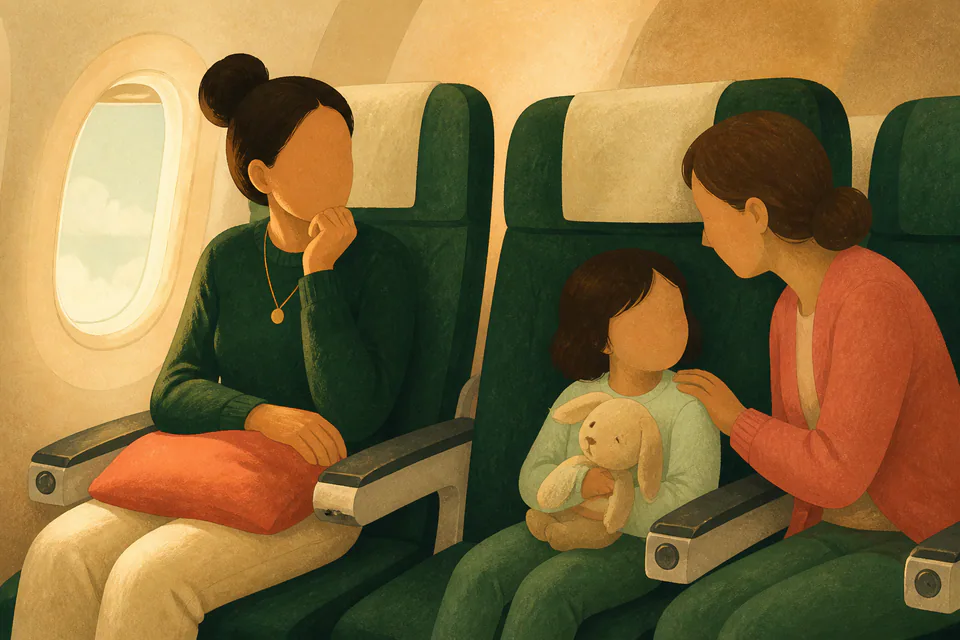
You paid extra for the aisle seat. Must you trade with a parent?
You reserved and paid extra for an aisle seat on a long flight. A parent asks you to trade for a middle seat so they can sit beside their young child after the airline separated them.
When does another person's predicament become your responsibility?