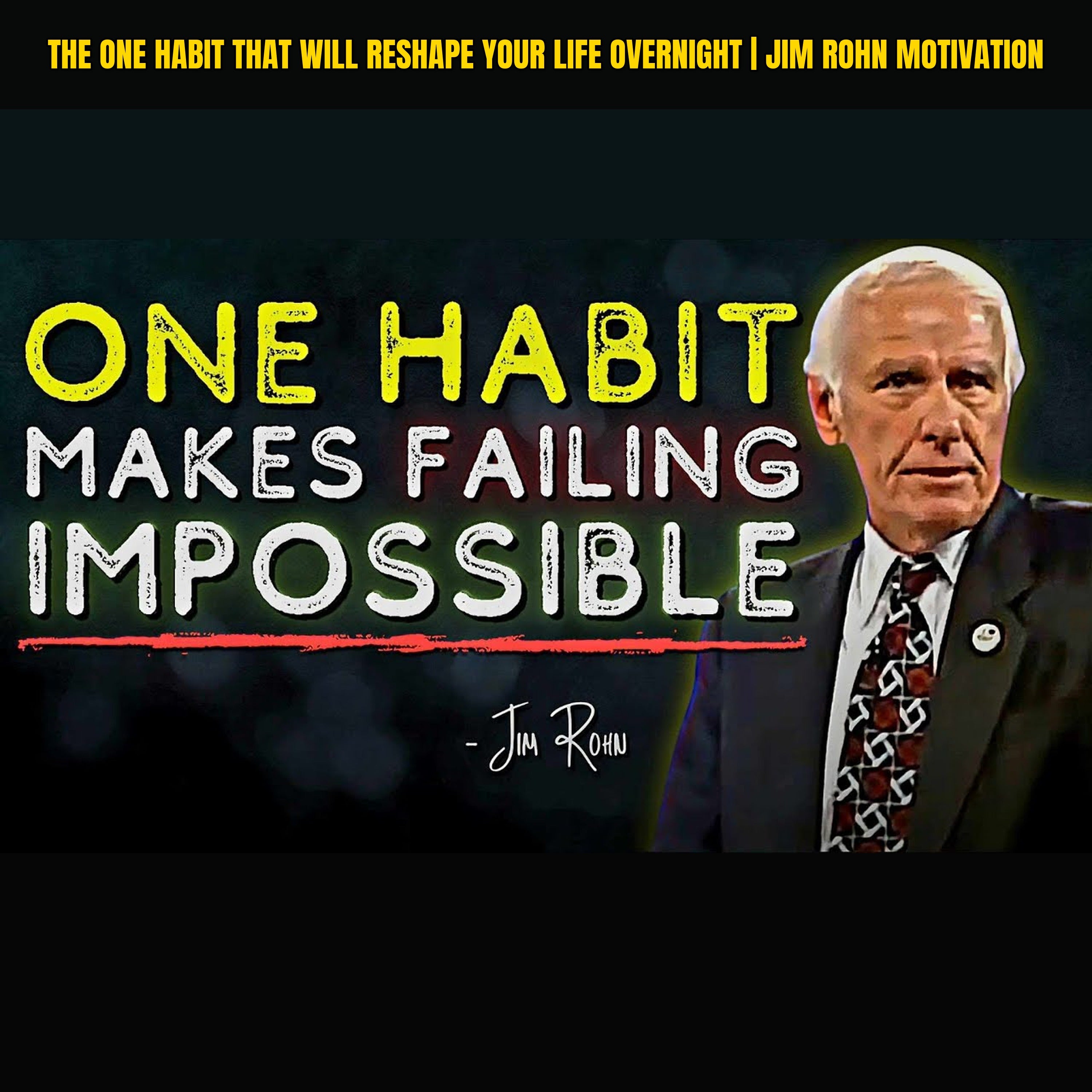
#JimRohnMotivation #JimRohn #JimRohnSpeech Success is not about luck or one big breakthrough—it’s about the habits you build and the actions you take every single day. In this Jim Rohn Motivation video, discover the one habit that separates winners from everyone else. Learn how taking full control of your time and energy will unlock discipline, momentum, and results faster than you ever imagined.Key Topics From This Motivational Video: The power of small, consistent actions in shaping your future How distractions steal your focus and keep you stuck Why discipline beats motivation every single time The mindset shift that will help you take control of your life How to eliminate wasted time and accelerate your success Most people believe success comes from motivation, but the truth is that winners don’t rely on motivation—they rely on discipline. If you wait until you “feel like it,” you will never take action. But when you make execution a habit, everything changes. This video breaks dow
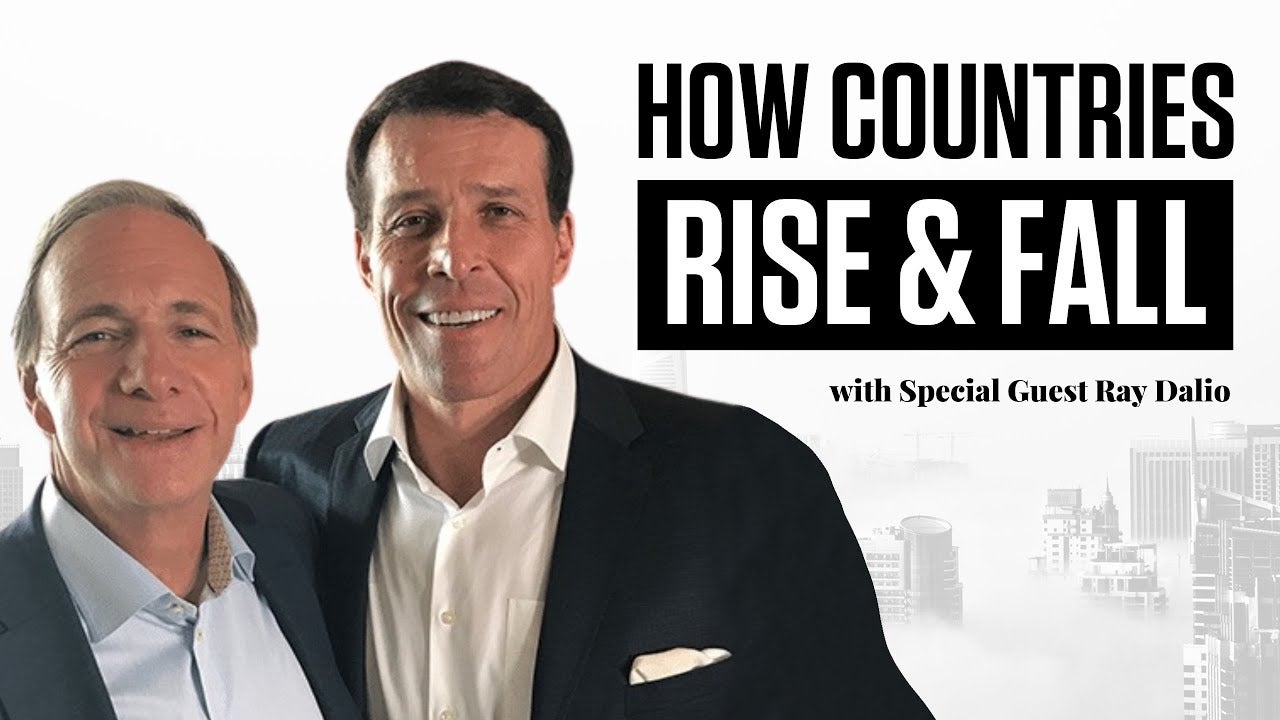
Changing World Order with Ray Dalio How countries rise and fall | What cycles of history can teach us now Uploaded 29-07-22 "Power comes to those that can recognize patterns" Tony Robbins SHOW NOTES : 1:39 Tony on the Power Patterns 8:51 The Cycle Explained: What's a New World Order? 16:00 What's a populist? 18:50 The 8 Measures of Power 23:52 The 3 Big Events that lead to a Changing World Order 28:40 Why did Donald Trump get elected in 2016? 31:02 The 5 Types of War 35:20 Ray's methodology of studying history 40:17 The collective experience is all about how we are with each other 41:29 Education, and disparity in the state of Connecticut 46:49 They call them revolutions but they're civil wars 54:03 Ukraine, Russia, and China 1:03:02 Inflation: What got us here and what do we do now? 1:10:00 Taking away buying power to fight inflation = period of stagflation 1:14:47 The Holy Grail of Investing = diversified uncorrelated assets 1:18:28 More on China 1:24:25 Ray's 3 Tips: How You Can Avo
Wild turkey has a reputation for drying out—and both recipes in this episode are built to beat that. Chef Gavin Jobe of Meribo Restaurant (https://www.meribopizza.com/) stuffs a butterfly-cut breast with a buttery rice-and-pecan roulade and finishes it sous vide. Meanwhile, up in West Virginia, Chris Ellis of Timney Triggers (https://timneytriggers.com/) and Jack Ellis spatchcock a fall bird brined in pickle juice and finish it with homemade turkey neck bone gravy. Together, they crack the code on one of hunting’s toughest table fare challenges. This Gun Talk Hunt is brought to you by Smith & Wesson (https://www.smith-wesson.com/), ZEISS (https://www.zeiss.com/corporate/us/home.html), Shooting Sports Life (https://www.shootingsportslife.com/), Savage Arms (https://savagearms.com/), and Range Ready Studios (https://rangereadystudios.com/). About Gun Talk Hunt Gun Talk Media's Gun Talk Hunt (http://guntalk.com/gun-talk-hunt), with Kevin “KJ” Jarnagin, pairs decades of experience with tod
Project Synapse: Markets in Freefall, Fragile Infrastructure, and AI's Perfect Storm The hosts banter through the show's intro before focusing on a sense that "things are out of control," citing a WallStreetBets suicide-hotline post amid a market crash and discussing cascading system failures involving Microsoft, the FAA, and a reported NSA internal communications outage. They argue politicians and leadership lack technical competence and clear messaging, increasing panic, while emphasizing that many problems stem from aging, underfunded infrastructure and complex, brittle software (PHP, NGINX, Java), not proven AI attacks—more a "perfect storm" of crises. They debate whether AI should help fix complexity, stressing critical thinking, accountability, and using multiple AIs to verify each other. In a lightning round they cover Anthropic's IPO performance, mixed reactions and token limits with ChatGPT 6.2 (favoring "Sol" over "Astra"), Google's cheaper Neon model and confusing UX, Loblaw
Alex Murdaugh's murder retrial has a new question hanging over it, and it starts with a shirt. The defense says SLED's lead agent, David Owen, described blood spatter to the grand jury even though the agency's own lab had found no human blood in tested stains. It also challenges his claim that shotguns at Moselle were loaded like the weapon used to kill Paul. At the November 13 hearing, Judge Debra McCaslin heard the arguments and did not toss the charges. She said she would try to issue a written decision by November 20. Before adjourning, she asked whether prosecutors could return to a grand jury and keep the April 5, 2027 retrial date. That's a practical question, not a verdict about anyone's honesty. Creighton Waters argued that Owen's statements were not intentionally deceptive and that the spatter expert continued to stand by his interpretation. The State also points to the kennel video and other evidence it says supports the indictment. The defense counters that the grand jury s
Steve Hsu is an AI founder, and physics professor at Michigan State University. He talks his upcoming documentary Machine God, interviewing both dreamers/doomers of AI, China blocking Nvidia chips, future of warfare, and much more. PLEASE SUBSCRIBE LIKE AND SHARE THIS PODCAST!!! Follow Me X- https://x.com/CoffeeandaMike IG- https://www.instagram.com/coffeeandamike/ Facebook- https://www.facebook.com/CoffeeandaMike/ YouTube- https://www.youtube.com/@Coffeeandamike Substack- https://coffeeandamike.substack.com/ Gab- https://gab.com/CoffeeandaMike Locals- https://coffeeandamike.locals.com/ Website- www.coffeeandamike.com (http://www.coffeeandamike.com/) Email- [email protected] Support My Work Venmo- https://www.venmo.com/u/coffeeandamike Paypal- https://www.paypal.com/biz/profile/Coffeeandamike Substack- https://coffeeandamike.substack.com/ Patreon- http://patreon.com/coffeeandamike Locals- https://coffeeandamike.locals.com/ Cash App- https://cash.app/$coffeeandamike Buy Me a Coffe
James and Frank dive into episode 540's lightning topics, exploring Apple's new Siri AI SDK that finally brings proper agentic app integration, Frank's smooth experience adding iPhone Duo support, and James's transformative use of Copilot Fusion for development. They also celebrate Tiny Clips as "real software," discuss bundling skills with NuGet packages, and break down the urgent .NET 8 & 9 end-of-life deadline before previewing an action-packed .NET Conf lineup. Chapters 00:00 Opening and Lightning Topics Format 02:06 Siri AI SDK and App Integration 14:18 iPhone Duo Development Challenges 25:01 Copilot Fusion and AI Tools 31:52 Tiny Clips: Building Real Software 36:55 NuGet Skills for Libraries 42:14 .NET Updates and Conference 48:32 Closing and Channel Info Frank: Twitter (http://twitter.com/praeclarum), Blog (http://praeclarum.org/), GitHub (http://github.com/praeclarum) James: Twitter (http://twitter.com/jamesmontemagno), Blog (https://montemagno.com/), GitHub (http://github.com/
A tradition can remain authentic while changing with the community that practices it.
Share your view, then see how readers voted. No sign-in required. This poll is shared across stories.
Do you agree or disagree?
Common Quandary
A Common Quandary to discuss
Another conversation to explore, separate from this news story.
A pricey AI tutor can turn B students into A students. Should schools let them use it?
An effective AI tutor adapts to each student and dramatically improves performance, but its subscription is expensive. A public school cannot provide it to everyone and worries that allowing its use will deepen existing inequality.
Should access be limited when a beneficial tool cannot yet be shared fairly?