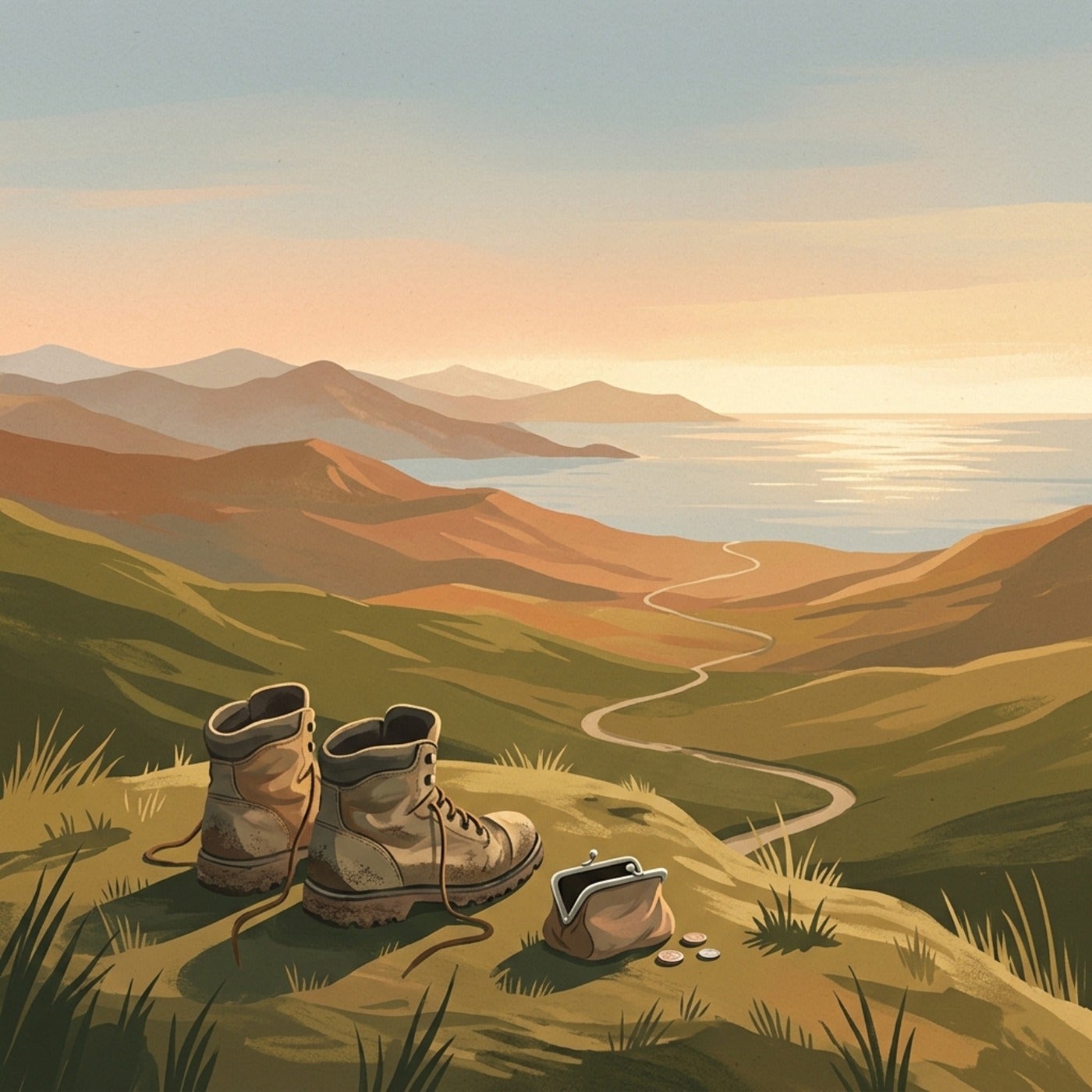
#62: Life Is Awesome. We Just Need to Realize It | Robert Greene
72 min
Listen through the publisher, then discuss the episode here or arrange an in-person Roundtable. Your city determines where to meet.
Roundtables are designed for groups of four, with a shared subject and room for everyone to speak. Come for discussion, with no dating expectation.
Robert Greene, author of The 48 Laws of Power, Mastery, and The Laws of Human Nature, nearly died of a stroke in 2018. It left him unable to type, so he spent the next seven years writing his new book, The Law of the Sublime, by hand. Michael speaks with Robert about what coming close to death did to his mind, why he believes humans need transcendent experiences as much as food and shelter, how comfort and old grudges keep our world small, and the everyday rituals he uses to wake back up to it. They discuss: (00:00) Cold open (00:59) The stroke (04:56) What nearly dying does to you (07:12) The book he waited 20 years to write (12:16) What is the sublime? (15:31) Finding amazement in his backyard (24:26) A need as deep as food (28:26) The lost rites of passage (33:18) How to make your own rituals (36:49) 40 minutes of meditation a day (45:37) What boredom is good for (50:31) How adults can slow down (53:36) Why nature matters (58:58) Choose discomfort (1:02:48) Death and the afterlife (1:07:26) Seven years writing by hand Get Robert's book, The Law of the Sublime: https://www.penguinrandomhouse.com/books/634294/the-law-of-the-sublime-by-robert-greene/ MacroFactor: Download the MacroFactor app and use code TWOPCT for 14 days free. Follow Michael: Host: Michael Easter Executive Producer: Robbie Hiser Music: The Heater Manager Graphics: Jackie Philips
Episode information is provided by the publisher. Listening takes place on the publisher’s service.
THE SEARCH FOR THE ULTIMATE RED LIGHT THERAPY IS OVER! After decades of exploring wellness technologies, Michael Jaco sits down with Rob Rene, founder of Exodus Strong, to explore the Red Light+ Total Body Reset system, the science behind red and near-infrared light, and why this technology has become such an important part of their wellness conversation. Rob's remarkable personal journey—including surviving five near-death experiences—inspired his mission to develop practical wellness tools that people can incorporate into their everyday lives. Discover the full-body Red Light+ Mat, designed for convenient 20-minute sessions, and the portable Red Light+ Wand, created for targeted use on areas such as the knees, shoulders, hands, and lower back. Michael and Rob discuss the technology, personal experiences, and how red light therapy may support a daily wellness routine. BLACK FRIDAY–CYBER MONDAY LISTENER EXCLUSIVE! This is your opportunity to explore Exodus Strong's special holiday offe
Get the 200+ Page Optimal Living Daily Workbook (PDF) - Free. Want to turn today's episode into an actionable plan? Episode 3614: Kym Wilson shares how she left a corporate finance career to pursue scuba diving and a 2,000-kilometer pilgrimage, and the panic she felt when her savings fell behind her peers. She explains why she came to see that net worth and life's worth are different measures, and why the experiences that change us also ripple out to others. The takeaway is that the cost of neglecting a dream can be greater than the money it takes to follow one. Read along with the original article(s) here: https://tinybuddha.com/blog/value-following-dreams-dont-make-money/ Quotes to ponder: "When you answer the call to adventure, you never know where you will end up." "Your net worth is not your life's worth." "I know that one day, when I am old and dying, I won't regret the things I never had, but I will regret the moments I didn't seize and the adventures and growth I never experien
Immerse yourself in 10 minutes of the best calming meditation music, designed to help you find focus and tranquility. As you listen to this soothing composition, allow the gentle melodies and serene tones to guide you into a state of deep relaxation and heightened awareness. Close your eyes, take a deep breath, and let go of any distracting thoughts or external worries. Allow the music to create a peaceful atmosphere, where your mind can find stillness and clarity. With each note and melody, feel the tension melting away from your body and mind. Let the music wash over you, bringing a sense of calm and centeredness. Allow it to anchor your attention, enabling you to focus on the present moment. As you tune in to the subtle nuances of the music, feel your mind becoming more attuned and receptive. Notice how your breathing naturally slows down, guiding you into a more relaxed and peaceful state. During these 10 minutes, let the calming meditation music become your refuge, a sanctuary of
For some reason, it did not stop him.Now I just want to ask you something real quick to put you in the mind of a bear. If you found some of your favorite food just left out and you somehow, like me most of the time, just couldn’t resist the temptation. Bears live and eat by what is detected by their noses, so logically, after eating its fill, a proper expectation would be that the bear would go sleep off a large meal upwind of where its food was cached. The wind carries both scent and sound to the bear as it rests and acts as an alarm to it to defend its cache. The hide was still up in the birch, untouched. He dropped his packboard at the base of the tree and glanced up to see where he would need to climb. Movement in the brush, some three hundred feet away, caught his eye. Two bears, roughly thirty feet apart, moved through the brush. From their color and build, he identified them as grizzlies, also called coastal brown bears.Up to that day, every bear he had met in the wild had chose
Listen to the full 1 Hour plus Between Friends episode. Go Directly to this Patreon Episode "I Just Need Everyone to Go Away plus Unicorn Lifeguards, Stalkers, Trauma and Me Fully Melting Down" Picture this: Your houseguest arrives in an hour, the furniture delivery is a disaster, and the bed is in the WRONG room! Chalene shares the hilarious chaos of trying to move a massive bed herself, in a tight dress and heels, while Bret gets sent on an emergency hardware store run. But just when they think they've got it handled, things take a painful turn! This story is part of The Saturday Spill series a little peek into the wild, unfiltered stuff that usually stays on Patreon. Some weeks it's hilarious, some weeks it's jaw-dropping, but it's always real life that doesn't quite fit on the regular show. If you're into a little chaos and behind-the-scenes tea, you're in the right place. If you love it, amazing…you can listen to the full, unedited version here https://Chalene.com/more (https://ww
In Part 2 of my conversation with manifestation researcher, coach and bestselling author Matt Cooke, we explore destiny, reincarnation and the nature of consciousness. Matt explains why the quality of our consciousness shapes how we experience life and why we do not manifest what we want - we manifest who we are being. We also discuss our relationship with money, becoming conscious of limiting beliefs and the importance of rehearsing who we are becoming by thinking, feeling, acting and behaving like the person already living the life we want to create. Matt also shares the practices he believes are non-negotiable for manifestation. Visit Matt's Instagram (https://www.instagram.com/mattcookecoach/) Matt's Website (https://www.mattcooke.me/) Beyond Wanting - Matt's Book (https://www.amazon.ie/Beyond-Wanting-Art-True-Manifestation/dp/059385330X) Follow The Beyond Podcast here (https://www.instagram.com/beyondpodcast333/). Join The Beyond Community here (https://the-beyond.mn.co/landing/).
Most podcasts will tell you the worst things for your health are drinking, processed food, and microplastics. But being disconnected from other people is about as bad for your health as smoking, and the places that kept us connected are disappearing. Researchers call them third places: not home, not work, but the bars, churches, diners, and malls where we gather with friends and strangers. They make us healthier and happier, yet they are closing, and since 1990 the share of Americans with no close friends has gone from 3% to 17%. Wendy Bounds is a Senior Vice President of The Wall Street Journal's Leadership Institute and the author of Little Chapel on the River, about Guinan's, a country store and bar on the Hudson River that became her third place after 9/11. Michael speaks with Wendy about what third places do for our health, the eight traits of a great one, why they're vanishing, and how to find one in a digital world. They discuss: (00:00) Intro (01:11) How surviving 9/11 changed
Over the last 100 years, the world has gotten safer and better in almost every single way, yet depression and mental health issues are higher than they've ever been. Dr. Kelly Lambert, a neuroscientist at the University of Richmond and author of Lifting Depression and Wild Brains, argues that one reason for this is that our brain is built to work for its rewards and to look forward to good things.The problem: Modern life is built to bypass all effort and give instant gratification. Michael speaks with Kelly about worker rats and trust fund rats, why crafts and hobbies may work like medicine, what wild animals reveal about modern stress, problems with how pharmaceutical studies are constructed, and why looking forward to something good may matter as much as getting it. They discuss: (00:00) Intro (01:05) Why mental health hasn't improved (06:02) Exercise and working for rewards (09:29) Why hard-won rewards feel better (11:40) Wild rats vs. lab rats (17:44) Why behavior often beat pills
If you go on the internet, you'll find a lot of experts using the internet to tell us why the internet is destroying our kids' mental health. But Ginny Yurich, the founder of 1000 Hours Outside and author of Until the Streetlights Come On, says the decline in kid and teen mental health started in the sixties, and is more linked to kids having less autonomy and time outside, and too much structure with school and extracurriculars. Michael speaks with Ginny about where the 1,000-hour number comes from, how busy families fit it in, how to handle screens without banning them, why bad weather and a little discomfort are good for kids, and where any family, or any adult, can start. They discuss: (00:00) Cold open (00:47) Where 1,000 hours comes from (05:32) Her first good day as a mom (09:25) Minutes outside, hours on screens (11:21) When both parents work (14:56) It works for adults too (17:48) Getting screen-loving kids outside (23:29) Screen time without saying no (25:56) Why play takes 4
People selling health products should provide evidence for their claimed benefits.
Share your view, then see how readers voted. No sign-in required. This poll is shared across stories.
Do you agree or disagree?
Common Quandary
A Common Quandary to discuss
Another conversation to explore, separate from this news story.
If a good deed is filmed for likes, is it still a good deed?
A local creator films themselves buying groceries for strangers. The videos generate substantial income, but they also inspire donations and allow the creator to help more people.
Do mixed motives diminish a genuinely helpful act?