Listen through the publisher, then discuss the episode here or arrange an in-person Roundtable. Your city determines where to meet.
Roundtables are designed for groups of four, with a shared subject and room for everyone to speak. Come for discussion, with no dating expectation.
Orla is back with questions this time and somehow that leads us everywhere from gastric ulcers and racehorse performance to long grass, toxic weeds and thyroid hormones. We start with a reminder that there really are no bad horses, after Orla discovers that some of her beautiful Bravo’s increasingly annoying behaviour was actually being driven by gastric ulcers. Within days of starting treatment, the behaviours disappeared. From there, Dr Nerida and Orla tackle some brilliant listener and MyHappy.Horse app member questions, including: what is the correct zinc-to-copper ratio in a horse’s diet? What should manure pH be in a racehorse? Should racehorses have their hay reduced before they race? And just how slowly should you introduce a new forage to a horse with a sensitive hindgut? They also dive into microbiome resilience and fibre diversity, why some horses cope beautifully with dietary change while others fall apart, and the deceptively difficult question of whether a laminitic horse can safely graze long, mature grass. Then things wander into pasture diversity, capeweed, Patterson’s Curse, toxic plants, selenium, thyroid hormones and why nutrition can sometimes be the missing piece when we’re trying to understand what is happening inside the horse. As always, there’s plenty of science, plenty of horse geekery, quite a lot of laughing, and a whole collection of (hopefully!) useful little nutrition lessons you can tuck away to use when you need them. Here is the amazing story about Jane Dudley and the 'unapproved and icky treatment' she used to cure her crippling depression, it is AMAZING! Brilliant example of the power of a healthy microbiome!! https://youtu.be/Le5LKPNlOHQ?si=1tKnkMTLDOtPRY6c To check your horse’s diet and KNOW you are feeding right, download the MyHappy.Horse app https://apps.apple.com/au/app/myhappy-horse/id6633422324 We’d love if you would follow the show and share this episode with a friend, it truly helps us get this information in front of more horse owners. And if you’d like to get in touch with Orla, [email protected]
Episode information is provided by the publisher. Listening takes place on the publisher’s service.
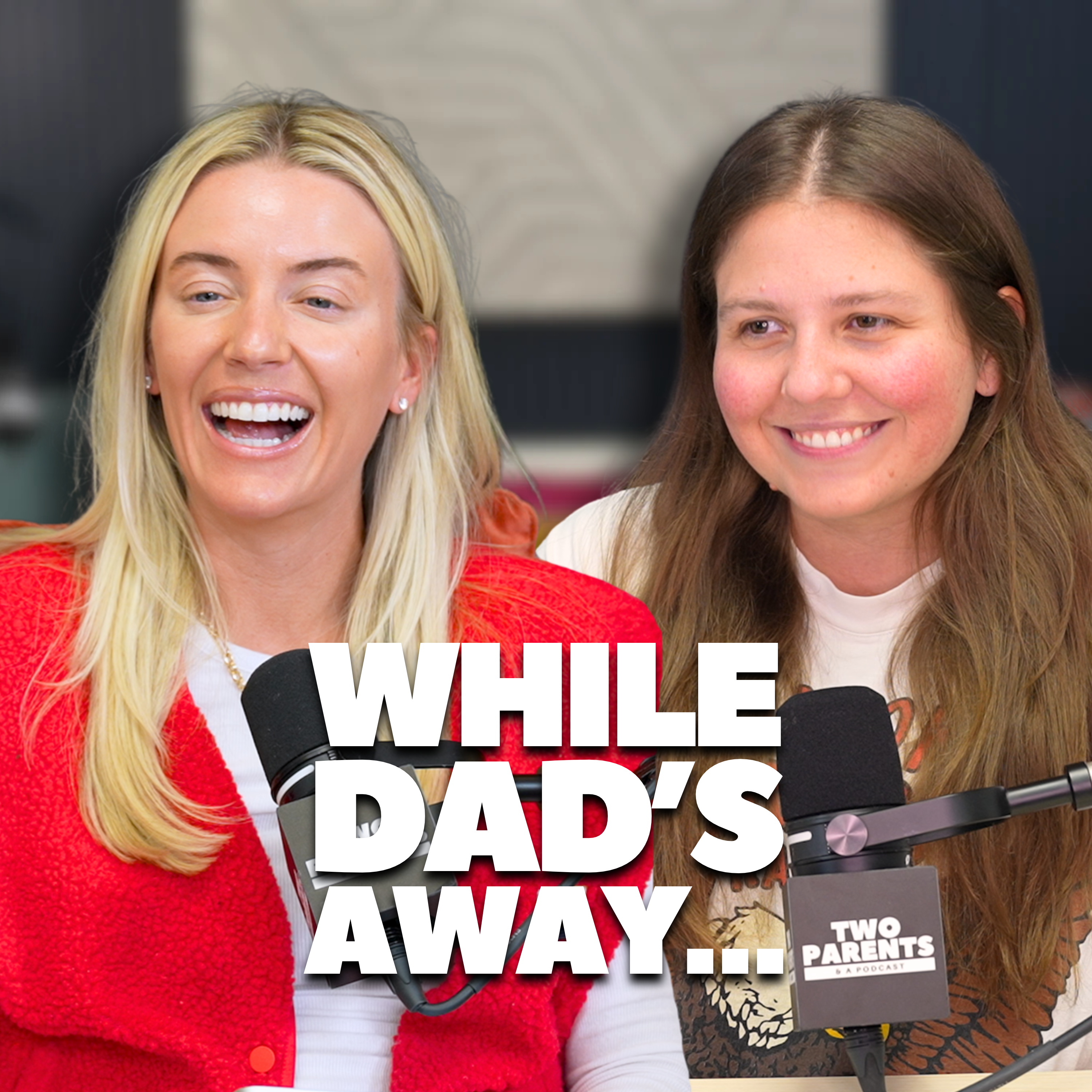
Welcome back to Two Parents & A Podcast.. the conversation chaos you didn’t know you needed, where nothing is off the table! (TY Morgan from the Spotify comments.. PS guys, do we like this one???) It’s a GIRLS EPISODE today, so OF COURSE we covered everything you thought we would: GTA 6, the Anthropic IPO & HYROX (hahahaha) Harrison is in Dallas doing his third race (spoiler: new PR, we’re proud), and while dad’s away.. Alex had a mommy-daughter SLEEPOVER with Tate. It was equal parts precious and chaotic: Tate slept sideways, Alex ended up at the foot of the bed, and there was a 3am tumble that Tate shook off like a champ. Also on the homefront: Tate CRUSHED her first dentist appointment AND this week she finally said “TATE” during “hey, hi, hello dancer!!”, and Rocky is still just killing it with the solids.. but we can’t say that for like the 5th episode straight, so we spared you. Then it’s Christmas szn business: the mom group chat is throwing a “favorite things” party (we explain
Snoring, mouth breathing, and picky eating are easy to brush off, but they can be clues that deserve investigating. In this conversation with Dr. Julia of Auris Wellness, a dentist who trained conventionally and then moved into biological and airway-focused care, we talk about what dental school never taught her and why she now helps families understand jaw growth, breathing, and sleep. Dr. Julia shares how she became a research assistant for Dr. Kevin Boyd, whose work comparing ancient skulls with modern patients is featured in James Nestor’s Breath, and how Weston Price’s observations about crowded teeth, narrow palates, and cavities connect to what she sees today. We get practical about the early warning signs parents can watch for, from snoring and restless sleep to bedwetting, picky eating, and thumb or finger sucking, and what everyday habits can support healthy oral development: chewing, straws and open cups, food textures, and more. Dr. Julia also explains how the airway, ears,
"I know something is wrong with my child... but every time I try to talk to them, they shut down." If you've ever had that thought, this episode is for you. As parents, it's so painful to watch our child struggle, yet every question we ask seems to push them further away. The harder we try to get them to open up, the quieter they become. In today’s episode, I explain why children go silent, what that silence might actually mean, and why the answer isn't usually finding the perfect question, but building a safe space for difficult conversations. I will talk through how to create the conditions that help children and teenagers open up naturally, and share the five things I use with families every day. I'll also break down how these approaches differ for younger children, older children, teenagers, and neurodivergent children, including those with ADHD, autism and alexithymia. If you're worried about a child who seems withdrawn, anxious, angry, secretive or simply unwilling to talk, this
Imagine walking through a huge, crowded city before cars were invented. Your shoes would be completely ruined by mud! For most of history, if you weren't rich enough to own a horse, you had to walk everywhere. But then came an incredible invention that changed how we travel forever: the bus! Travel back in time with Mira and Finn to 1662 Paris, where famous mathematician Blaise Pascal launched the very first horse-drawn public carriages. Next, we are hopping aboard George Shillibeer's massive 1829 London "Omnibus" that carried 22 passengers at once! But with thousands of horses pulling buses, London soon faced a very smelly problem—mountains of horse poop! Yuck! Discover how the first double-decker buses had open roofs where passengers got soaked in the rain, and why the first motorized bus built by Karl Benz in 1895 was so weak that people had to get out and push it up hills! Plus, find out the amazing reason why London’s famous double-decker buses are painted bright red. Hop on and g
What do fish talk, fish cakes, and fish oil have in common? This episode of WeWow, the bonkerballs variety show for kids and families from the creators of Wow in the World, has all of that and more. Dennis and Reggie are back with another weekend full of laughs, listener love, and a fishy encore episode that'll have the whole family talking all over again. Whether you're a longtime Wowzer or just tuning in, WeWow on the Weekend is the kind of family variety podcast that makes every car ride, breakfast table, and slow Sunday morning a little more wow-worthy. This weekend, it's... Fish Wow... on the Week Fish!?! Dennis and Reggie talk all things fishy, and make some fish cakes during Dishin' It Up With Dennis! And if that's not enough, WeWow on the Weekend wraps up with a fan-favorite encore of "SomeFIN Smells Fishy in Here, Part 2" from Wow in the World—an episode about fish oil, packed with big ideas, bigger laughs, and the kind of curiosity that makes the whole family lean in. "SomeFI
Read: 1 Corinthians 12:20-26 (https://www.biblegateway.com/passage/?search=1+Corinthians+12%3A20-26) Julian tossed the ice in the sink. The burn on the palm of his hand had stopped hurting. What a relief. But by the time he got back upstairs, the little red mark had started to sting a little. Julian ignored it. He had a spaceship to finish. He attached a row of laser guns to one side of the ship. As he extended the wing tips with long thin pieces, the pain in his hand increased. Julian stopped building and cradled his burned hand with his good one. Why was he so wimpy? It was just a little burn! He picked up another piece with his good hand, but the pain from the burn was overwhelming. He dropped the piece and ran to Mom. “You need ointment and more ice, Julian,” she said. “Why did you throw the ice away?” She spread a little ointment on his hand and folded his fingers around a bag of ice wrapped in a cloth. “Take that with you in the car. We’re going to take Mrs. O’Keefe dinner for to
First. Second. Third. Fifth. Sixth. IN THE MELBOURNE CUP! On 3 November 2026, Ciaron Maher Racing made history, becoming the first stable in 166 years to train the Melbourne Cup trifecta, with an extraordinary FIVE of the first SIX horses across the finish line. How on earth do you achieve something like that? And what is Ciaron Maher Racing doing differently? There are many answers to that question, but one thing they do very differently is how they feed their horses. And that's something Dr Nerida knows quite a bit about, because she's the equine nutritionist responsible for developing and continually refining the stable's feeding programmes! Following this incredible Melbourne Cup result, we're bringing back one of our most loved Happy Horse Nutrition conversations, with Katrina Anderson, Head of Sport Science, and Joshua Kadlec-Cavanagh, Head of Data and Performance at CMR. Together with Dr Nerida, they take us behind the scenes of a stable willing to challenge some of the most ing
Can lunging your horse actually be harder work than riding? Does speed strengthen bones or damage them? And could restricting calories make an already good-doing horse even thriftier? Coming to you from Tokyo, Japan, Dr Nerida is joined by equine exercise physiologist Dr Brian Nielsen and researcher Renee Harbowy to unpack some of the fascinating science presented at the 12th International Conference on Equine Exercise Physiology (ICEEP). After five days, around 80 research presentations and some very full brains, the three sit down to share the research that caught their attention, challenged their thinking, and might just change the way we feed, train and manage our horses. They explore new research on lunging and exercise intensity, the complicated relationship between speed, bone strength and injury risk, why training young horses isn't necessarily a bad thing, and how mitochondria respond to calorie restriction — with some interesting implications for managing overweight horses. O
Communities should invest in adapting to unavoidable hazards as well as preventing future damage.
Share your view, then see how readers voted. No sign-in required. This poll is shared across stories.
Do you agree or disagree?
Common Quandary
A Common Quandary to discuss
Another conversation to explore, separate from this news story.
You know the relationship is over, but the vacation is nonrefundable. Do you wait to break up?
You have decided to end a year-long relationship. In five days, you are both leaving on an expensive vacation that cannot be refunded or transferred. Your partner is excited and believes the relationship is thriving.
Can avoiding financial waste justify delaying a painful truth?