After some life updates (which is all the people really want to hear anyway), Jonah Goldberg turns his hand to ruminating on Trump’s villainous stupidity, the trilateral summit with Vladimir Putin and Xi Jinping, nuclear policy, New York City’s supermarkets, socialist contempt for the middle class, GDP, Ro Khanna, the Bulwark squabble, recent tech failures, the National Popular Vote Interstate Compact, and magical thinking about politics. Show Notes: —LFG AO Pod (https://thedispatch.com/podcast/advisoryopinions/should-lame-ducks-hibernate/) —Special Event: Advisory Opinions: Live! (https://www.capcitycomedy.com/shows/393484) —Mamdani on supermarkets (https://x.com/MorePerfectUS/status/2123188786926391338/video/1) —Irving Kristol in The Public Interest: “Rationalism in Economics” (https://www.nationalaffairs.com/public_interest/detail/rationalism-in-economics) —American Compass’ postelection survey (https://americancompass.org/post-midterm-survey/) —Dan Senor Remnant (https://thedispatc
This episode is brought to you by Sarmaya Partners. Learn more about Sarmaya’s LENS ETF, their full data and comparison, including performance here: https://sarmayaetf.com/ In this episode of Other People's Money, Max Wiethe sits down with Muddy Waters Capital founder Carson Block to discuss his firm's explosive new short thesis on Nvidia. Block breaks down the alarming connections between a former Nvidia executive and a former SMCI executive recently implicated in a major chip smuggling scandal. The conversation dives deep into the national security implications of dual-use technology and how the ongoing geopolitical tug-of-war between the US and China is reshaping the semiconductor sector. Tune in to hear why Block believes this scandal goes far beyond CEO indiscretions and could trigger a massive regulatory reckoning for Silicon Valley's biggest players. Follow Muddy Waters on X: https://x.com/muddywatersre Follow Max on X: https://x.com/maxwiethe Follow Other People’s Money on: App
Wall Street suffers its worst tech selloff (https://seekingalpha.com/article/4970161-november-correction-is-not-over?source=wsb_podcast%3Awall_street_enters_thanksgiving_week_reeling_from_tech_rout) in years. (0:18) Anthropic loses $109B in value (https://seekingalpha.com/news/4675405-blame-game-emerges-after-anthropics-ipo-market-value-plunge---wsj?source=wsb_podcast%3Awall_street_enters_thanksgiving_week_reeling_from_tech_rout) after IPO. (1:19) October inflation data sets stage for Fed decision. (3:30) Show Notes Trump threatened data center tax (https://seekingalpha.com/news/4675392-trump-threatens-us-firms-building-overseas-data-centers?source=wsb_podcast%3Awall_street_enters_thanksgiving_week_reeling_from_tech_rout) Nvidia criminal probe (https://seekingalpha.com/news/4675398-nvidia-probed-over-criminal-violations-california?source=wsb_podcast%3Awall_street_enters_thanksgiving_week_reeling_from_tech_rout) Dividend Roundup (https://seekingalpha.com/news/4675149-dividend-roundup-nv
One of the best Christian films that Glenn Beck has ever seen was written by… Ben Shapiro? Glenn speaks with Ben about his new film, “Confession,” starring Rob Lowe and James Franco, a gritty drama about a prisoner in Stalin’s USSR. They discuss why Ben wanted to tell this story, why it feels very different from your standard Christian film, and what it may signal about Hollywood, which is snubbing it. Glenn also gets Ben’s thoughts on why antisemitism has become so popular on both the left and right, as well as what it truly means to be a man. Plus, Ben gives his rapid-fire takes on this week’s biggest news stories: the release of GTA VI, the outages, Jensen Huang and Nvidia, Robert Pattinson’s casting as James Bond, the midterms, the next leaders of the Republican and Democratic parties, data centers in space, how Joe Rogan became a right-wing icon, and whether woke is coming back. Glenn’s Sponsors: PreBorn: This Christmas, you can sponsor an ultrasound and help save a baby’s life fo
Jensen Huang stepped down as Nvidia CEO on November 12, 2026, after reports about an extramarital relationship with Alice Huang, a former senior executive at Megaspeed. U.S. intelligence reportedly viewed her as an asset working for Beijing. That allegation is not a conviction, and it is not the same thing as proof Nvidia secrets changed hands. Tony Brueski brings in retired FBI Special Agent Robin Dreeke, former leader of the bureau’s Counterintelligence Behavioral Analysis Program, for the question behind the headlines: how does somebody who helped build one of the world’s most important technology companies fail to recognize a possible intelligence threat in his personal life? Huang apologized to his family and Nvidia employees for infidelity. The board announced an outside investigation, while saying it knew of no reason to believe national security or proprietary information was compromised. Reuters subsequently reported that Huang had previously told Nvidia leaders his encounters
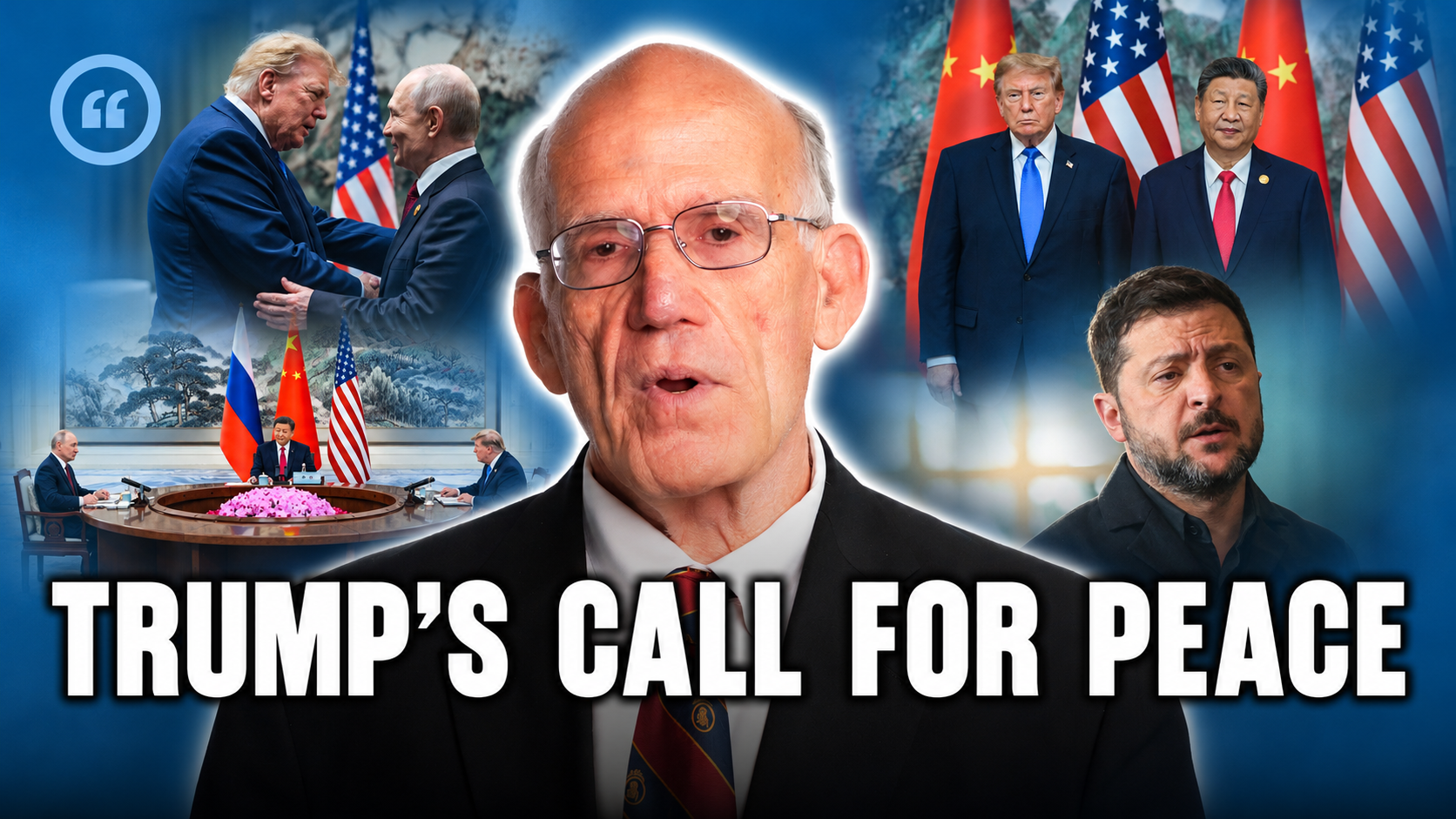
President Donald Trump's first ever trilateral summit with Vladimir Putin and Xi Jinping raises questions about the future of the war in Ukraine and whether a peace agreement could finally be within reach. Victor Davis Hanson and Sami Winc examine the summit on today’s edition of “Victor Davis Hanson: In His Own Words,” discussing Russia's declining influence, potential territorial concessions in Ukraine, and Europe's frustration over Trump's peace negotiations. Hanson criticizes Hillary Clinton's attacks on Trump's diplomacy; he also argues that European leaders have weakened their influence by neglecting defense spending and relying on American military protection. They discuss Elon Musk's shifting political allegiances, and Hanson warns that distancing himself from MAGA may not protect him from Democrat investigations. They also discuss the potential economic benefits of artificial intelligence and the challenges facing Hakeem Jeffries as Democrats prepare to take control of the Hou
The Washington Roundtable is joined by Raphael Warnock, the Georgia senator, for a live conversation about what he calls the “parting of the Red Sea”: the Democratic victories in Senate races in Texas, South Carolina, Mississippi, and across the South. Warnock discusses what he sees as the priorities for his party now that it holds power in Congress—including dealing with Citizens United and dark money in politics—and why he believes that the path to a sustainable Democratic majority lies in the South. Warnock also reflects on how his faith has shaped his approach to politics. “I refuse to give in to what some call the politics of scarcity; this belief that we just don’t have enough,” he says. “Then, you know, you look up, we’ve spent billions of dollars on a stupid war.” This conversation was taped before a live audience at Sixth & I, a cultural center and synagogue in Washington, D.C., on November 18th. This week’s reading: “Two Autocrats and an American President with Autocrat Envy
The veteran transportation-safety reporter Matthew L. Wald joins Tyler Foggatt to discuss the Federal Aviation Administration’s recent nationwide grounding order, which disrupted more than ten thousand scheduled flights, and what it revealed about the vulnerabilities of the country’s aviation system. They discuss what caused the ground stop, how a seemingly minor equipment upgrade could have such far-reaching consequences, and whether responsibility lies with the Trump Administration’s cuts and disruption of the F.A.A.’s workforce or with previous administrations’ failures to modernize the aging infrastructure. They also explore the growing role of automation in air travel, including an $875-million A.I. system being introduced by the F.A.A., and whether such innovations stand to improve aviation or introduce new risks from user error to cyberattacks. Does this incident, along with the series of high-profile outages affecting technology, banking, and national-security systems, point to
Giddy Democrats are celebrating historic victories (https://www.newyorker.com/news/the-lede/what-this-weeks-elections-mean-for-the-future-of-elections) in the midterm elections, but “in Europe we have to keep our heads on, because actually it doesn’t make such a big difference for us,” says Timothy Garton Ash, a British historian. For the next two years, Trump “is still in charge of foreign policy. He’s going to be the largest and angriest lame duck in the history of the world.” The Oxford professor, who covered the fall of Communist autocracies in Eastern Europe and has written nearly a dozen books on Europe, talks with David Remnick about the challenges facing a possible Democratic successor, and whether a future Administration can regain America’s place in a world where illiberal regimes are ascendant. Further reading: “How the Dangerous Rise in Anti-Immigration Politics Went Mainstream (https://www.newyorker.com/news/q-and-a/how-the-dangerous-rise-in-anti-immigration-politics-went-
Rebuilding after a disaster should sometimes mean changing where or how people live.
Share your view, then see how readers voted. No sign-in required. This poll is shared across stories.
Do you agree or disagree?
Common Quandary
A Common Quandary to discuss
Another conversation to explore, separate from this news story.
Someone reserves the best gym machine with a towel. When may you move it?
At a crowded gym, a towel has occupied the most popular machine for fifteen minutes while its owner chats across the room. Gym rules prohibit reserving equipment, but everyone occasionally steps away between sets.
How long may convenience masquerade as continued use?