Listen through the publisher, then discuss the episode here or arrange an in-person Roundtable. Your city determines where to meet.
Roundtables are designed for groups of four, with a shared subject and room for everyone to speak. Come for discussion, with no dating expectation.
After PAI replaces most of the Problem Solvers, Max & Molly struggle to adjust to ordinary school life. They decide to become unofficial, present-day problem solvers. But their attempts to help people go nowhere until strange events at school include missing computers, mysterious pinstripes on the football field, and a car that Charlene claims Max gave her. Is this a glitch in the system or a bigger problem? Math Concepts: Fractions, decimals, and percentages Finding percentages of quantities: Calculating 29% of 1,200 students Percentages and subtraction Division and estimations History/Geography/General Ed. Concepts: Artificial intelligence and automation The French Revolution & the storming of the Bastille on July 14, 1789 The historical figure Marie Antoinette
Episode information is provided by the publisher. Listening takes place on the publisher’s service.
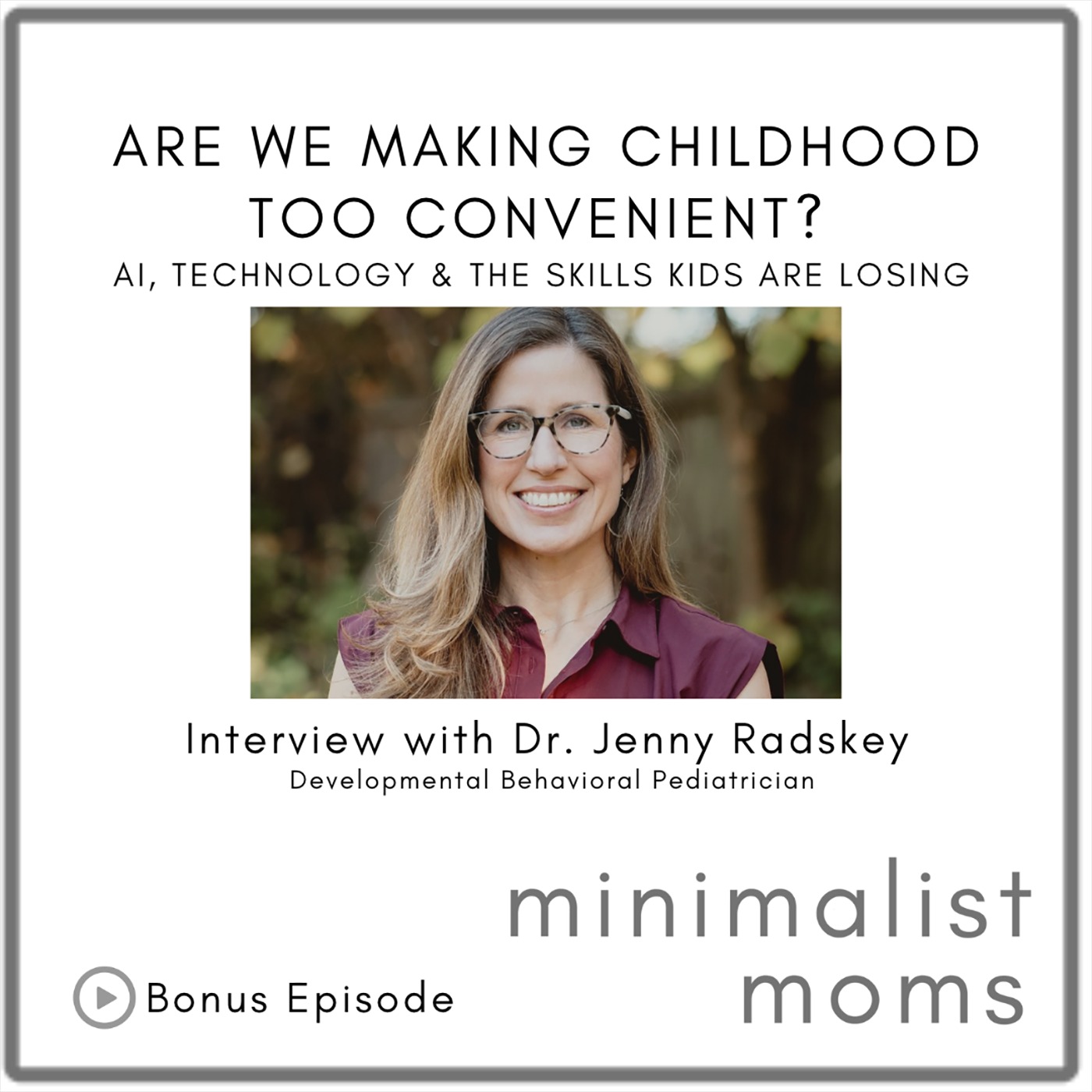
Are we making childhood easier at the expense of the very skills our kids need to thrive? We've talked about screen time and technology on the podcast before, but today's conversation takes us into territory we haven't really explored on the show yet: artificial intelligence and its potential impact on our children's development. As AI becomes more integrated into everyday life, I think it's worth asking some important questions about what our kids might be gaining - and what they could be missing along the way. I'm joined by pediatrician and researcher Dr. Jenny Radesky to explore how technology is reshaping childhood in ways we may not even recognize. From handing over a device to calm a difficult emotion to turning to AI for instant answers, are we unintentionally removing the everyday opportunities our children need to develop patience, persistence, creativity, and critical thinking? Just because something makes life easier doesn't necessarily mean it's making life better. Links Di
In this honest and reassuring conversation, Steph is joined by clinical psychologist and author Tara Porter to ask whether, in our attempts to give our children the very best, we might actually be making parenting harder than it needs to be. From tutoring, extracurricular activities and the pressure to get the right grades, to screen time and trying to get every parenting decision right, it can feel as though we're constantly trying to optimise our children's futures. But what if some of that effort is getting in the way of what matters most? Tara draws on 28 years of working in the NHS with young people to explore the things that may be contributing to the rise in distress she has seen. They talk about the impact of the digital world, education and modern parenting, and how our understandable desire to give children opportunities can sometimes turn into pressure, comparison and a loss of independence. Tara shares why focusing so much on the future can mean missing the good stuff happe
Have you ever wondered how a kid who loved playing basketball on the sunny beaches of Hawaii grew up to become the leader of the United States? Meet Barack Obama! Born in Honolulu, Barack had an amazing childhood that even took him all the way across the world to live in Indonesia. But he didn't just want to travel—he wanted to help people! After college, he moved to the windy city of Chicago to work as a community organizer, helping neighborhoods solve problems by working together as a team. He soon realized that to make a truly massive difference, he needed to understand the law. So, he went to Harvard and made history as the very first Black president of the Harvard Law Review! But his biggest historic moment was still to come. On a freezing cold day in January 2009, millions of people watched as Barack Obama was sworn in as the 44th President of the United States, becoming the first African American to ever hold the office! Tune in to discover his incredible true story, from shooti
⭐⚽ JOIN FOOTBALL FOR KIDS PLUS ON PATREON! OR SUBSCRIBE THROUGH APPLE PODCASTS! VISIT OUR OFFICIAL WEBSITE https://www.forkids.world (https://www.forkids.world/) GET YOUR PDC MONOPOLY! GROWN-UPS! WHY JOIN FOOTBALL FOR KIDS PLUS? Give your football-loving child even more of the stories they love, without adding to their screen time! Football For Kids Plus gives your family: Ad-free listening across Football For Kids. Exclusive bonus episodes you won't hear on the main podcast. Early access to new episodes and our family football quizzes, including Kids vs Adults and Teamwork Makes the Dream Work. Fun end-of-episode quizzes to encourage learning, listening and family interaction. More inspiring football stories for car journeys, bedtime, school runs and family time. ️ And every subscription directly supports Football For Kids, helping us create more independent, educational and entertaining content that brings children and grown-ups together through football. ⚽ INSPIRE • EDUCATE • MOTIVA
Should your child really be on a travel team at age 7? Travel teams in elementary school, private coaches by age 8, and pressure to find "their thing" before second grade. Parents are told that the earlier kids specialize, the better their chances. In this episode of Raising Good Humans, developmental psychologist Dr. Aliza Pressman talks with David Epstein, New York Times bestselling author of Range: Why Generalists Triumph in a Specialized World (https://davidepstein.com/range/), about what the research shows on early specialization. David draws on a major new review in the journal Science of nearly 30,000 athletes, musicians, scientists, and chess players and explains why the best performers as kids are rarely the best as adults, why sampling many activities builds better long-term fit, and why kids who diversify suffer fewer injuries and less burnout. What you’ll learn: - Why the best kid athletes rarely become the best adult athletes - How playing multiple sports protects kids fro
Artificial intelligence (AI) seems to be everywhere these days. Programmers use it to write code, and financial analysts use it to follow–and predict–the stock market. Students use agents (AI) like Claude or ChatGPT to help them study, or sometimes to help them finish their homework. Chances are you use AI every day, whether you intend to or not. If you enter anything into a search on your browser, the first answer at the top of your screen is an AI-generated summary. Should you trust AI with your family’s health? How You Can Listen You could listen through your local public radio station or get the live stream at 7 am EST on Saturday, November 21, 2026, through your computer or smart phone (wunc.org (https://www.wunc.org/)). You can subscribe through your favorite podcast provider, download the mp3 using the link at the bottom of the page, or listen to the stream on this post starting on Nov. 23, 2026. How Do You Use AI for Your Family’s Health? Our guest for this show is an old frien
Episode Description: To Max & Molly’s surprise, The Problem Solvers unveil PAI, a new artificial intelligence designed to make solving problems faster, easier & cheaper. But when PAI bungles the reception and lays off 90% of the organization, Max and Molly realize this technological upgrade could spell disaster. Math Concepts: Ratios, fractions, & percentages. Factorials: Understanding factorial notation (3!=321=6) Pythagorean theorem Fractions and subtraction. History/Geography/General Ed. Concepts: Critical thinking and problem solving: Interpreting clues, testing assumptions, and reconsidering an approach when the first attempt fails. Music theory: Triplets divide the duration normally occupied by two notes of the same rhythmic value into three equal notes. Latin vocabulary: The origins of a.m. and p.m. Ethics and responsibility in AI.
Looking for something fun to do for the kids (or whole family) on the Friday of Thanksgiving? Come to Who Smarted? Live! on Zoom, Friday, November 27. There will be two shows one at 8PM EST and one 8PM PST, running about an hour each, with us in the booth live on video! From the same team that created MATH, Who Smarted? is another popular family show that teaches you about everything! You'll be in the booth for the first time, watching host Trusty and his friend Chet Nickerson record an episode of Who Smarted? Live all about the moon landing. We'll also have a snarky moon on hand who doesn't really believe anyone can land on it. We'll also play some Trusty Trivia live and answer SmartyQ's live. This is a first-ever event, and it's just $20 per family with the early bird special. Go to whosmarted.com and click Who Smarted? Live to grab your tickets now. There'll be one show at 8 pm Eastern and one show at 8 pm Pacific. Come to whichever works for your family, or come to both. That's $20
Sports organizations should limit gambling promotion aimed at their supporters.
Share your view, then see how readers voted. No sign-in required. This poll is shared across stories.
Do you agree or disagree?
Common Quandary
A Common Quandary to discuss
Another conversation to explore, separate from this news story.
A coworker tells you their salary in confidence—and proves everyone else is underpaid. Do you share it?
A coworker privately tells you their salary and asks you not to repeat it. You later realize the figure is strong evidence that several equally experienced colleagues are being underpaid.
When does fairness outweigh a promise of confidentiality?