Censorship at student papers and the role of social media in Gen-Z protests
42 min
Listen through the publisher, then discuss the episode here or arrange an in-person Roundtable. Your city determines where to meet.
Roundtables are designed for groups of four, with a shared subject and room for everyone to speak. Come for discussion, with no dating expectation.
Protests across Europe led by youth movements have drawn attention to the role of social media in spreading information and misinformation. Largely led by Gen-Z, these protests have included references to films like The Hunger Games and The Avengers, and featured people in costumes taking part in 'aura battles', while memes of the demonstrations are shared online. Researcher Dr Nayana Prakash considers how online platforms, viral videos and AI-generated content are now an inextricable part of protest movements. After Russian TV sent a camera crew to report on a Welsh independence march, BBC Monitoring’s Russia specialist Francis Scarr examines how Russian state media is reporting on independence movements across the world, and what this coverage reveals about the Kremlin’s portrayal of European instability and decline. A new survey by the Student Publication Association suggests that more than a quarter of student newspapers and magazines lack full editorial independence from their publishers. The SPA’s chair Emily Pitt-Shaw and Tamara Greatrix, editor-in-chief of Birmingham Uni's student newspaper Redbrick, discuss the implications for press freedom on campus. Filmmakers Itab Azzam and Jack MacInnes reflect on their documentary One in a Million, which follows a Syrian family over ten years as they rebuild their lives after fleeing Aleppo. Centred on Israa, first seen aged 11, the film traces her journey through adolescence, marriage and motherhood as she navigates life between two cultures. Presenters: Katie Razzall and Ros Atkins Producer: Tim Bano
Episode information is provided by the publisher. Listening takes place on the publisher’s service.
Master the skills that change lives — enroll in your free human behavior course today: https://nci.university/learn Uploaded 01-03-26 Iran didn’t slowly become what you see on the news — it was psychologically taken. In this episode, I break down the real mechanism behind Iran’s transformation: the difference between a people and the system that cages them, how revolutions don’t shift power but shift who gets to use violence, and why fear — not religion — became the enforcement tool. From a modern, secular Iran in the 60s and 70s to a regime sustained by narrative control, surveillance, and compliance rituals, this is a case study in how educated civilizations get hijacked without realizing it. We’ll dissect the psychological trap that started in 1979, why today’s protests are memory colliding with fear, and the three paths Iran is likely to take next. This isn’t just about Iran — it’s a preview of what happens anywhere belief becomes mandatory and truth becomes a liability. Please not
In this conversation I’m speaking to Rebecca Olive. Rebecca is a feminist cultural studies researcher whose work explores how everyday sport and leisure are shaped by cultural politics, relationships between humans and non-humans, environmental wellbeing, and social media. My understanding of her research is she looks very closely at why people do things that make up a culture, and the meaning of everyday practices in people’s lives. We chatted about why people are drawn to the ocean in the first place and what keeps us coming back. How swimming and surfing becomes more than recreation, and into an emotional relationship that shapes how we understand risk, shark risk, and our place in it. She also discusses how storytelling, social media and drone footage may influence our perception of danger and coexistence. Apologies, I’m a Bit under the weather in this one and in the opening couple of minutes, probably would have been a good idea to have the microphone turned on. Recorded at 3pm on
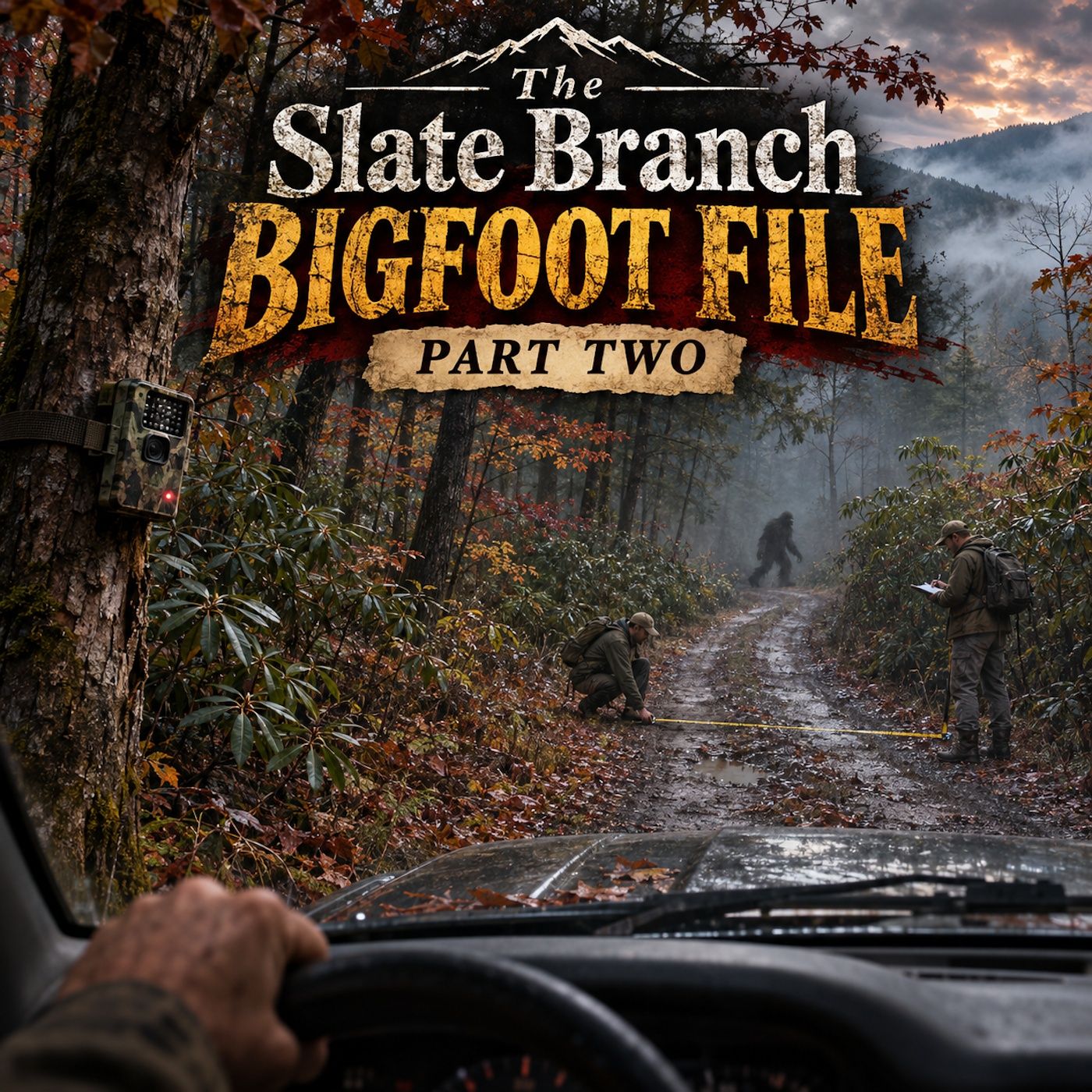
On October 7, 2017, Tom Rigsby watched something large, dark, and walking upright cross a remote logging road in western North Carolina. The encounter lasted less than five seconds. Tom waited two days before reporting it, and when he finally put his experience in writing, he never once used the word Bigfoot. In Part Two of The Slate Branch File, Brian takes a closer look at the encounter that started it all. Drawing from the field notebooks of former wildlife survey technician Nate Calder, Brian examines Tom’s credibility, his years of experience working in bear country, and the details he initially refused to include in his official statement. When Nate and Evan Harlan return to the crossing site to recreate the encounter, their measurements raise more questions than answers. Meanwhile, a mysteriously repositioned trail camera, an overlooked access route through the surrounding national forest, and troubling gaps in the crew’s assumptions suggest the remote property may not have been
In this episode of the Weekend T, Michael Deacon and Tim Stanley debate whether Robert Pattinson has what it takes to be James Bond (https://www.telegraph.co.uk/films/2026/11/18/unlikely-rise-007-oddball-robert-pattinson/), why the franchise should return to its Cold War roots and whether modern 007 films have lost their sense of fun. They also question why grown men are taking time off work to play Grand Theft Auto VI (https://www.telegraph.co.uk/news/2026/11/18/school-send-minibus-truants-playing-grand-theft-auto/), and discuss Russell Brand’s right to maintain his innocence after his convictions. Plus, David Beckham’s Poundland perfume problem, a royal who boils eggs in hotel kettles and a taste test of this year’s Christmas sandwiches – including Gail’s (https://www.telegraph.co.uk/news/2026/03/17/gails-anti-semitism-and-far-left-conspiracy-theories/) £7.80 offering. ► Subscribe to our new Daily T YouTube channel: youtube.com/@dailytpodcast ► We want to hear from you! ► Sign up to
Prince Harry criticizes the Trump administration’s approach to Ukraine and says he would return to military service if asked. Palace Intrigue covers his interview with The Telegraph during a visit to Lviv, his support for Ukraine, and his comments about veterans being prepared to serve again. Former royal protection chief Dai Davies argues that Harry’s public remarks could complicate his security and create difficulties for King Charles. A source close to the Duke of Sussex pushes back, questioning Davies’s decision to discuss Harry’s protection publicly. Royal writer Tom Sykes also criticizes the timing of Harry’s publicity during Prince William and Kate Middleton’s Earthshot visit to India. Plus, Harry discusses life in Britain with Meghan Markle, Prince Archie, and Princess Lilibet during an appearance on ITV’s This Morning. He shares updates on the children’s adjustment to school, Christmas plans, country walks, and pub life. The family’s Winter Wonderland visit also draws coverage
In today's brief: Lake Erie, 1957: a newly released Air Force report says two boys saw a humming, bell-shaped craft near the Enrico Fermi Atomic Plant. Skinwalker Ranch: owner Brandon Fugal calls the new files landmark and recalls a daylight saucer over the mesa. Warship footage: a 20-second 2020 infrared clip shows a light crossing a US Navy ship in the Middle East, with no Pentagon assessment. Martha's Vineyard, 1957: a spiked, nickel-coloured object that the Air Force put down to a radar-reflector balloon. Loch Ness: reported sightings jump to 15 this year, up from six in 2025. The Book of Miracles: a 16th-century manuscript of comets, blood rain and multiple suns heads to auction at Christie's. Quick hits: a 1952 file blames the saucer wave on temperature inversions; more Pentagon UFO files are on the way. Every story and source: https://believepod.com/ufo-paranormal-news-22-november-2026/ New episodes every morning. Keep your eyes on the sky. Sources: FOX 2 Detroit: https://www.fo
As Grand Theft Auto VI is released after more than a decade of development and many months of hype, we look at how a Scottish video game became one of the world’s most successful — and most profitable — entertainment franchises. Brian Baglow worked for GTA creators Rockstar Games on the original title and now leads the Scottish Games Network. Cara Ellison also worked for Rockstar Games and is now a video games journalist. They consider the franchise's Scottish roots, its influence and legacy, and reveal what they know about the new game. ITN’s Chief Executive Ian Rumsey reflects on his first six months in the role, outlining how the company’s four newsrooms operate and his plans for the organisation as it adapts to a changing media landscape and the implications of Sky’s proposed takeover of ITV. The rise of social media is reshaping how court cases are reported. Veteran court reporter Sian Harrison and criminal barrister Andrew Taylor assess how online influencers are entering courtro
It's been a week of great consequence for the media. On Monday, Russell Brand was sentenced to over ten years in prison for rape and sexual assault. On Tuesday - in a separate story - ITV News and The Guardian named David Walliams as the celebrity who tried to use an injunction to block the publication of sexual misconduct allegations. Also in the last week, Channel 4 announced it is axing Married at First Sight after earlier this year the BBC reported rape allegations from two female cast members. Each story raises important questions about the culture of the media industry, now and in the past. Is this a reckoning for the sector? We spoke to Dame Caroline Dinenage MP, chair of the Culture, Media and Sport Committee, Priya Dogra, chief executive of Channel 4, and a panel of guests to talk us through these stories: Rosamund Urwin, chief news correspondent at The Sunday Times; Alex Wilson, partner at RPC, and Sarah Ditum, author of Toxic: Women, Fame and The Noughties.
People directly affected by a local change should have more influence than other residents.
Share your view, then see how readers voted. No sign-in required. This poll is shared across stories.
Do you agree or disagree?
Common Quandary
A Common Quandary to discuss
Another conversation to explore, separate from this news story.
A stranger is sitting at your usual café table. Can you ask them to move?
You visit the same café every Saturday and always write at one particular table. Today a first-time customer is sitting there while several other tables remain open. The staff recognize you but there is no reservation policy.