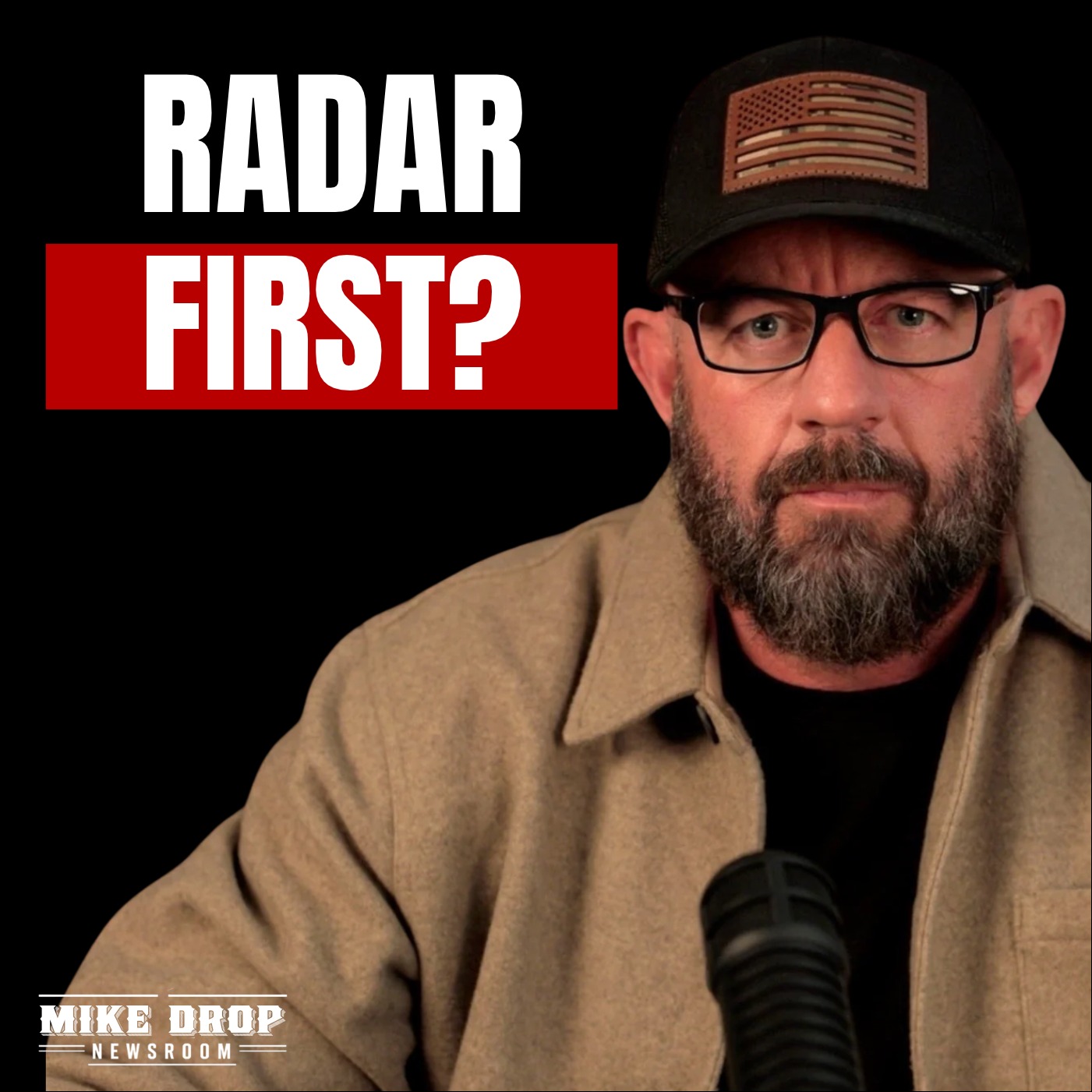
CENTCOM Gets Ready to Strike Iran Again | Mike Drop Newsroom
23 min
Listen through the publisher, then discuss the episode here or arrange an in-person Roundtable. Your city determines where to meet.
Roundtables are designed for groups of four, with a shared subject and room for everyone to speak. Come for discussion, with no dating expectation.
U.S. Central Command is finalizing preparations to restart major operations against Iran, and President Trump says Americans will know "soon enough." MIKE DROP NEWSROOM | 06 NOVEMBER 2026 U.S. officials told Axios that CENTCOM is finalizing preparations for a possible return to major operations against Iran, though no new order has been given. President Trump met with his national security team Wednesday and Thursday, and officials pointed to the November 9 new moon as favorable for operations. Meanwhile tankers are still burning in the Strait of Hormuz and Iran says its seven conditions must be met before the strait reopens. Mike Ritland breaks down why the new moon matters, what "finalizing preparations" means for U.S. troops in the region, and whether the carrier group headed for the Gulf signals strikes are coming. Also covered: Iran's nuclear proposal through Qatar and its security chief's meeting with Putin, Turkey's parliament approving a defense pact with Saudi Arabia and Pakistan and why a NATO ally in the fight changes everything, War Secretary Pete Hegseth's $350 billion request and the impeachment push, and Gov. Gavin Newsom emptying California's death row. Is the carrier heading to the Gulf a sign strikes are coming, or is there still an off-ramp? Tell us in the comments. Want ad-free Newsroom updates? 00:00 CENTCOM finalizes preparations to strike Iran again 01:10 Why the Nov. 9 new moon matters 02:30 What "finalizing preparations" means for troops 03:00 Tankers burn as the U.S. blockade holds 03:50 Iran's seven conditions and the stalemate 05:45 Does the carrier group mean strikes are coming? 06:40 Iran's nuclear offer through Qatar and Putin 10:20 Turkey joins the Saudi-Pakistan defense pact 12:25 Why a NATO ally in the fight changes everything 14:25 Hegseth's $350 billion request and the impeachment push 17:25 Is it worth it? What success looks like 19:40 Newsom empties California's death row 22:05 Wrap-up Privacy & Opt-Out: https://redcircle.com/privacy
Episode information is provided by the publisher. Listening takes place on the publisher’s service.
For review: 1. Iraq has reached a compromise with the powerful Iran-backed militia Kataeb Hezbollah, three senior security officials said, after Prime Minister Ali al-Zaidi readied security forces to move against the group. Reflecting the gravity of the situation, Iraqi Shiite political sources said Esmail Qaani, commander of Iran’s elite Revolutionary Guards’ Quds Force, arrived in Baghdad late on Monday to help defuse tensions with Kataeb Hezbollah, Tehran’s most powerful militia ally in Iraq. 2. Lebanese President Joseph Aoun launched a lengthy rebuke of Iran in an Independence Day address, arguing that the Islamic Republic does not have the right to interfere in Lebanon’s internal affairs, as it long has via support for its local terror proxy, Hezbollah. 3. Yemen’s Houthis launched strikes on the Saudi capital Riyadh on Saturday, after vowing reprisals for a “special operation” by the Saudi-led coalition fighting them. The coalition later said it had “intercepted and destroyed” thr
Hey everybody, Tom Bilyeu here. On today’s episode of Impact Theory, we’re taking on a topic that’s got the whole world holding its breath: the escalating crisis between the United States and Iran. As tensions ratchet up, we’re asking the tough questions—how did we get stuck in this “escalation trap,” and what does it mean for America’s global leverage, our economy, and our very sense of security? The conversation focused on why the traditional idea of “strategy” might be failing policymakers, using powerful analogies—like chess versus roulette—to show how doubling down in conflict can spiral out of control. We’ll break down the risks of tactical “wins” that create even bigger crises, the real leverage Iran holds with control of the Strait of Hormuz, and the mounting pressure on President Trump as political support erodes and legacy hangs in the balance. A key theme that emerged is what happens when military might runs into decentralized opposition, and why high-stakes gambles—like the
Today, the dust has settled in Brussels and back in the Newscast studio in London Laura and Paddy take a look at how yesterday’s new EU-UK deal is going down with ministers, in Westminster more widely and most importantly with voters at home. Laura has been speaking to the foreign secretary Ed Miliband about whether the issue of tuition fees for EU students could scupper the rest of the deal. Plus, More in Common pollster Luke Tryl explains what the polls tell us about public opinion of our relationship with the EU and whether voters are ready to reopen the Brexit debate. You can now listen to Newscast on a smart speaker. It works on most smart speakers. New episodes released every day. The presenter was Adam Fleming. It was made by Anna Harris with Jesse Fox. The social producer was Grace Braddock. The technical producer was Mike Regaard. The assistant editor is Chris Gray. The senior news editor is Sam Bonham.
Before House Democrats voted on Hakeem Jeffries for Speaker, nobody was running against him, but a group of new progressive members, known as "The Bloc," wouldn't commit to backing him without guarantees. Asked about the holdouts, Jeffries told reporters: "You'll have to ask, you know, those individuals." In the Senate, Chris Van Hollen was challenging Chuck Schumer for leader, and Schumer was bristling. Meanwhile, John Fetterman was hinting he could leave the party if Van Hollen won. Don was joined by Mehdi Hasan, founder and editor-in-chief of Zeteo, to talk about who should lead the Democrats and whether the party was already blowing its big win. GUEST: Mehdi Hasan, founder and editor-in-chief of Zeteo FIND THE DON LEMON SHOW: Youtube: https://www.youtube.com/@TheDonLemonShow Substack: https://substack.com/@donlemon Facebook: facebook.com/donlemon Instagram: instagram.com/donlemonofficial Tik Tok: tiktok.com/@donlemonofficial LEMON NATION: Website: donlemon.com Buy Merch: https://do
This week on the Mark Levin Show, 2028 Republican Presidential candidates must directly address the urgent threats to the country - Marxism and Islamism. These candidates should deliver bold, courageous speeches that clearly explain what is happening in the country, identify those responsible, and directly challenge these threats rather than leaving such warnings to a small number of media voices. Also, it is difficult to believe so many major outages affecting entities such as the NSA, FAA, airline systems, Microsoft, and Apple services could be merely coincidental. The timing and scale of the incidents are troubling and remain inadequately explained. President Trump had proposed a major modernization and restructuring of air traffic control in 2017 that Congress failed to enact. Had those reforms been adopted, many current FAA failures might have been avoided. Later, does Senator John Kennedy know anything about originalism? Originalism is not pure textualism. The meaning and intent
Alex Murdaugh's murder retrial has a new question hanging over it, and it starts with a shirt. The defense says SLED's lead agent, David Owen, described blood spatter to the grand jury even though the agency's own lab had found no human blood in tested stains. It also challenges his claim that shotguns at Moselle were loaded like the weapon used to kill Paul. At the November 13 hearing, Judge Debra McCaslin heard the arguments and did not toss the charges. She said she would try to issue a written decision by November 20. Before adjourning, she asked whether prosecutors could return to a grand jury and keep the April 5, 2027 retrial date. That's a practical question, not a verdict about anyone's honesty. Creighton Waters argued that Owen's statements were not intentionally deceptive and that the spatter expert continued to stand by his interpretation. The State also points to the kennel video and other evidence it says supports the indictment. The defense counters that the grand jury s
Iran says it shot down a U.S. drone over the Strait of Hormuz as CBS News reports the U.S. and Israel are weighing a new assault on Iran. MIKE DROP NEWSROOM | 21 NOVEMBER 2026 Iranian state TV claimed Saturday that Iran downed a U.S. drone near Qeshm Island; the U.S. has not confirmed it. CBS News reported, citing sources, that the U.S. and Israel are considering a new assault in the short term, driven by Israeli concern over how fast Iran is rebuilding its missile production and moving sites underground. President Trump told Israel's Channel 12 he is not rushing any decision. At the same time, the New York Times reported Israeli warnings that Iran has made progress on chemical and biological weapons and could use them against U.S. officials, though some U.S. officials doubt those warnings. Mike Ritland breaks down why a single intelligence source shouldn't drive a decision this big, how corroboration works when lives are on the line, and what would actually change his mind. Also cover
Hours after U.S. fighter jets struck Iranian missile launch sites on Qeshm Island, drones came at American bases in Bahrain and Kuwait, and Iran's army chief is promising a more decisive response to the next U.S. move. MIKE DROP NEWSROOM | 18 NOVEMBER 2026 Central Command says IRGC one-way attack drones launched toward Bahrain were intercepted with no damage to U.S. equipment and no injuries to American personnel. ABC News counts it as Iran's third strike on Bahrain in about a week. Kuwait's air defenses were also knocking down drones overnight, Al Jazeera reported, though Kuwait has not said where they came from. Mike Ritland breaks down what it means that Kuwait is now in the picture, including Ali Al Salem Air Base, the base U.S. forces launched from during the 2003 invasion, why the real question is how many incoming drones our air defenses can handle at once, and why nobody can explain the strategy behind waiting. Also covered: three carrier groups and new mines in the Strait of H
Iran has gone after a U.S. radar in Bahrain three times in five days, and U.S. fighter jets have now struck back at an IRGC missile site on Qeshm Island. MIKE DROP NEWSROOM | 17 NOVEMBER 2026 CENTCOM said the latest Iranian drones were intercepted with no damage to U.S. equipment and no injuries to American personnel. ABC News reported, citing a U.S. military official, that U.S. fighter jets then struck an IRGC missile site on Qeshm Island, and Iran's IRNA reported several explosions. A third U.S. carrier, the USS Theodore Roosevelt, is now in the region. Mike Ritland breaks down why Iran keeps going after the same radar sites, and why knocking out radar is usually the first step before a larger attack. Also covered: the NSA's classified network goes down, a reported Iranian dirty bomb plot against officials in Washington, the Houthis close in on Aden and the Bab al-Mandab, the Pentagon tells Ukraine's backers its deep strikes aren't working, and the Senate energy permitting bill clear
Schools should explain the purpose of a rule before punishing students for breaking it.
Share your view, then see how readers voted. No sign-in required. This poll is shared across stories.
Do you agree or disagree?
Common Quandary
A Common Quandary to discuss
Another conversation to explore, separate from this news story.
You wear an expensive outfit once and return it spotless. Clever or dishonest?
You buy an expensive outfit for a single event, keep it spotless, and return it the next day. The store's generous policy allows returns without asking whether an item was worn.
Does exploiting a policy differ from breaking a rule?