Does Exercise Make You a Better Person? A Philosopher-Ultrarunner Weighs In
36 min
Listen through the publisher, then discuss the episode here or arrange an in-person Roundtable. Your city determines where to meet.
Roundtables are designed for groups of four, with a shared subject and room for everyone to speak. Come for discussion, with no dating expectation.
"We develop good characters in the same way that we become better runners," writes the philosopher Sabrina Little in her book The Examined Run. "We practice." Today's episode is all about the practice of becoming a better person, and raises the question of how participating in sport can help (or hurt!) us in that endeavor. In addition to being a philosophy professor and virtue ethicist, Little is also a world-class runner, a five-time ultra running national champion. So she's perfectly suited to tell us not only how to develop our character through sport, but how to use philosophy to improve our performance. So if you’re an athlete struggling to think how to push through discomfort, or a coach who’s trying to light that competitive fire in athletes while still building up their character, just hoping to become a bit better of a person, or all three, this episode is for you. Thanks! Spotify (https://open.spotify.com/show/08qLiDYVaUURcOD7MmsQBf) PocketCasts (https://pca.st/94v1jrn2)
Episode information is provided by the publisher. Listening takes place on the publisher’s service.
For written details on this paper, see the StayCurious Metabolism Newsletter: https://staycuriousmetabolism.substack.com/p/the-art-of-a-heartbeat-one-of-the?r=40ekz2 Snyder Interview 1: https://youtu.be/mCrc4gfbK2o Snyder Interview 2: https://youtu.be/kMpGkg4zMOU Snyder Interview 3: This one! Snyder Interview 4: Coming Soon… Leptin Resistance Letter: https://staycuriousmetabolism.substack.com/p/obesitys-secret-letters-the-hidden?r=40ekz2 Gift Guide: https://staycuriousmetabolism.substack.com/p/saint-dr-nicks-holiday-gift-guide?r=40ekz2 This conversation with Stanford’s Professor Michael Snyder breaks down one of the most important exercise studies ever published — a deep, molecular look at what really happens inside your body when you work out. We explore how thousands of molecules shift in real time, why inflammation during exercise is actually a good thing, how omega-3 signaling, mitochondrial remodeling, nitric oxide pathways, and metabolic flexibility all come together in a coordin
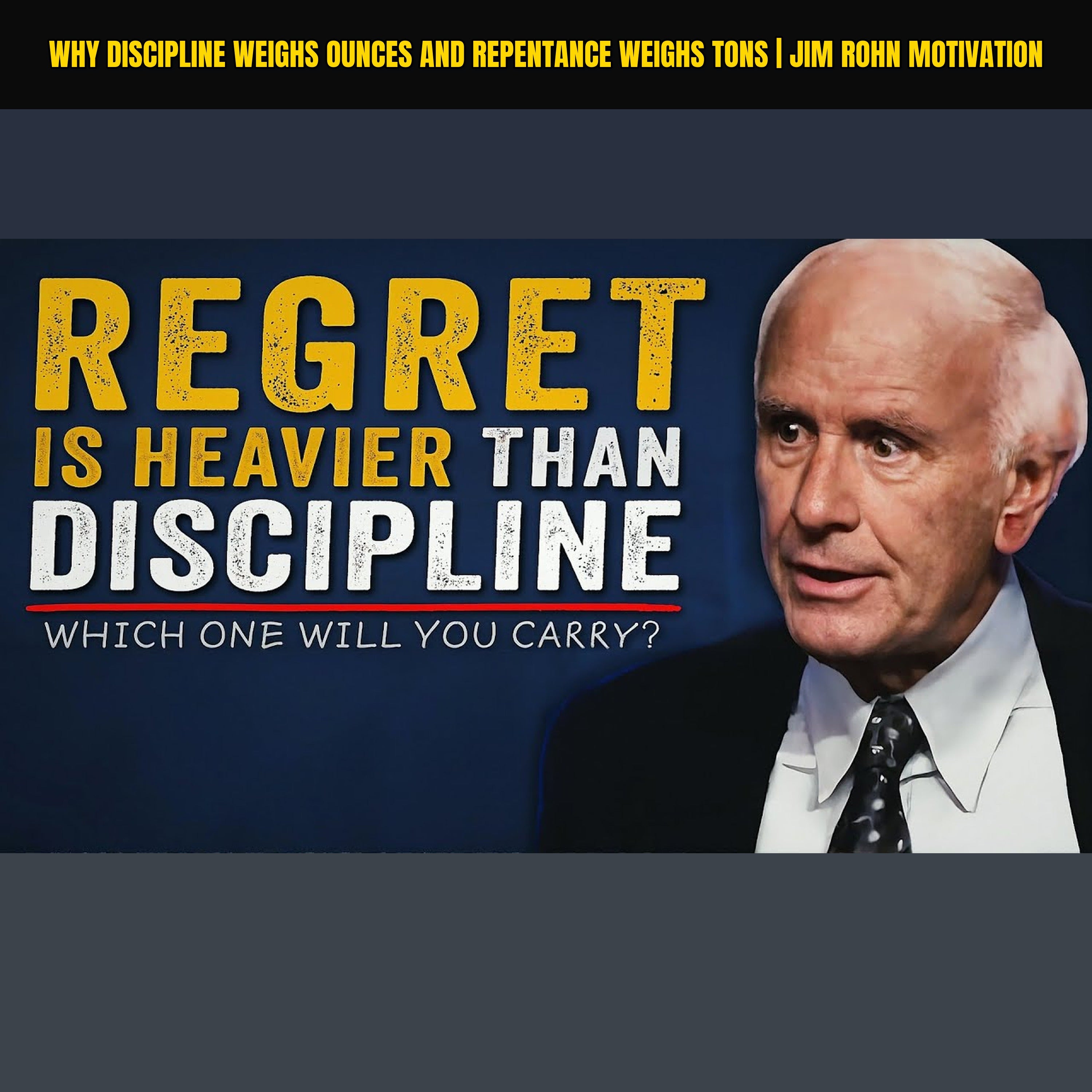
#JimRohnMotivation #JimRohn #JimRohnSpeech In this Jim Rohn Motivation video, Jim reveals one of life’s greatest truths: you will either carry the ounces of discipline or the tons of regret. Through powerful examples and timeless wisdom, he shows how small daily choices shape your health, wealth, relationships, and legacy. Key Topics From This Motivational Video: The difference between discipline and regret How small daily choices compound over time Why maturity is choosing “ounces” today for freedom tomorrow The role of discipline in health, wealth, and relationships How discipline builds dignity, confidence, and legacy This powerful motivational video highlights Jim Rohn’s philosophy that life always sends a bill—you either pay with discipline now or regret later. He emphasizes how success is not an event but a process of small, consistent actions. Each book read, dollar saved, and promise kept is an ounce that builds toward the good life. Neglect, however, compounds into regret that
Imagine if every big change in our lives came with a whole community stepping up beside us… In this episode, I sit down with Dr Arne Rubinstein, former GP and emergency doctor, founder of the Rites of Passage Institute, and a man who's spent more than 30 years walking young people across the threshold into adulthood. Arne's work began around a fire at his very first men's gathering, listening to a hundred men wrestle with the same handful of wounds. Then in the Emergency Dpt, he kept meeting teenagers who'd pushed it one step too far... kids trying to become adults with nobody there to hold them. He came to believe every young person will go through a rite of passage either way. The question is whether we leave them to create their own, or gather around and help. We talk about why our culture is so good at turning away from the big moments - from first periods to menopause to death - and what opens up when we turn towards them. We explore: Separation, transformation and integration, an
Happy Sunday! Welcome to Heal Squad’s The Sunday Set Up. Life lessons to help you start the week. How much of success comes down to simply showing up? This week, we talk keeping an open mind, taking chances, and recognizing the doors that open along the way. From Olympic athletes appearing on national television alongside Mercedes Moné to performers who keep showing up week after week hoping for their big break, we explore why success isn't always about talent or luck. Sometimes it's about making connections, putting in the effort, and being willing to try without knowing what we'll get in return. We talk knowing when to stop investing time in people who aren't willing to help themselves, and why even experiences that don't work out can teach us something valuable. The takeaway: don't wait for the perfect moment or expect someone else to make things happen. Be willing to take a chance, walk through the doors that open, and remember that half of life is just showing up. Plus, a little b
A.I. for Starting to Exercise: Building a Routine That Actually Sticks, a practical, beginner-friendly look at how artificial intelligence can help you build a routine that actually sticks this time. Starting to Exercise? Press play on Episode 429 of A.I. for Beginners and learn exactly how artificial intelligence, especially ChatGPT, alongside Nike Training Club, can help you build a routine that actually sticks this time. WHAT YOU WILL LEARN IN THIS EPISODE - Why starting to exercise is so hard to handle alone, and what is actually going on underneath it - A specific way to use Nike Training Club to work through it, step by step - An example prompt you can copy word for word: "Here is my current fitness level and schedule, help me build a realistic beginner routine" - A second practical technique, with another ready-to-use prompt: "Give me a simple way to track my progress that doesn't rely on willpower alone" WHO THIS EPISODE IS FOR - Anyone currently working on starting to exercise
Text me what you thought of the show (https://www.buzzsprout.com/1959372/fan_mail/new) Can working night shifts affect your fertility, ovulation or IVF success? After speaking with numerous women trying to fall pregnant while working shifts, including those undergoing expensive IVF treatment, I wanted to explore what the research actually tells us. In this episode of A Healthy Shift, we discuss how night shifts, disrupted sleep and circadian misalignment may affect reproductive health. We cover: Why the fertile window is so short. Shift work, reproductive hormones and menstrual irregularities. What research says about night shifts, fertility and IVF outcomes. The roles of sleep, stress, nutrition, weight and exercise. Practical steps for women trying to conceive while working shifts. Research links shift work with menstrual irregularities, but evidence that night shifts directly cause infertility or reduce IVF success remains uncertain. If you're trying to get pregnant while working ni
You know the moment. You step up to the start line of a race, go to present a pitch at work, or sit down for an important interview or test, something you’ve rehearsed so many times you could do it in your sleep. And yet, on the biggest stage, with people watching, it doesn’t feel so automatic anymore. Your heart’s beating out of your chest. Your voice gets shaky. You think about bowing out entirely. Maybe your performance even falls apart. You choked. Why? Surprisingly, it has nothing to do with how much you care or your skill level. In fact, it’s sometimes the ones who care or prepare the most that choke the hardest. Understanding why this happens, how to prevent the choke, and, if you can't, what to do in the moments during and after, is the key to performing well when the pressure is on. Thanks! Spotify (https://open.spotify.com/show/08qLiDYVaUURcOD7MmsQBf) PocketCasts (https://pca.st/94v1jrn2)
If this past weekend's NYC Marathon taught us anything, it's that success often requires patience and flexibility. Jess McClain spent years away from running before taking second place (and during the race she barely held on, only to finish with a breathtaking final surge). Andreas Almgren missed years of running with stress fractures, and then won in his marathon debut, closing with a 4:30 mile. Whether it's in running or in life, most of what we want won't come right away, despite all the stories about overnight success. So today Steve and Clay explore the tools that can help you hold on through the hard miles, on and off the course. Thanks! Spotify (https://open.spotify.com/show/08qLiDYVaUURcOD7MmsQBf) PocketCasts (https://pca.st/94v1jrn2)
Officials should publicly explain serious mistakes that affect a competition's outcome.
Share your view, then see how readers voted. No sign-in required. This poll is shared across stories.
Do you agree or disagree?
Common Quandary
A Common Quandary to discuss
Another conversation to explore, separate from this news story.
A reserved meeting room has been empty for twenty minutes. Can your group take it?
Every library study room is occupied except one marked reserved. Its booking began twenty minutes ago and nobody has appeared. Your group has an urgent presentation to prepare, while library rules say reservations remain valid for half an hour.