Dylan Jones, past master of the long lunch, saw the music world from a restaurant table
45 min
Listen through the publisher, then discuss the episode here or arrange an in-person Roundtable. Your city determines where to meet.
Roundtables are designed for groups of four, with a shared subject and room for everyone to speak. Come for discussion, with no dating expectation.
London restaurants were where musicians, actors, writers and TV stars were seen “and how you knew where they were in the days before social media”. They were a form of theatre with a shifting cast and a way of gauging celebrity status. Dylan Jones – who’s lunched long and hard in the heart of the media – sees that vanishing world as a measure of changing times and fashions in his toothsome new book ‘Table Hopping: the Secret History of London Restaurants’. And pulls up two chairs for us here to look back at … … the birth of pop culture at the Speakeasy, Ad Lib and the Bag O’ Nails … Hockney, Jagger, Lucian Freud, the Sex Pistols and Ian Dury’s public beef with Omar Sharif … “restaurants were about learning how to behave in public” … Jeffrey Archer and Michael Winner fighting over Lady Di’s table … Michael Caine and Peter Langan creating the first internationally known London restaurant … the agony of celebrity hierarchy: “the Beckhams couldn’t get the top table as it was reserved for Harold Pinter” … Alex James, Damien Hirst and Keith Allen’s “bar tab as long as a bog roll” … Malcolm McLaren’s doomed Hammer of the Gods movie with Daniel Day-Lewis as Plant, Gary Oldman as Page and Robbie Coltrane as Peter Grant … “AA Gill could close a restaurant” … Anthony Bourdain, Marco Pierre White and the rise of the rock’n’roll chefs … and how the ‘90s are the new ‘60s “where everyone felt they were in the Green Room”. Order copies of ‘Table Hopping’ here: https://uk.bookshop.org/p/books/table-hopping-the-secret-history-of-london-restaurants-from-langan-s-brasserie-to-the-wolseley-dylan-jones/2def4f36390c3026? (https://uk.bookshop.org/p/books/table-hopping-the-secret-history-of-london-restaurants-from-langan-s-brasserie-to-the-wolseley-dylan-jones/2def4f36390c3026) Hosted on Acast.
Episode information is provided by the publisher. Listening takes place on the publisher’s service.
Myf is dying to talk about You Can See Everything, the three-hour documentary from Nathan Fielder and Lance Oppenheim, so she brings in someone who can see what she couldn’t: writer Sarah Krasnostein, author of The Mushroom Tapes, The Trauma Cleaner and The Believer. They unpack the 30 days with Elizabeth Holmes before prison, why we’re so fascinated (and so quick to laugh) at women who commit crimes, and where the line sits between fact and fiction. Fair warning: spoilers ahead. Guest: Sarah Krasnostein Author of The Mushroom Tapes, The Trauma Cleaner and The Believer Insta - @sarahkwrites Website - sarahkrasnostein.com (http://sarahkrasnostein.com/) Chapters 0:00 You Can See Everything review: why Myf couldn't look away 3:04 Why are we fascinated by women who commit crimes? 5:02 Elizabeth Holmes and the "narcissist's vacation" 6:45 Nathan Fielder's career: Nathan For You to The Rehearsal 8:39 Why the three-hour runtime works 11:50 Elizabeth Holmes, neurodiversity and guilt 17:48 Spoi
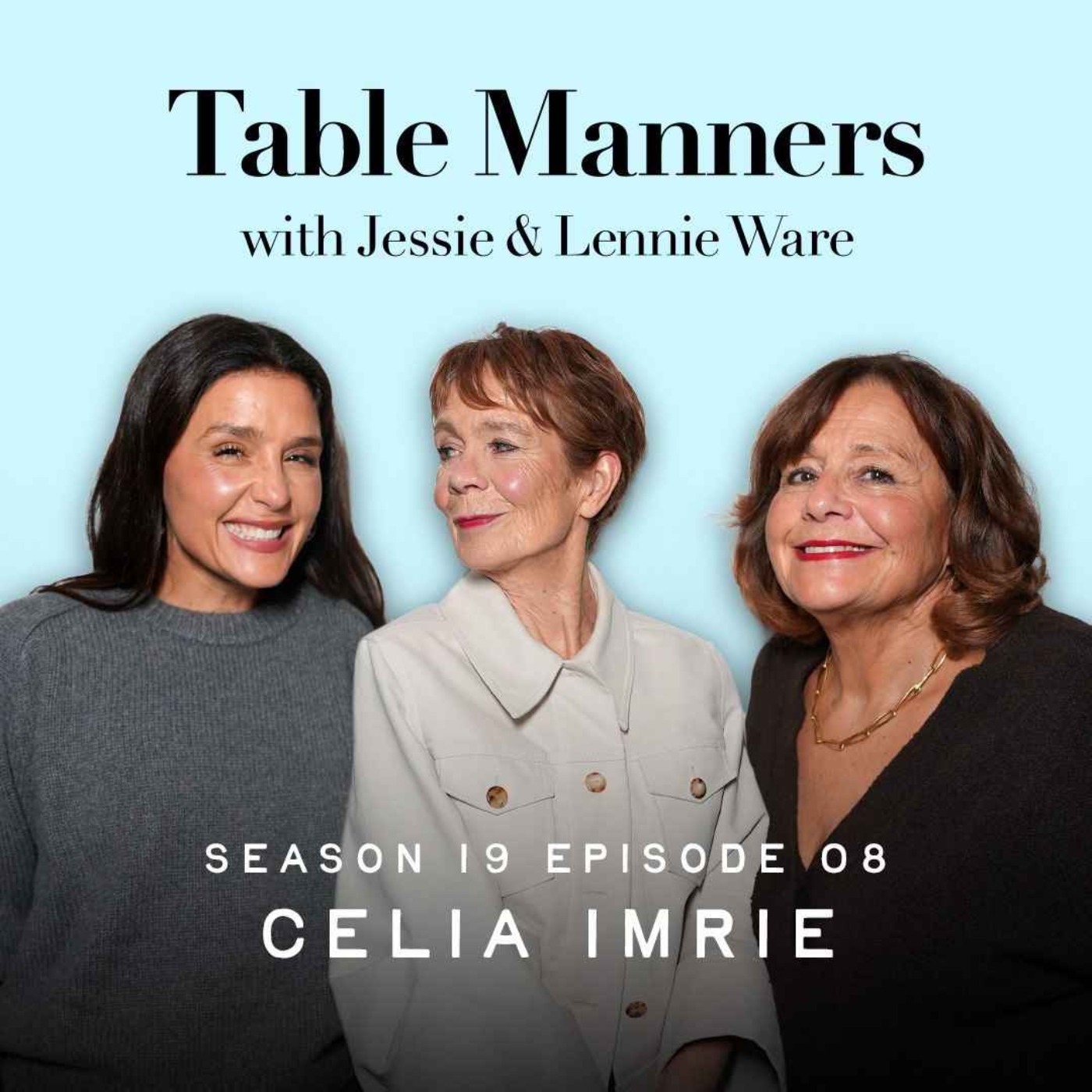
This week we have legendary actress Celia Imrie popping round for dinner! From Absolutely Fabulous and Bridget Jones to Calendar Girls, Star Wars, The Diplomat (mum's fave) and (my fave) Better Things - Celia Imrie has graced our screens in just about everything! We heard all about Celia’s extraordinary career, from her early days as a chorus girl touring the world with Glenda Jackson to her love of working with Pamela Adlon on Better Things. We chatted about her experience in the Traitors castle, her love of travelling across the Atlantic by cruise ship, her upcoming role in Tomb Raider, and a brilliant story involving Mikey Maddison & Quentin Tarantino! What a lovely treat to have Celia at the table - thank you for such a fun evening! Celia is in the Sky series 'War', which finishes on the 20th November, and her latest travel memoir, 'The Elegant Hustler: Adventures From a Life on the Move' is out now. Listen & watch Table Manners here - https://tablemanners.komi.io/ Follow Table Man
Hour 1 Show Opening Regina Belle Make it like it was Aston Grey Project - How Does It Feel Carmichael MusicLover - Pair-a-Dice Phyllis Hyman - Can't we fall in love again Shayla Dunn - Sex For Breakfast The Double Down: Tank Chante Moore - It s Alright Chante' Moore -I Cry to Myself Pavé P - Representation India Arie - Always In My Head Maggie Ray - Way Back (Smooth Mix) The Jones Girls - Baby Don_'t Go Mario & Sabrina Claudio - Like Her Too Aretha Franklin - Never Leave You Again Hour 2 Aaliyah Monroe - Count On Me Conya Doss - Long Haul John Legend - You & I (Nobody In The World) Fourcast - Give My Love A Try (Soul Mix) Men At Large - Holiday Rare Hard To Find Throwback Jam Tony Terry - With You (1990) Walter Jackson - Tell Me Where It Hurts Coco Jones - Love Me Through Blue Eyes Soul Corner Annie Tracy - To Love and Be Loved Brian Culbertson - Colors of Love Justin Nozuka - Moonlight Radiator (feat. Elijah Fox) Maggie Ray - Famous Michael Mcdonald - Stop Look And Listen Sinéad Harne
Stuart and Joe take a look at this week's music biz stories, including... → £8.4bn. That’s how much the UK’s music industry is worth to the national economy, according to a new report from UK Music. → Streaming service Deezer has published its second annual survey of music fans’ views on AI. What did it find this time? → Could Spotify be banned for under-16s in the UK? Probably not, but the idea has been floated in the past week as a possibility (https://musically.com/2026/11/12/uks-social-media-ban-for-under-16s-could-include-music-streaming/)… → Another app that will almost certainly be subject to the ban is TikTok, but this week it was talking about musicians in the UK doing well on its app (https://musically.com/2026/11/13/tiktok-trumpets-livestreaming-success-for-uk-based-musicians/)… → It’s nearly time to wish Tina Turner a happy 87th birthday. Or at least, it would be if she hadn’t passed away in 2023. But the custodians of her estate and music rights are going to get fans to ce
House music at its best! It’s another glorious week for new house music with a lovely blend of piano house, funky grooves, deep emotive vocals, tribal beats and oldskool favourites in the first hour, before moving on to heavier tracks in the second hour as always. Tracks released on November 13 unless shown. 1. Keep On Running - Zac Samuel [Goodside Records] RELEASE DATE: NOV 27 2. Say My Name (Extended Mix) - Powered Djs, Zero Sugar, Sacha LMS [Future House Cloud] 3. What I Love (Extended Mix) - Ralph C [HouseU Tunes] 4. Superdisco (Extended Mix) - Jude & Frank feat. Leyla Diamondi [Myth of NYX] RELEASE DATE: NOV 20 5. U Call It Love (Extended Mix) - Midnight City [All Night Long Records] RELEASE DATE: NOV 27 6. All I Want To Do (Extended Mix) - Earth n Days [HouseU Music] RELEASE DATE: NOV 20 7. Only Love (Original Mix) - Jerome Sydenham, Fatima Njai [Ibadan Sound] 8. Make You Feel (Extended Mix) - Roger Da'Silva [PHXBLK] RELEASE DATE: NOV 27 9. Every Day - ZPLASH [ID] RELEASE DATE:
Written by Rob Hirst, and completed by his daughter Lex, the new book, World Is Almost At Peace, moves through the many songs Rob wrote and recorded and shares remarkable detail about the writing of a lifetime of music. Lex Hirst and Rob’s wife, Lesley Holland join Andy to share their memories of Rob and their reflections on his life and his music. Hana Stretton’s first album, Soon, was a response to isolation - with Covid and Australian bushfires looming in its background. On her latest, tiarn (https://hanastretton.bandcamp.com/album/tiarn-2), Hana has been folding ever more into her compositions: more voices, more instruments, more ideas, but it retains much of that shimmering, distant sound and remains inspired by the natural world around her. Hana is performing 8 Dec at Phoenix Central Park, Sydney; 9 Dec at Lansdowne Hotel, Sydney; 10 Dec at Thornbury Theatre, Melbourne; 11 Dec at Oregon Hall, Beechworth; 13 Dec at Meredith Music Festival Music heard in this program: Title: StoveA
The Moog, the Hammond, the Fender Rhodes, the Theremin! Every new electronic instrument sparked a gold rush to be the first to use it but few inventors made any money. Most were just tech pioneers with arrows in their backs toiling at the interface between science and sound. Laurent de Wilde talks here, in his enviable Paris loft, about his new book ‘Wizards Of Sound: how Electricity Changed the Course of Music’ and the records that map out the story, which takes in … … ‘Strawberry Fields’ and the miracle of the Mellotron … the Beach Boys, Booker T, Jagger, Madonna and other early adopters … when Herbie Hancock met a Rhodes piano at a Miles Davis session … churches, living-rooms, jazz, R&B, soul, rock and the journey of the Hammond organ … “we don’t want a washing-machine onstage!” – the Stones v the Moog synthesiser … the story of the Rhodes piano and the injured US servicemen … the plummeting cost of technology from the Fairlight to the iPhone … how Keith Emerson turned modular music
Ken Womack lectures and writes about the Beatles and his latest (with Scott Freiman) dismantles every track they released up to 1966 to work out the recording process and the instruments used. It’s a labour of love and, at times, detective work. He talks here from his guitar-stacked room in New Jersey about ‘The Beatles’ Touring Era’ and what he learnt from writing it. High in the mix … … the value of the ‘secret weapons’ George Martin, Ken Scott, Norman Smith and Mal Evans and the fact that EMI owned the building … the forces that had to be aligned to make those records work and why “the odds were off the chart” … how George Harrison transformed And I Love Her, She Loves You and Nowhere Man … Dylan’s reaction when they played him Tomorrow Never Knows and how “he changed their art forever” … what 18 year-olds see in the Beatles … ‘banger moments’ on Long Tall Sally, This Boy, Baby’s In Black and She Loves You … the celeste on Baby It’s You, the ‘harpsichord’ on In My Life and the glori
n honour this week of an old pal, one of the greatest storytellers we ever met. In pursuit of at least two “genuine ripples”, we alight upon … … his priceless Q coverlines - ‘Kate Bush: booze, fags, blokes and me!’ ‘R.E.M.: boffin bongo weirdy and beardy’ … drinking ink while chewing paper … why he had 17 copies of Marquee Moon … the Helmet of Destiny in the Room of Shame! … the magic of old office life … his Russian hat and his tribute to Moscow … to Amsterdam with Danny Baker to learn how to smoke dope … ‘Love working with you, man. Sorry you didn’t get a chance to speak' … dictating columns in the Total Sport office … “I’ll be back and we’ll go for a drive in my Bentley’ … and Football365, talkSPORT and the value of finding everything interesting. And this is the wonderful podcast with him six years ago when he’d just moved back to Ireland with 20,000 records: https://www.youtube.com/watch?v=CPXFThuuIiU Hosted on Acast.
Disease statistics should include context about who is affected and how counts are collected.
Share your view, then see how readers voted. No sign-in required. This poll is shared across stories.
Do you agree or disagree?
Common Quandary
A Common Quandary to discuss
Another conversation to explore, separate from this news story.
The prettiest trees on your street are ecological troublemakers. Do they come down?
A row of mature flowering trees defines a neighborhood and provides valuable shade. Ecologists identify them as invasive and recommend replacing them with native saplings that will take decades to grow.
How should visible community value be weighed against gradual ecological harm?