I'm Too Hard on Myself — Guided Meditation for Self-Compassion, Negative Self-Talk & Anxiety | 10 Minutes Are you too hard on yourself? A small mistake, something forgotten, a day you simply ran out of energy, and that familiar voice arrives: "I should have done better. Why am I like this? Why can't I just get things right?" This guided meditation for self-kindness and anxiety helps you step back from negative self-talk, soften the pressure you've been carrying and practise speaking to yourself with a little more care. For gentle support every day, download Anchored, my app for panic and anxiety. Guided sessions, breathing tools and fresh caring tips daily, and it plays with the screen off. iPhone: https://apps.apple.com/us/app/anchored-panic-anxiety/id6785035669 | Android: https://play.google.com/store/apps/details?id=com.martinhewlett.anchored We begin with easy breathing and a slightly longer out breath, then learn to notice the inner critic without arguing with it. Through a short
Why does Allah allow good people to suffer? When hardship enters your life, does it mean Allah is displeased with you, or could your struggles be bringing you closer to Him? Every believer experiences moments of pain, loss, uncertainty, and heartbreak. But in Islam, suffering is not necessarily a sign of Allah's anger, and experiencing sadness does not mean your faith is weak. In this powerful and comforting Islamic lecture, Ustadh Reece explores the deeper wisdom behind life's difficulties, the true meaning of Sabr, and how Muslims can remain connected to Allah ﷻ during their hardest moments. Through lessons from the Qur'an, authentic Hadith, and the lives of the Prophets, this reminder explores: - Why Allah tests those who believe in Him - How hardship can become a means of spiritual growth - What Prophet Muhammad ﷺ taught us about grief and sadness - The patience and beautiful du'a of Prophet Ayyub (AS) - How the story of Prophet Yusuf (AS) reveals Allah's wisdom - Why both blessing
Money. Validation. Likes. Who you're “supposed” to be. What if the things you've been chasing are actually blocking your manifestations? Human Design expert Jenna Zoe joins Lacy and Jessica to explore how to manifest in the new paradigm, where the gap between cause and effect is shrinking and the universe is clearing away anything that isn’t soul-driven. Jenna explains passenger consciousness, why you can’t solve everything with your mind, and how being radically honest with yourself (even about the job, home, or relationship you’re questioning) allows life to redirect you before you hit rock bottom. Together, they explore the four transformations in Human Design: digestion, environment, perspective, and motivation. Jenna shares how your perspective can reveal what's pulling you off your path, why your personal frequency matters more than productivity, and how to use your strategy and authority to tap into your intuition. Plus, Lacy has a live aha moment about where her soul is guiding
2027 KICKSTARTER https://nla.to/KS (http://nla.to/KS) What if the chart you consult is not a verdict but a mirror—and what if the most honest thing it reflects is your own relationship with fear and desire? ———— 2027 KICKSTARTER Tools for a deeper astrological practice await. Support Our 2027 Campaign: In this podcast episode, Adam Elenbaas takes a final look at the Sun in Scorpio squaring the Leo stellium of Mars, Jupiter, and the South Node. But rather than a conventional forecast, he offers something more personal: ten provocative truths learned over seventeen years and more than thirteen thousand charts. You may notice a familiar ache here—the quiet hope that astrology will finally deliver certainty about the future. Perhaps you recognize the pattern of consuming the craft out of dread rather than devotion. The invitation of this transit is not to predict but to reflect. This episode asks what happens when the oracle becomes a mirror for the soul rather than a machine for outcomes.
SAVE THE BEES. SWEETEN YOUR LIFE. THE PUREWAVE REVOLUTION CONTINUES! MICHAEL JACO welcomes BRENT KNUDSEN back for an extraordinary conversation about PureWave® Cell technology, the sacred geometry of the Flower of Life, magnetic fields, and the growing movement to support honeybee colonies worldwide! ⚡ THREE YEARS OF RESEARCH — A MAJOR MILESTONE FOR PUREWAVE! Brent discusses a newly published, peer-reviewed, three-year study examining the PureWave Cell's potential effects on honeybee resilience. With research published in Electromagnetic Biology and Medicine, the team is celebrating an important milestone in its mission to explore how magnetic technology may influence the natural environment. THRIVING BEE COLONIES — REAL STORIES FROM THE FIELD! Hear firsthand accounts from beekeepers using PureWave technology and reporting encouraging changes in their colonies. From hive resilience and colony development to the challenges facing pollinators, Michael and Brent explore why protecting hon
Jacob had spent much of his life running, deceiving and trying to secure his future through his own strategies. He had deceived his father, taken his brother Esau's blessing and eventually fled from the consequences of his actions. Years later, he was returning home, but the thought of facing Esau terrified him. Jacob's story reminds us that transformation is not always comfortable. Sometimes God confronts the very things we have spent years hiding behind: deception, fear, pride and the need to control everything. His past was real, and its consequences did not disappear overnight, but his encounter marked the beginning of a different chapter Every contribution counts. Thank you for being part of our journey!
Basic household water needs should come before less essential uses during shortages.
Share your view, then see how readers voted. No sign-in required. This poll is shared across stories.
Do you agree or disagree?
Common Quandary
A Common Quandary to discuss
Another conversation to explore, separate from this news story.
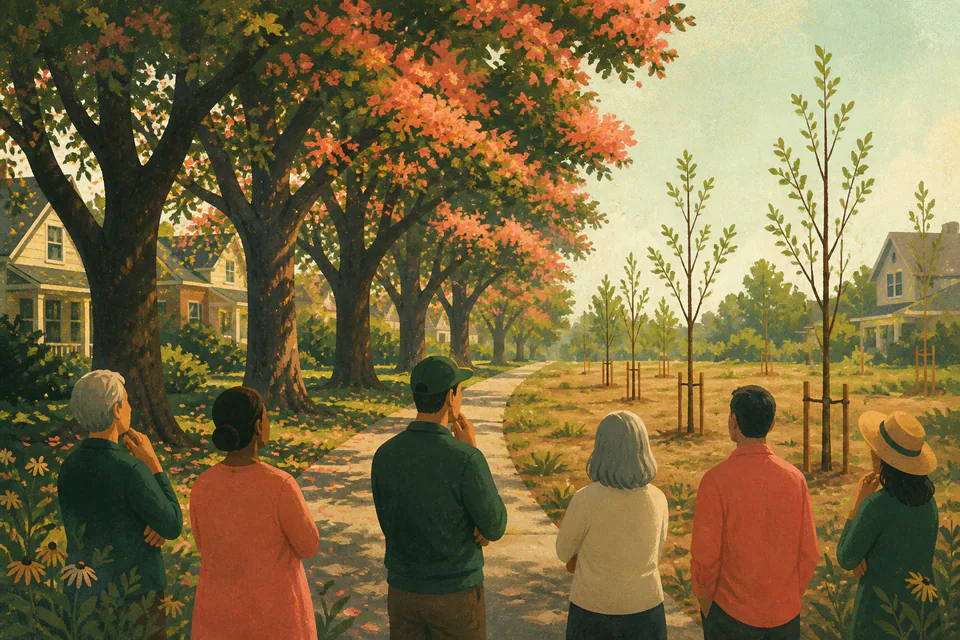
The prettiest trees on your street are ecological troublemakers. Do they come down?
A row of mature flowering trees defines a neighborhood and provides valuable shade. Ecologists identify them as invasive and recommend replacing them with native saplings that will take decades to grow.
How should visible community value be weighed against gradual ecological harm?