Listen through the publisher, then discuss the episode here or arrange an in-person Roundtable. Your city determines where to meet.
Roundtables are designed for groups of four, with a shared subject and room for everyone to speak. Come for discussion, with no dating expectation.
This is the third session which focuses on Emily Dickinson. In the tenor of the ancient practice of Lectio Divina, James Finley reads passages from Emily's poetry, reflects on core themes, and finishes with a meditative practice. Resources: The transcript for this episode can be found here. (https://cac.org/wp-content/uploads/2026/10/TTTM-1406-Mix2.pdf) The books we will be using this season are: The Complete Poems of Emily Dickinson, Edited by Thomas H. Connect with us: Email us: [email protected] December 03, 2026. This podcast is made possible, thanks to the generosity of our donors. If you would love to support the ongoing work of the Center for Action and Contemplation and the continued work of our podcasts, you can donate at https://cac.org/support-cac/podcasts/ Thank you!
Episode information is provided by the publisher. Listening takes place on the publisher’s service.
In this Lonesome Conversation, Jonathan and I explore his reframe that recovery is really the recovery of agency — and that chasing “false freedom” can leave us more alone, not less. He makes the case that binding yourself into a marriage, a family, something with real constraints is where a surprising depth opens up, and I share my own years of love avoidance that I mistook for freedom until I realized I’d built a prison. A conversation that turns our ideas about freedom and connection upside down. About Jonathan Jonathan Dickinson is the chief executive officer and co-founder of Ambio Life Sciences. One of the world’s leading experts on ibogaine, Jonathan brings over 15 years of experience in clinical care, traditional practice, and psychedelic research to his leadership at Ambio. A Mexico-licensed psychologist and former executive director of the Global Ibogaine Therapy Alliance, he authored the field’s foundational safety guidelines and has published widely on ibogaine’s therapeuti
Could one of the church’s biggest problems today be coming from within? Todd Friel and Ken Ham discuss the church, culture, and evangelism. Plus, Michael Todd has been named an apostle—complete with a startling prophecy. Segment 1 What Ken Ham will never let Todd forget. Why do unbelievers visit the Ark Encounter? Who’s defining your identity? Segment 2 Could America’s worst days still be ahead? Is today worse than the days of Noah? What’s keeping Christians from evangelizing? Segment 3 This will change the way you evangelize. Does your day job matter to God? The most dangerous word in America. Segment 4 Michael Todd’s surprising new title. What modern apostles and popes have in common. A prophecy about Michael’s political future. ___ Thanks for listening! As part of our Multiply 2027 year-end campaign, every gift made through December 31, 2026, will be matched dollar-for-dollar, up to $750,000. Your generosity helps us train evangelists, equip pastors, and multiply our gospel impact.
This is our unabridged interview with Isabela Granic. Developmental psychologist Isabela Granic is no technophobe. In the middle of a moral panic over kids and video games, she helped pioneer MindLight (https://playmindlight.com/), a biofeedback video game shown in clinical trials to significantly reduce anxiety symptoms in children ages 8 to 12. But as technology continues to evolve, and AI moves into every corner of childhood development, she’s worried. Isabela joins Lee C. Camp to explore what children need to grow into resilient, flourishing adults, and why a “frictionless” future may take away the very struggles that form us. This is part 2 of our 2-part series: The Cost of Outsourcing Your Humanity to Tech. This project was made possible through the support of a grant from Templeton World Charity Foundation, Inc funder DOI 501100011730) through grant https://doi.org/10.54224/35684https://doi.org/10.54224/35684. (https://doi.org/10.54224/35684%E2%81%A0%E2%81%A0%E2%81%A0.) The opin
An 18-year-old at Columbia wrote a rebuttal defending Jane Austen, and her teaching assistant was livid. Thomas Mann went unmentioned in her four years there, not even once. And she says literary circles don't like Dostoevsky, because he points readers toward faith. Liza Libes on what happened to the study of great literature.Liza talks about growing up on Russian classics in a Soviet-immigrant home, Edward Said and Cloud Nine at Columbia, why she found 2026 Nobel laureate Anne Carson's poetry empty, Cormac McCarthy being mocked in MFA classrooms, and why authors like Dostoevsky, T.S. Eliot, Thomas Mann and Vladimir Nabokov still point readers toward beauty and redemption.Liza Libes is an author, poet and the founder of Pens and Poison (pensandpoison.org), her Substack, YouTube channel, Instagram and podcast dedicated to restoring literature as an art form. She holds a BA and MA in English and Comparative Literature from Columbia University and is the founder and CEO of Invictus Prep.
What if you could travel into the future and witness the next great transformation of humanity? In this extraordinary conversation, returning guest Pamela Aaralyn joins Next Level Soul to explore her experiences with bilocation—a spiritual practice she describes as projecting consciousness into other timelines and experiencing life through another version of herself. Pamela shares what she believes she has witnessed in 2027, 2030, 2032, 2036, and even the year 3300, including predictions about financial instability, the rapid evolution of artificial intelligence, major changes in education and employment, and the possibility of unprecedented extraterrestrial disclosure. She also describes meeting her future self, learning from a more evolved version of her consciousness, and why she believes our choices can change the future. During a live bilocation session, Pamela describes what she perceives as a turning point in 2032, when extraterrestrial craft allegedly become impossible to ignor
This week, Laylla and Chelle have a lovely conversation with Fiona Heckels and Kazz Goodweather, better known as the Seed Sistas, about their book Witches’ Forbidden Herbs and the plants with the most wonderfully wicked reputations. Clinical herbalists, eco-activists, and self-described herbal drama queens, Fi and Kaz have spent more than twenty years bringing plant science, folklore, and magick together. They join us to explore the witching world of belladonna, henbane, and datura, and to ask who decided these herbs were forbidden. Was it the plants, their potency, or the people who knew how to work with them that made everyone so nervous? Naturally, we get into flying ointments, the stories behind a witch’s flight, and the ways plants become part of ritual. Laylla brings her Beyond Flying Ointment workshop into the conversation with talk of cannabis as an entheogen and smokable spells. We also make room for the overlooked, unloved, and decidedly ugly herbs, because apparently every p
On this special bonus episode, James Finley and Kirsten Oates interview Br. Paul Quenon about his special connection to the poetry of Emily Dickinson. Brother Paul Quenon, OCSO: is a brother at the Abbey of Gethsemani. He entered the abbey in 1958 and was a novice under Thomas Merton. In addition to the usual monastic jobs, Br. Paul is a poet, photographer and published author. He has played an active role in the International Thomas Merton Society for a half-century. His memoir, In Praise of the Useless Life, received a Catholic Press Award, and he has published ten books of poetry. Now in his eighties, he continues his life of choir, prayer meditation, and cooking at the monastery. Resources: The transcript for this episode can be found here. (https://cac.org/wp-content/uploads/2026/11/TTTM-1408-Mix2.pdf)https://cac.org/wp-content/uploads/2026/11/TTTM-1407-Mix2.pdf The books we will be using this season are: The Complete Poems of Emily Dickinson, Edited by Thomas H. Connect with us:
In this third dialogue session, Jim and Kirsten will focus on two more of Emily's poems, Because I could not stop for death, and I know that He exists. Resources: The transcript for this episode can be found here. (https://cac.org/wp-content/uploads/2026/11/TTTM-1407-Mix2.pdf) The books we will be using this season are: The Complete Poems of Emily Dickinson, Edited by Thomas H. Connect with us: Email us: [email protected] December 03, 2026.
Admissions should consider applicants' circumstances alongside grades and test results.
Share your view, then see how readers voted. No sign-in required. This poll is shared across stories.
Do you agree or disagree?
Common Quandary
A Common Quandary to discuss
Another conversation to explore, separate from this news story.
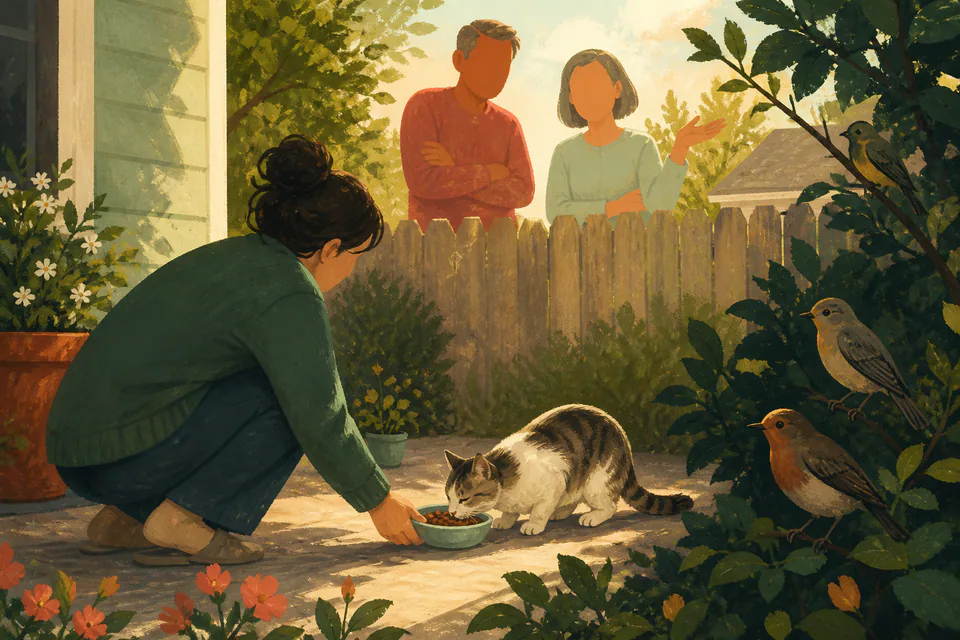
A stray cat adopts you—and starts killing birds. Do you keep feeding it?
A stray cat visits your yard daily and appears to depend on the food you leave out. Neighbors complain that outdoor cats kill birds and say feeding it encourages the problem without taking responsibility for the animal.
Does caring for one visible animal excuse harm to less visible ones?