Listen through the publisher, then discuss the episode here or arrange an in-person Roundtable. Your city determines where to meet.
Roundtables are designed for groups of four, with a shared subject and room for everyone to speak. Come for discussion, with no dating expectation.
In November 2015, 35-year-old mother of three Deanne Hastings was excited for a fresh start after completing her first day of orientation at a cosmetology school in Spokane, Washington. That evening, her fiancé returned home to find a short handwritten note saying she had a great day and was running to the grocery store. Hours later, her locked car was found abandoned in downtown Spokane with her purse, wallet, and phone inside. Over the next 24 hours, bizarre sightings, a welfare check at a convenience store, and stolen debit cards painted a confusing trail that ended near a wooded hillside close to her home. More than a decade later, Deanne remains missing, leaving behind shifting witness accounts, troubling text messages, and a family still fighting for answers. Anyone with information regarding Deanne Hastings case can still submit tips to Spokane Police Department Crime Check at 509-456-2233.
Episode information is provided by the publisher. Listening takes place on the publisher’s service.
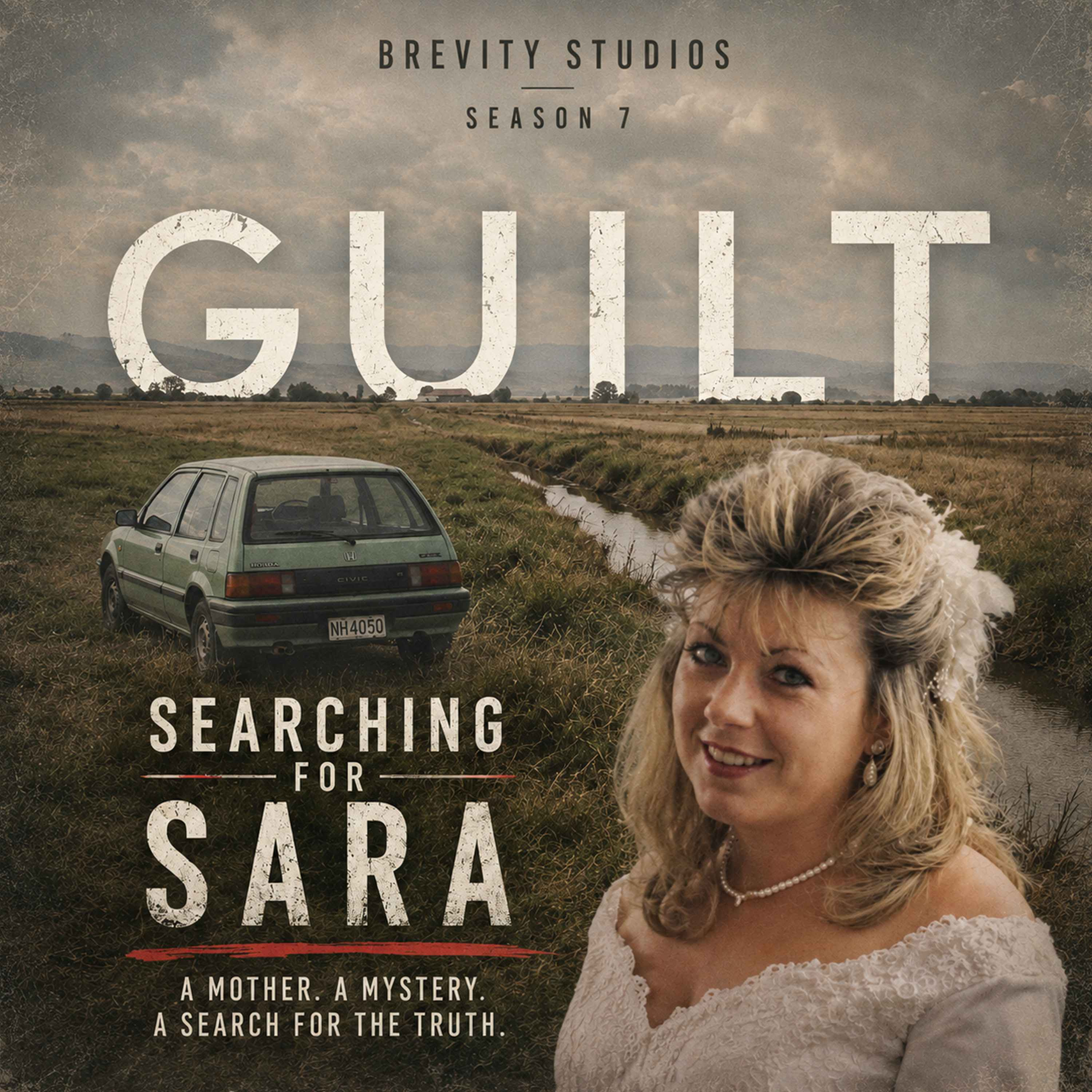
By the winter of 2003 the search for Sara Niethe has ended, and police are still calling it a missing person case. Then, in July, they reveal that two men say they saw a car driven erratically through Ngatea around midnight on the night she was last seen, with its headlights off. Ryan drives the route in the dark, asks retired detective Bruce Currie how a witness like that should be tested, and follows Sara’s family and friends through a reward, a Christmas and a year that ended without answers. CAN YOU HELP? If you were the truck driver who saw a car without lights on State Highway 2 and in Ngatea on the night of Sunday 30 March 2003, or the man filmed at the Shell station on Orchard Road in Ngatea just after midnight that night, Ryan would like to speak to you. The same goes for anyone who rang police about Sara’s car that year, or who was in Ngatea that night. Sara’s car was a light green 1987 Honda Civic hatchback, registration NH4050. You can contact Ryan through theguiltpodcast.c
After ten weeks of evidence, a jury took just over two hours to find Beau Lamarre-Condon guilty of murdering Jesse Baird and Luke Davies. The former New South Wales police officer shot the two men with his police-issued pistol at Jesse’s Paddington home on February 19th, 2024. Beau Lamarre-Condon had become obsessed with him after Jesse ended their sexual relationship, which he only ever said was casual; but Beau Lamarre-Condon wanted more. He then murdered Luke Davies, Jesse’s new boyfriend, to eliminate a witness. In this episode, Wayne and Charlotte retrace the events behind the verdict, from the stalking and jealousy described in court to the fatal shootings at Jesse’s Paddington home and the elaborate attempts to conceal what happened afterwards. Revisiting key trial testimony, they unpack the forensic evidence that challenged Beau Lamarre-Condon’s account, the messages sent from Jesse’s phone after his death, and the eight-day search that ended with both men’s bodies being found
On November 16, 1991, Crystal Faye Todd went out with friends near Conway, South Carolina, and was supposed to be home by midnight. When the 17 year old didn’t return or call, her mother knew something was wrong. Crystal’s white Toyota Celica was found locked in a middle school parking lot, but there was no sign of her. The following morning, two hunters discovered her body beside a rural road. Investigators believed Crystal may have known the person who killed her. They began interviewing friends and acquaintances, sorting through conflicting accounts, and asking men from her life to provide biological samples. DNA testing was still unfamiliar to many investigators and jurors, and each comparison required laboratory work rather than a quick database search. In this episode, we follow the search for Crystal’s killer, the DNA match that changed the investigation, and the confession that became the subject of a divided court ruling. We also discuss the person who stayed close to Crystal’
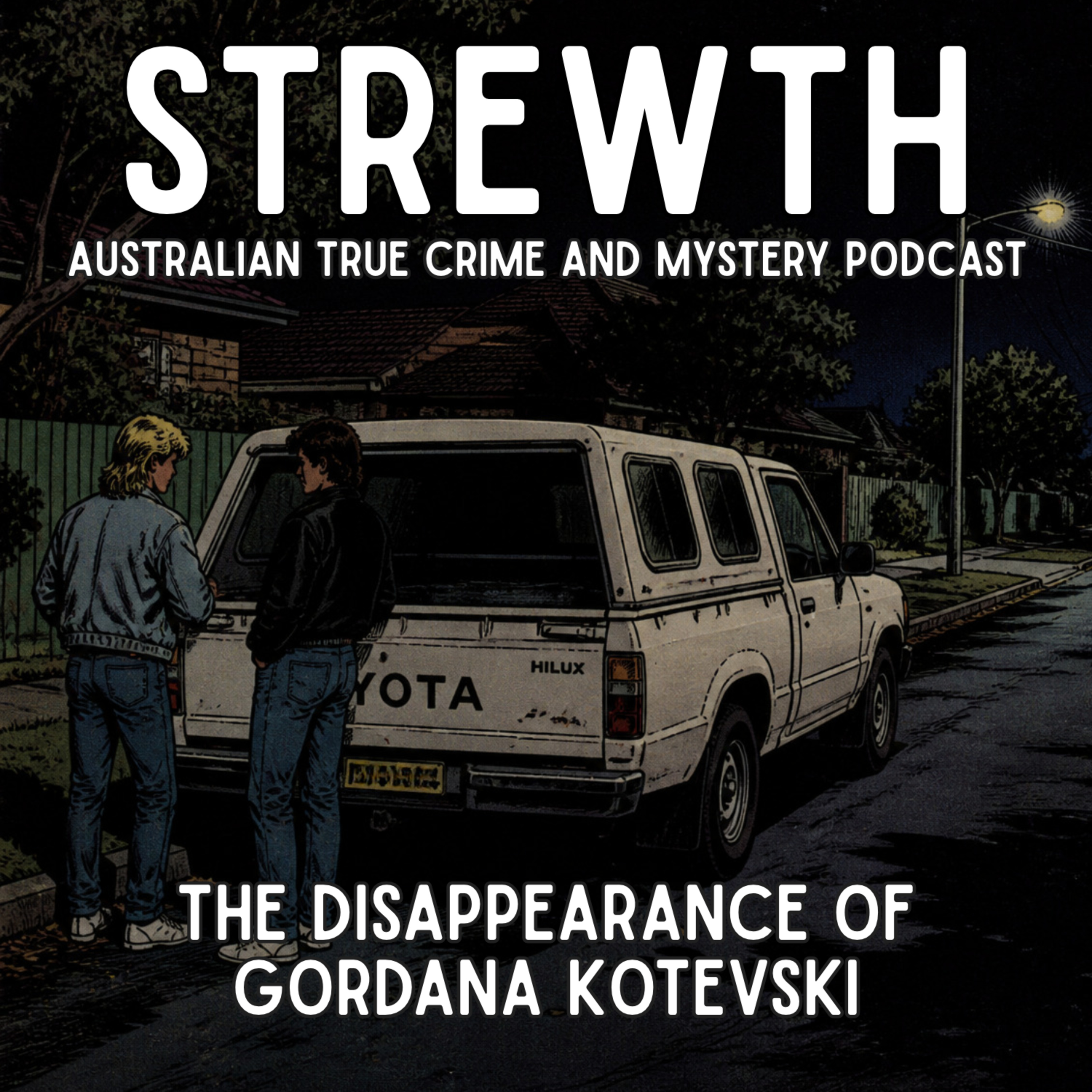
In the spring of 1994, sixteen-year-old Gordana Kotevski quit her job at a Newcastle deli to get away from a man. She had a name for him. She called him the Spook. She started again behind the counter at Pizza Hut, and every time the bell over the door rang, she looked up in fear. A few weeks later, on a warm Thursday night, she turned down a lift home from the local shopping centre and walked towards her aunt's house on Powell Street. Just short of that front door, a white ute was waiting with its lights off. Gordana has never been found. But in the months after she vanished, two men picked up the phone, one to the police and one to a late-night radio show, with specific information about who was involved. Then they disappeared too. Two Crime Besties - https://www.twocrimebesties.com/ Strewth social media links -https://linktr.ee/strewthpodcast Contact me - [email protected] Theme Music - Jesse Frank on Pixabay Sources 2NURFM. (2026, June 26). Police appeal for two anonymous wi
Caleb Flynn’s digital trail and his final statement to Ashley Flynn’s family describe two sharply different kinds of evidence. Days after the jury heard about deleted applications and an enormous archive of messages, Flynn apologized for his affair at sentencing while denying that he killed his wife. The trial of the former church worship leader focused in part on records investigators could still recover. A witness described approximately 107,000 GroupMe messages connected to Flynn and Alleigha Botner. Phone examination showed ChatGPT removed on February 15, 2026, and GroupMe and Instagram removed after 1 a.m. on February 16. Investigators examined messages in which Flynn had expressed anger and violent thoughts about Ashley. Jurors also heard evidence from phone records and an Apple Watch. Prosecutors argued the data undermined Flynn’s account of a home invasion; his attorneys disputed the circumstantial case. A Miami County jury convicted Flynn on all nine charges on September 29. A
Today we’re covering two cold cases that were solved in 2026! They call it the golden age of DNA, and we’re seeing more cases solved, even if it's decades later. Lisa McBride was taken from her home in the dead of night. Her bed was stripped bare, her phone line cut. For thirty years, the only lead was a crumpled note found in a blazer pocket, and a stranger's drunken confession that nobody believed. 16-year-old Sheri Jo left for school on a gray November morning and never arrived. Witnesses saw her get into a vehicle, but every description was different. The only thing her killer left behind was his DNA, and when they were finally able to test it, it matched the least expected perpetrator. TW: Kidnapping, SA, Suicide Love true crime, horror, folklore, and the unexplained? Join us in the Rogue Detecting Society on Patreon.
On June 11, 2005, 22-year-old Todd Geib left an apple orchard bonfire party in Casnovia, Michigan, on foot after a fight broke out, placing a series of brief, disoriented phone calls to friends saying he was lost "in a field" before his line went dead with only heavy breathing heard on a callback. Despite a massive three-week search by over 1,500 volunteers, K-9 units, thermal aircraft, and dive teams, no trace of him was found until July 2, 2005, when property owners discovered his body in Ovidhall Lake—a lake divers had already searched. Although the medical examiner ruled his death an undetermined drowning, Todd's mother, Kathy Geib, and independent forensic pathologists disputed the finding, pointing to several suspicious details about his case. More than two decades later, despite outside decomposition experiments and ongoing advocacy from his family, the Michigan State Police have kept the case closed, leaving the true circumstances of Todd's death unresolved. Anyone with any inf
About six miles off the coast of the northeastern United States lay a group of small islands and tidal ledges called the Isles of Shoals. One of those islands is most well known for an infamous double homicide dating back to the 1870s. The only inhabitants of Smuttynose Island, the Hontvets were creating a thriving fishing business after immigrating from Norway. Unfortunately, a tragedy struck the family when an intruder took the lives of two family members during an attempted burglary. Today, Smuttynose Island is mainly known for this infamous massacre.
When 13 year old Kelsey Shannon went for a walk in October 2009 and didn’t return home, her family was terrified of the worst. Four months later, a set of human remains were found nearby her home in Broomfield, Colorado. Just a day after the skeletonized remains were identified to be Kelsey, her boyfriend, 18 year old Alexander Pacheco, was arrested for her murder. Friends of Pacheco told authorities how he admitted to them that he had killed Kelsey and even offered to show them her remains. Pacheco was then charged with murder and abuse of a corpse. Kelsey thankfully eventually saw some form of justice, but that is never enough.
Admissions should consider applicants' circumstances alongside grades and test results.
Share your view, then see how readers voted. No sign-in required. This poll is shared across stories.
Do you agree or disagree?
Common Quandary
A Common Quandary to discuss
Another conversation to explore, separate from this news story.
You are not sick—you just cannot face work today. Do you call in sick?
Your employer offers sick leave but no personal days. You are not physically ill, yet you feel exhausted and know a day away would help. Saying you are sick is the only way to take paid time off without explanation.
Do unjust workplace rules change the duty to be truthful?