Listen through the publisher, then discuss the episode here or arrange an in-person Roundtable. Your city determines where to meet.
Roundtables are designed for groups of four, with a shared subject and room for everyone to speak. Come for discussion, with no dating expectation.
In America, we’ve been blessed with an overabundance of food. Most of us live within just a few miles of restaurants and grocery stores. So, do we really need to ask God to “give us this day our daily bread”? Dr. Robert Jeffress explores our need for God’s provision in our lives.
Episode information is provided by the publisher. Listening takes place on the publisher’s service.
Welcome to Ep#3 in our Full Table & a Well-Fed Soul Series When Food Becomes More Than Fuel Why Food Is About Connection—and How to Keep It from Becoming Self-Sabotage Food was never meant to be just another thing to manage, measure, or get right. It's nourishment, yes—but it's also tradition, celebration, connection, and some of our most meaningful memories. In this episode of A Full Table and Well-Fed Soul, Jess and Micah explore what happens when we allow food to become part of the moments that matter most. From Christmas Eve traditions and family recipes to the deeper spiritual significance of sharing a meal, they unpack why food has always been about more than nutrition. But what happens when the holiday table brings complicated family dynamics, emotional triggers, or pressure to eat perfectly? How do we enjoy the experience without swinging between restriction and overindulgence? Want to dive into this 1:1 with Jess and prep your January plan? Snag the limited-time Empowered Eati
Read: Matthew 28:19-20; Hebrews 4:12 (https://www.biblegateway.com/passage/?search=Matthew+28%3A19-20%3B+Hebrews+4%3A12) Sheri clutched her new book to her chest as she held the phone to her ear. “Yes, you totally need to read it! The last few chapters are great!” “You always find such fun books! I’ll look for it at the library the next time I go,” her friend Megan said. “Oh, my dad is calling. I’ve got to go.” Sheri hung up, then went into the family room and plopped on the couch beside Mom. “You really enjoyed that book, didn’t you?” Mom said as she folded some towels. “Yes!” Sheri flipped through it. “It’s the best I’ve read in ages! There’s romance, heroes and villains, battles of good versus evil, and so much more!” “That does sound exciting.” Mom smiled. “I know of another book like that, filled with good versus evil, heroes battling villains, and even romance. It’s my favorite.” Sheri furrowed her brow. “What book is that?” Mom held up the book beside her. “The Bible. Have you t
What if the scale isn't telling you the whole story? Have you ever been consistent with your workouts, making better food choices, and really trying to take care of yourself, only to step on the scale and see absolutely no change? And just like that, your motivation takes a hit. You start questioning whether your workouts are working, whether you're doing enough, or whether you need to change something. But here's what I want you to understand: The scale is only measuring one small piece of your health and fitness journey. It doesn't measure how much stronger you've become, how much better your endurance is, how much energy you have, or how much easier it is to do things that used to feel difficult. And if you're only using the scale to determine whether you're making progress, you could be missing some pretty amazing changes happening in your body. Today, we're talking about five ways to measure your fitness progress beyond the scale so you can start recognizing the changes that actua
Read Online (https://catholic-daily-reflections.com/2026/11/21/christ-the-universal-king/) Christ the Universal King “Then he will say to those on his left, ‘Depart from me, you accursed, into the eternal fire prepared for the devil and his angels. For I was hungry and you gave me no food, I was thirsty and you gave me no drink, a stranger and you gave me no welcome, naked and you gave me no clothing, ill and in prison, and you did not care for me.’” Matthew 25:41–43 On June 11, 1899, Pope Leo XIII solemnly consecrated the entire human race to the Sacred Heart of Jesus, a moment he regarded as the “great act” of his pontificate. This consecration was rooted in the sacred truth that, “[Christ’s] empire includes not only Catholic nations, not only baptized persons… but also all those who are outside the Christian faith; so that truly the whole of mankind is subject to the power of Jesus Christ” (Annum Sacrum, 3). This prophetic act of entrustment was followed by decades of growing unrest
The Teapot by Hans Christian Andersen — A Short Calming Bedtime Story for Sleep & Insomnia | Books at Bedtime Drift off to sleep with The Teapot by Hans Christian Andersen, a short and gentle fairy tale read aloud by Martin Hewlett on Books at Bedtime, the sleep story series from Calming Anxiety. A proud porcelain teapot rules the tea table. The cups have their handles and the sugar bowl its lid, but the teapot has both, and a spout besides, and it believes that makes it the queen of the tea table. Then one afternoon a delicate but awkward hand lifts it, and the teapot falls. The spout snaps off, the handle snaps off, and everybody laughs at the teapot rather than at the hand that dropped it. Called an invalid and pushed into a corner, the broken teapot is given away to a poor woman, who fills it with earth and plants a flower bulb inside. And there, just as it is, the teapot's better life begins. The bulb becomes its living heart, and as the flower grows and blooms, the teapot forgets
Welcome back to The Calm & Happy Home Podcast! This week I’m joined by someone I’ve been desperate to share with you, Dr Gregory Dunn-Smith, or Acupuncture Greg as he’s known on my Instagram. He’s a Doctor of Chinese Medicine and a metaphysics specialist, and every time I leave a session with him I feel like a different person, like the fog has lifted. If you’ve ever wondered how to know if you’re living in alignment, this one is for you. We talk about what Greg actually does, why your reality is something you’re creating, and why it’s so important to ask yourself what you love to do. And I have some exciting news about my live shows. How Greg went from professional dancer to Doctor of Chinese Medicine, and what a metaphysics specialist does How to know if you’re in or out of alignment Why “what do you love to do?” is a better question than “what do you do for work?” Changing your energy by changing your environment, even just your living room layout Greg’s small retreats in Bali The 7
When you’re going through a troubling issue, is prayer your first line of defense? Or has prayer become a last resort? Dr. Robert Jeffress suggests that extraordinary people, such as the prophet Elijah, recognize the power of prayer—and use it!
You’ve likely heard plenty of persuasive arguments about the power of prayer. And there’s plenty of Scripture to affirm that’s true. But do you honestly feel like your prayers make any difference? Dr. Robert Jeffress shares several helpful prayer tips based on Elijah’s dramatic—and effective—prayer on Mount Carmel.
If you attend church, you’ve likely heard your pastor give persuasive arguments about the power of prayer. But do you honestly feel like your prayers make any difference? Dr. Robert Jeffress offers several helpful tips that are based on Elijah’s dramatic—and effective—prayer on Mount Carmel.
A merger should be approved only when there is a credible case that customers will benefit.
Share your view, then see how readers voted. No sign-in required. This poll is shared across stories.
Do you agree or disagree?
Common Quandary
A Common Quandary to discuss
Another conversation to explore, separate from this news story.
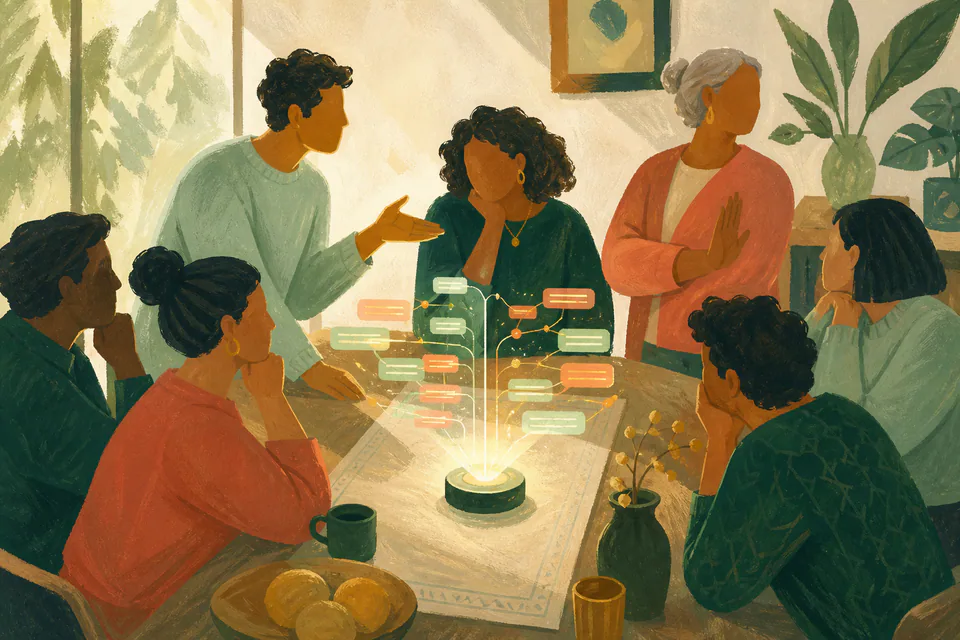
Your family wants an AI to settle an old argument. Would you hand over the group chat?
A recurring family dispute has reached the point where nobody agrees on what was actually said. Your cousin proposes uploading five years of the family group chat to an AI that can reconstruct events, flag contradictions, and recommend a fair resolution. Nearly everyone agrees—but one relative refuses.
Can a tool make a family argument fair without turning intimacy into evidence?