From Retrenchment to Reimagining The Future of International and Development Cooperation
Listen through the publisher, then discuss the episode here or arrange an in-person Roundtable. Your city determines where to meet.
Roundtables are designed for groups of four, with a shared subject and room for everyone to speak. Come for discussion, with no dating expectation.
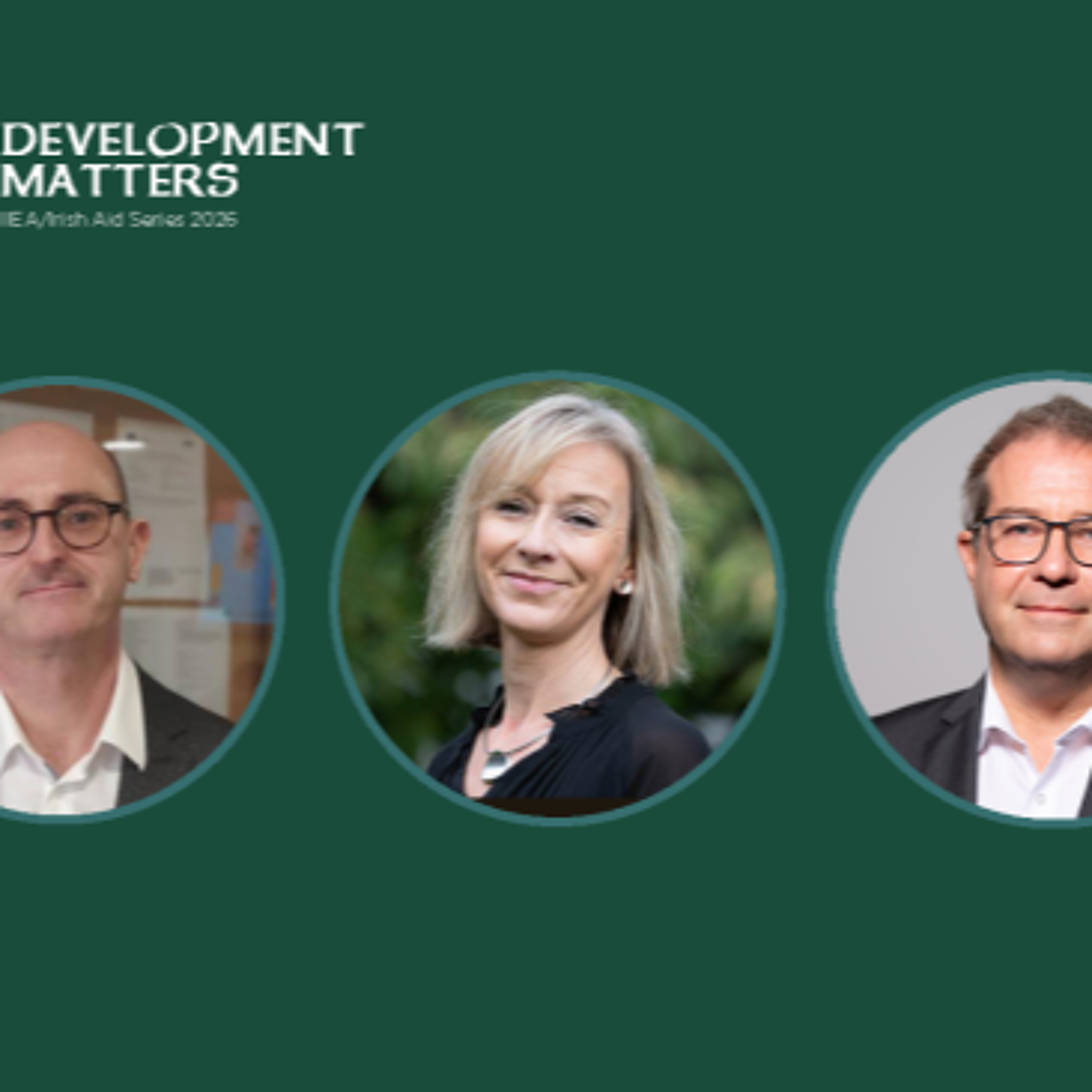
In their presentation, Dr Andy Sumner and Dr Stephan Klingebiel reflect on the impact of the fall of almost a quarter of official aid from OECD donors in 2025, the largest annual drop on record. They will take account of the fact that the second Trump administration has torn up the rulebook of development cooperation and that other donors are shifting orientation. Furthermore, they consider futures for development cooperation and explore who will define the new key idea of ‘mutual interest’. The speakers acknowledge that small coalitions of like-minded countries are already building practical tools where universal agreement is hard to reach. They close with an analysis of what like-minded donors can do now. Dr Susan Murphy will chair the event. She is Associate Professor of Development Practice at Trinity College Dublin, Chair of the Development Studies Association of Ireland and a member of the Executive Committee of EADI. Dr Andy Sumner is Professor of International Development at King's College London. He is President of the European Association of Development Research and Training Institutes (EADI), which has over 100 institutional members. Questions of global inequality run through all his work. Specifically, how inequality is produced and reproduced, within countries and between them, and how economics, politics, and policy shape it. He is a Fellow of the Academy of Social Sciences and the Royal Society of Arts. In Indonesia, he is Visiting Professor at the Centre for Economics and Development Studies, Padjadjaran University. He is a Senior Non-Resident Research Fellow at UNU-WIDER, Helsinki, and the Center for Global Development, Washington DC. In addition, Dr Sumner co-founded the International Development Institute at King's which has since grown into a department. Over 25 years he has published 16 books and more than 100 papers. Dr Stephan Klingebiel is Chair of the Research Programme “International and Transnational Cooperation” of the German Institute of Development and Sustainability (IDOS). His research and university teaching focuses on innovations for transnational cooperation, political economy of aid, aid and development effectiveness, global public goods, rising powers, and governance issues in sub-Saharan Africa. He served as the Director of UNDP's Global Policy Centre in Seoul, Republic of Korea, and as the Founding Director of the KfW Development Bank office in Kigali, Rwanda. Furthermore, he is an Honorary Distinguished Fellow at the Centre for Sustainability, Jindal School of Government and Public Policy, India. In addition, Dr Klingebiel has been a Visiting Professor at several universities including Stanford University, the University of Turin, and Ewha Womans University in Seoul.
Episode information is provided by the publisher. Listening takes place on the publisher’s service.
Listen at the source ↗