Listen through the publisher, then discuss the episode here or arrange an in-person Roundtable. Your city determines where to meet.
Roundtables are designed for groups of four, with a shared subject and room for everyone to speak. Come for discussion, with no dating expectation.
Have you ever wondered why sloths are the slowest mammals on Earth? Get ready for a wild adventure into the jungle canopy to discover the super-slow secrets of these incredible creatures! Did you know it can take a modern sloth up to thirty whole days just to digest a single leaf? Or that they move so slowly they actually grow a living invisibility cloak of green algae in their fur? We are uncovering all the gross and amazing facts, from hundreds of moths living on their backs to the weird sticky ribs that keep their organs in place when they hang upside down! But wait, we are also traveling back in time to the Ice Age to meet their unbelievable ancient ancestor, the Megatherium! Imagine a gentle giant the size of an elephant, weighing as much as a school bus, and standing over twenty feet tall on its hind legs! You won't believe how this massive prehistoric beast survived, defended itself against scary saber-toothed cats, and even helped invent avocado farming! Tune in to find out how one animal family found two totally opposite, amazing ways to survive!
Episode information is provided by the publisher. Listening takes place on the publisher’s service.
Have you ever told someone, "Thanks a million!" or claimed you have "a million toys to clean up"? We use the word "million" all the time to mean "a whole lot," but have you ever stopped to wonder just how big a real million actually is? Join Mira and Finn on a mind-blowing math adventure as they discover the quiet power of giant numbers! Imagine counting one number every single second without ever stopping to eat or sleep. It wouldn't take a few hours or a long weekend—it would take you about eleven and a half days just to reach one million! And what about its giant neighbor, the billion? Counting to a billion the exact same way would take a whopping thirty-two years. That's a grown-up's whole life so far! In this amazing episode, we won't just look at numbers on a page; we’ll learn to feel their true size. Find out how much space a million grains of rice would take up, and discover exactly how far a million footsteps would carry you. Get ready to stretch your brain and learn why being
Have you ever seen pictures of giant stone heads sitting in the grass and wondered how they got there? Get ready for a mind-blowing adventure to one of the most remote places on Earth: Rapa Nui, also known as Easter Island! About 800 years ago, expert Polynesian sailors found this tiny island in the middle of the Pacific Ocean using only the stars and ocean currents to guide them. Once there, they carved nearly a thousand massive stone statues called moai! But here is the biggest surprise: these statues aren't just heads—they have full bodies buried underground! Some weigh as much as 40 cars, and the islanders moved them without wheels, cranes, or metal tools. How did they do it? The local legends say the statues literally walked to their places, waddling side to side with the help of ropes and incredibly smart human engineering! Join Mira and Finn as they uncover the secrets of the moai, find out how the island got its English name from a Dutch captain, and learn all about the giganti
Big News! Clicking Here (https://meditationsounds.supercast.com/) Email List (https://bit.ly/3T010m4) Guided Meditation for Children | Hot Air Balloon Ride AdventureLet your child’s imagination soar in this relaxing guided meditation designed just for kids. In this peaceful hot air balloon adventure, your child will float high above the clouds, exploring the sky while feeling calm, safe, and happy. Perfect for bedtime, nap time, or quiet moments during the day, this meditation helps children slow down, breathe deeply, and find their inner calm. With gentle storytelling and soothing background music, this experience promotes emotional balance, better sleep, and a peaceful heart. Ideal for ages 4–10, but magical for dreamers of all ages. #GuidedMeditationForChildren#KidsMeditation#RelaxationForKids#BedtimeMeditation#MindfulnessForKids#HotAirBalloonMeditation#CalmKids#MeditationStory#PositiveKidsContent#PeacefulParenting guidedmeditation for children, kids meditation, bedtime meditation f
I just wanted to reach out to all 30,000 people that participated in THE FIRST EVER‼️ VIRTUAL‼️ UNLEASH THE POWER WITHIN event! Uploaded 21-07-20 WE MADE HISTORY TOGETHER! WHAT A WEEKEND WE SHARED! Thank you for inviting me into your homes. It was an absolute honor to be your guest. We enrolled 22,500 ticket-holders but the most magical part was seeing it become 30,000 as participants from 138 countries shared this experience with their roommates, partners, dogs, cats, kids, and sometimes the whole family! I've been so touched reading all of your messages and hearing what this has done for the people that you shared this with — this was really a family experience and that is perhaps what moves me the most about this new format. I have so much gratitude for MY ENTIRE TEAM, the staff, and volunteers, and A/V production support working around the clock to make this happen. (Actually, six different companies came together and joined forces to pull off this great feat in the last 2 and a ha
In this Jim Rohn Motivation video, we unpack the real meaning of resilience—not as something you're born with, but something you build. It’s not about pretending life is easy. It’s about developing the mindset, discipline, and strength to keep going when everything in you says stop. Key Topics From This Motivational Video: Resilience as a skill, not a trait Taking full ownership of your life and mindset Reframing adversity into growth opportunities Emotional regulation and grounded self-talk Endurance, grit, and the decision to grow daily This Jim Rohn Motivational video reminds us that resilience doesn’t come from waiting for life to calm down—it comes from training your mind to rise in the middle of the chaos. It’s a mindset built on consistent ownership, reframed challenges, and the ability to lead yourself under pressure. Strength isn’t given. It’s earned—through the unseen decisions you make when no one is watching. This Jim Rohn Motivational Video Is Perfect For: Anyone feeling o
What if the change you've been asking for is already knocking? In this best-of compilation from The Positive Mindset Podcast, Henry Lawrence pulls together his best moments on letting go and being restored to who God made you to be, from six episodes: the stirring you feel when it's time to change; an opening prayer for anyone who feels alone right now; why your higher self is the true you, the one designed by God, not a more productive version of you; the cast on a broken arm that protected you and now limits you; the old painted-over furniture that gets restored, not rebuilt; why so much of our tiredness comes from holding too tight; how God moves what you couldn't; why everything is borrowed; and choosing to keep believing when it feels like a war broke out around you. It includes a prayer near the start and closes with the rising tide, a blessing and a thank-you. In this episode: • "That stirring is the truth knocking on a door that you've been leaning on with your whole weight." •
Did you know your mouth is a nonstop biological water park?! Every single day, your body makes enough saliva to fill up to four whole water bottles! But spit isn't just warm water—it's a magical biological potion packed with incredible superpowers. Join Mira and Finn as they explore the wild world of saliva! Discover how a microscopic machine called amylase starts digesting your favorite foods the exact millisecond you take a bite. Find out how spit turns sharp, crunchy chips into soft, squishy balls to protect your throat! Plus, did you know saliva actually builds invisible armor for your teeth by filling in holes with special minerals like calcium and phosphate? It even works as a magical liquid key to unlock flavors—without saliva, chocolate and pizza would taste like absolute cardboard! From amazing spit factories hiding inside your cheeks to real-life birds that build entire nests out of spit, get ready for a mind-blowing biological adventure! Tune in to find out why your mouth is
Have you ever wondered how the sun can suddenly disappear in the middle of the day? Or why the moon sometimes turns a spooky blood red? Join Mira and Finn on a mind-blowing cosmic adventure as they uncover the amazing secrets of solar and lunar eclipses! Discover the magic of the "four hundred rule" that lets our tiny moon block out the massive, blazing sun. Imagine standing in the path of the "umbra" as a giant shadow races across the Earth at a jaw-dropping five thousand miles per hour! We will explore the glowing corona, find out why animals get so confused when the sky goes dark, and learn how Earth's atmosphere paints the moon with the colors of every sunrise and sunset in the world at the exact same time. Plus, find out how a total solar eclipse in the jungle helped the famous scientist Albert Einstein prove his theory of the universe and rewrite the laws of physics! Get ready for a stellar episode filled with out-of-this-world facts, epic science history, and an awesome quiz to
Have you ever wondered how a plain bite of food turns into an amazing slice of delicious pizza? Get ready to explore the wet, wild, and microscopic world inside your mouth! Did you know that your tongue is completely different from the one you had two weeks ago? It’s true! Your taste buds actually shed and regrow every ten to fourteen days because eating is such a tough, messy job. Join Mira and Finn as they shrink down to discover the tiny mushroom-shaped bumps on your tongue called papillae, which hide up to eight thousand secret taste buds! We'll learn how your saliva washes food into tiny caves where special banana-shaped cells recognize five basic tastes: sweet, salty, sour, bitter, and a delicious savory flavor called umami! Plus, prepare for the biggest plot twist in human biology: you are actually smelling your food from the inside of your own mouth! Find out how your nose and brain team up to do ninety percent of the heavy lifting when you eat. Grab a tasty snack, hit play, an
Officials should investigate credible environmental concerns before harm is conclusively proven.
Share your view, then see how readers voted. No sign-in required. This poll is shared across stories.
Do you agree or disagree?
Common Quandary
A Common Quandary to discuss
Another conversation to explore, separate from this news story.
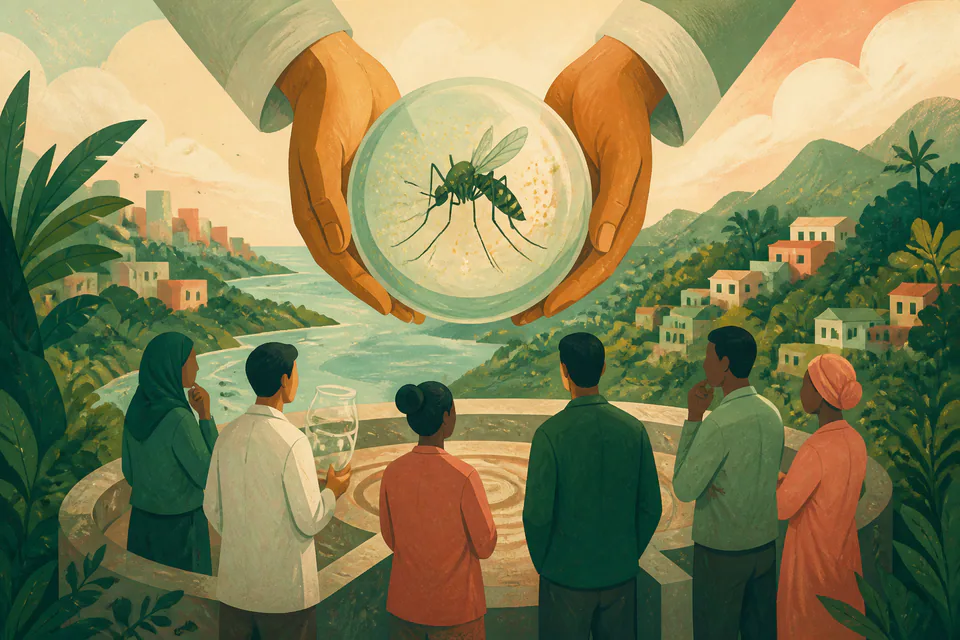
Scientists can edit mosquitoes until a deadly disease disappears. Who gets to say yes?
Scientists can potentially release modified mosquitoes whose genes would spread through wild populations and sharply reduce a deadly disease. The ecological effects could cross borders and may be impossible to reverse.
Who may authorize an irreversible change intended to save lives?