Listen through the publisher, then discuss the episode here or arrange an in-person Roundtable. Your city determines where to meet.
Roundtables are designed for groups of four, with a shared subject and room for everyone to speak. Come for discussion, with no dating expectation.
Have you ever wondered what a lightyear really is? Even though it has the word "year" in it, a lightyear doesn't measure time... it measures distance! In this episode, we explore just how fast light travels and how far it can go in a single year. You'll find out why scientists use lightyears to understand space, and what it means when a star "lightyears away!" Seven Reasons to join the Curious Kids Club! SupportCuriousKids.com (https://supportcuriouskids.com/) Your curious kids get a shout out on their birthdays! Ad-Free Podcast Feed Participate in Curious Kids Club episodes Bonus episodes! Activity sheets for every new episode of the show Weekly newsletters so you never miss anything!
Episode information is provided by the publisher. Listening takes place on the publisher’s service.
Almost 50 years after launch, NASA’s Voyager mission is exploring space beyond the Sun’s protective bubble. No other human-made object has traveled that far. Now, Voyager 1 reaches a new milestone: it will be one light-day from Earth. Explore the distant shores of interstellar space with Jamie Rankin, the Voyager deputy project scientist. Jamie helps us understand what Voyager is revealing about our corner of the universe and how NASA keeps a nearly 50-year-old mission running. For more information about Voyager, visit nasa.gov/voyager (https://science.nasa.gov/mission/voyager/).
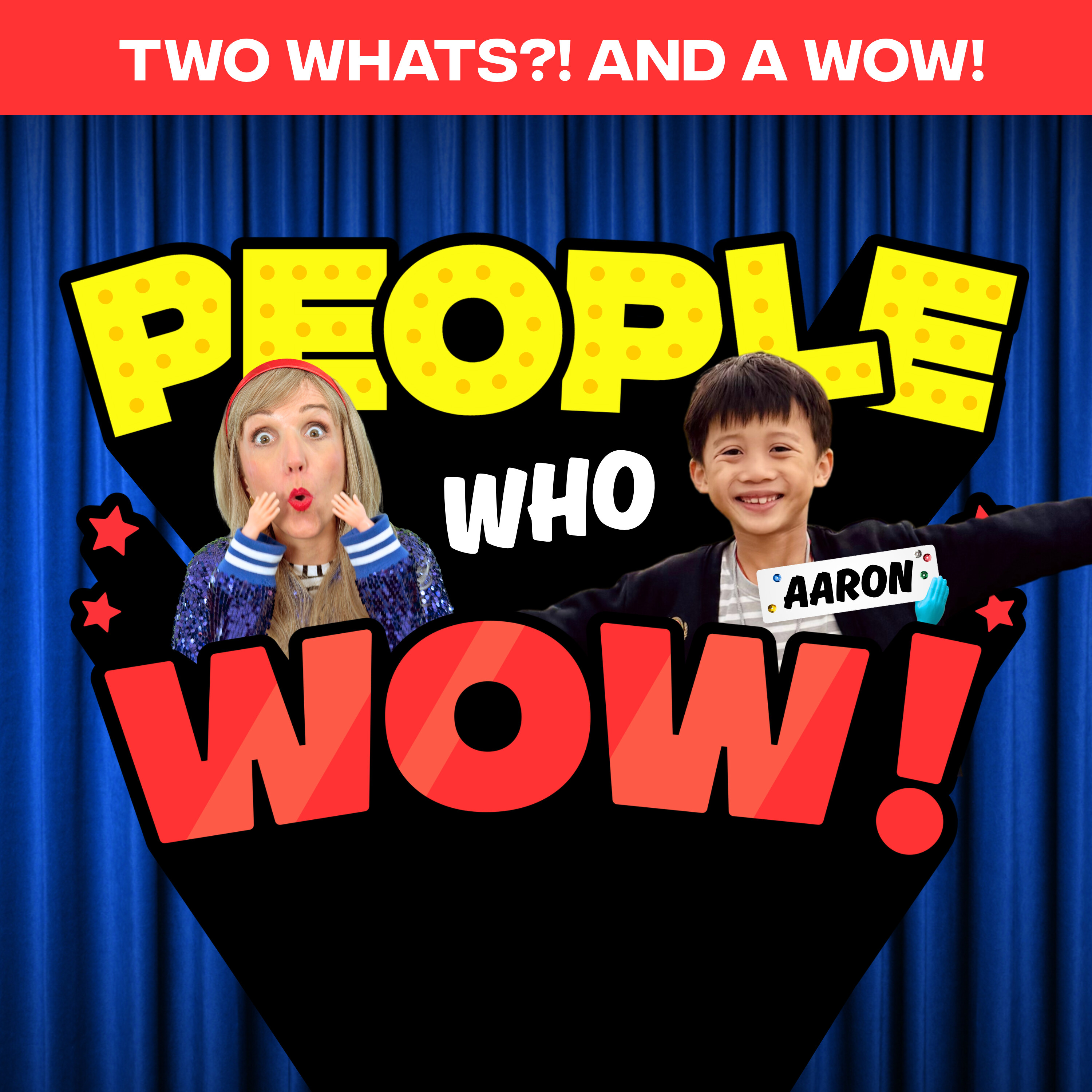
What does it take to be an awesome kid who WOWs, and can you guess which stories are true? In this game show podcast for kids, Mindy Thomas sits down with Aaron to share surprising facts and sneaky fibs about his life! This interactive interview podcast for kids invites listeners to play along, think critically, and discover what it really means to be a kid who WOWs! In this two-truths-and-a-lie podcast all about Aaron, families will hear unbelievable stories about which talent Aaron has performed on stage, a challenge he's undergone, and his unique friendship! But not everything you hear is true… Can you figure out which facts are real? This episode blends gameplay with real conversation as Mindy and her guest share stories that are surprising, funny, and sometimes totally unbelievable. From talents and challenges to friends, listeners will explore how Aaron WOWs every day! Along the way, kids and grownups will get to combine curiosity and play, discover the joy of human connection, a
Have you ever begged for an amazing new toy, like a giant remote-controlled robot, absolutely sure that it would make you happy forever? But then, after a month or two, it just feels like one of your regular toys! Why does that super happy feeling wear off so fast? Join Mira and Finn as they explore a mind-blowing psychological concept called the hedonic treadmill! In 1978, a researcher named Philip Brickman interviewed people who won massive lottery jackpots. You would think they'd be dancing with joy every single day, right? Surprisingly, he found they were barely any happier than their neighbors! Find out how our brains quickly get used to amazing new things, and why a massive 2020 study in Sweden showed that winning millions doesn't actually change your day-to-day happiness very much. Discover why ancient thinkers like the Greek Stoics and Buddhists figured this out thousands of years ago, and learn the amazing secret to true happiness: noticing the small, everyday pleasures around
Have you ever wondered why different shapes roll in completely different ways? If you push a ball, it rolls smoothly in any direction you choose. If you push a soup can on its side, it rolls in a perfectly straight line. But if you push a party hat, it spins round and round in a circle! Why does this happen? It all comes down to a secret rule of the universe: how a shape is curved decides exactly how it moves! Join Mira and Finn as they uncover the hidden instructions built into every shape. You will learn why we don't make car wheels out of spheres, and why the wide base of a cone always outruns its pointy tip. Then, travel back to 1929 Switzerland to meet inventor Paul Schatz, who created an incredible, mind-bending new shape called the oloid! This strange, twisted shape doesn't roll straight or in a circle—it dances and wobbles, touching every single part of its skin to the ground as it moves. Get ready to look at everyday objects in a totally new way!
This episode is part of Beyond the Budget: Getting Ahead Before the New Year, brought to you in partnership with Pearler, an online investing platform helping everyday Aussies build long-term wealth. Find out more at pearler.com (http://pearler.com/) and get your first three trades free atwww.pearler.com/lp/start (http://www.pearler.com/lp/start). We’re so excited to welcome money psychology expert, author and mum Emma Edwards to talk about all things money! Emma teaches the softer skills of money, helping people understand the role their emotions play in their financial confidence. This kicks off our money mini series with a chat that’s honest, emotional and leaves you with real homework. We discuss… Dropping the shame: why “I’m just bad with money” is a story we tell ourselves, and where to start if you’re clueless How the way you grew up with money shapes what feels possible now Why short-term wants feel cheaper than long term needs, and how to bring micro moments of your dream life
YouTube star Hank Green (https://www.hankgreen.com/) has spent almost 20 years inside the attention economy. He and his brother John started Vlogbrothers in 2007, built SciShow and Crash Course, and helped build the genre of content an entire generation of kids grew up on. He knows exactly how these platforms are built to keep you watching, because he's spent his career building things people watch. In this episode, Dr. Sheryl talks to Hank about what all that experience has taught him. One of the newest things he’s built is ClockwiseTV (https://clockwisetv.com/), an app he made after one too many fights with his 10-year-old son about screen time: no feed, no autoplay, and a cutoff you set in advance that the app just honors. They also get into what the algorithm is mechanically exploiting in a kid's brain; why "it's inexcusable that I had to build this myself" is both a complaint about the platforms and an admission about himself; and his own family’s positions on AI and chatbots. Fol
More Captain Curious Adventures: CuriousKidsEveryDay.com/CaptainCurious (https://curiouskidseveryday.com/CaptainCurious) Blast off to Saturn with Captain Curious! We sail past a pale yellow world wrapped in glittering rings, test what a helium balloon does in weightless orbit, and discover why Saturn is a gas giant you cannot land on. We "surf" the speedy rings, count Saturn's many moons, and touch down on Titan to experience its icy dunes and lakes of liquid methane. Saturn is one of the wildest planets yet! Seven Reasons to join the Curious Kids Club! SupportCuriousKids.com (https://supportcuriouskids.com/) Your curious kids get a shout out on their birthdays! Ad-Free Podcast Feed Participate in Curious Kids Club episodes Bonus episodes! Activity sheets for every new episode of the show Weekly newsletters so you never miss anything!
How do rockets lift off and stay on course? Discover how rocket exhaust creates thrust and how movable engines help steer each launch! Seven Reasons to join the Curious Kids Club! SupportCuriousKids.com (https://supportcuriouskids.com/) Your curious kids get a shout out on their birthdays! Ad-Free Podcast Feed Participate in Curious Kids Club episodes Bonus episodes! Activity sheets for every new episode of the show Weekly newsletters so you never miss anything!
How does sand become a smooth window or a hollow bottle? Learn how glassmakers melt ingredients together, shape hot glass, and cool it carefully. Seven Reasons to join the Curious Kids Club! SupportCuriousKids.com (https://supportcuriouskids.com/) Your curious kids get a shout out on their birthdays! Ad-Free Podcast Feed Participate in Curious Kids Club episodes Bonus episodes! Activity sheets for every new episode of the show Weekly newsletters so you never miss anything!
Local communities should have more freedom to set their own rules.
Share your view, then see how readers voted. No sign-in required. This poll is shared across stories.
Do you agree or disagree?
Common Quandary
A Common Quandary to discuss
Another conversation to explore, separate from this news story.
Software says a student cheated with AI. Is that enough to fail the paper?
A teacher suspects several essays were written with AI. Detection software marks one student's work as highly likely to be generated, but the software is known to make mistakes and the student denies using it.
How should responsibility be assigned when evidence is powerful but unreliable?