How Generative Engine Optimization Changes the Way Customers Find You with Justin Inman
52 min
Listen through the publisher, then discuss the episode here or arrange an in-person Roundtable. Your city determines where to meet.
Roundtables are designed for groups of four, with a shared subject and room for everyone to speak. Come for discussion, with no dating expectation.
AI search visibility means little if the recommendation gets your business wrong. In this episode, Chris sits down with Justin Inman, founder and CEO of emberos and a former Google enterprise growth leader, to explore how AI-generated answers shape brand discovery. They discuss generative engine optimization, the shift toward zero-click search, and why accurate recommendations depend on signals across your website, reviews, publishers, and creators. Justin explains how his team approaches AI brand management by tracing the sources behind inaccurate answers and identifying which information to correct. The conversation covers testing customer questions across chatbots, the limits of visibility scores and content shortcuts, and the challenge of measuring AI-assisted purchases. Justin also shares how Granola, Claude, and HubSpot support his meeting preparation, with human review remaining essential. Listen to learn what to check first and how to assess whether your brand is being recommended for the right reasons. Chapters: (00:00) Introduction (03:10) How AI Recommendations Change Brand Discovery (12:00) AI Brand Management and the Brand Knowledge Graph (13:39) Generative Engine Optimization Beyond Traditional SEO (21:18) When AI Gets Your Brand and Products Wrong (24:29) Tracing and Correcting Inaccurate AI Answers (26:33) Running an AI Search Visibility Audit (30:32) Why Internal AI Agents Need Fresh Context and Human Review (37:04) AI Meeting Preparation with Granola, Claude, and HubSpot (40:49) Testing AI Recommendations with Real Customer Questions (42:36) Measuring AI-Assisted Purchases in a Zero-Click World Resources: Find Out More About Justin Inman: Justin Inman on LinkedIn: emberos | AI Brand Management: https://www.emberos.ai (https://www.emberos.ai/) AI Tools and Resources Mentioned: Granola | AI Meeting Notes: https://www.granola.ai/ The AI Notepad for back-to-back meetings (https://www.granola.ai/) Claude | AI Assistant: https://claude.ai/Claude Help Center (https://support.claude.com/en/articles/8114487-what-interfaces-can-i-use-to-access-claude) HubSpot | CRM Platform: https://www.hubspot.com/ Homepage (https://www.hubspot.com/)
Episode information is provided by the publisher. Listening takes place on the publisher’s service.
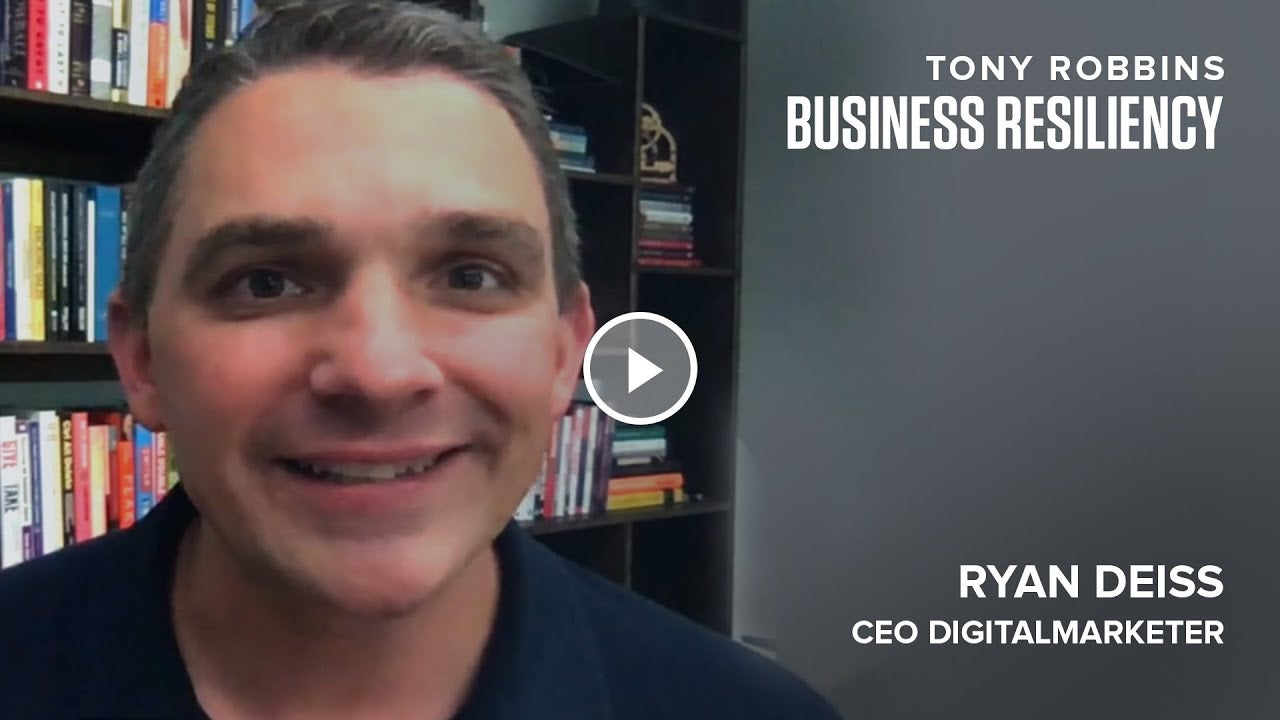
What will you do when the going gets tough? How will you react to economic winter, changes in the market and other events beyond your control? Will you shrink back in fear and adopt an attitude of scarcity – or will you power forward and learn how to take advantage of the moment? Uploaded 28-04-20 In this video, Ryan Deiss, CEO of Digital Marketer, best-selling author and expert investor, shares what you can do to not only continue to grow your business, but to grow as a human being as well. There are ways to make the most of hard times as a business leader, marketer, parent and friend. It’s all about turning your obstacles into opportunities. How can you do that? You must shift your focus. Instead of focusing on the negative, find the possibilities. You can head to https://www.tonyrobbins.com/career-business/where-focus-goes-energy-flows to learn how to get focused in this new environment. Tough economic times put most people in a mindset of scarcity and fear. They pull back. Business
Alex and Sam cover Claude Code 2.1.329 and a review workflow that names the pull request, pins the changes, separates findings from tests and checks that the right code was examined. All worked scenarios are hypothetical. Includes a Railway affiliate advertisement. Sources: https://github.com/anthropics/claude-code/releases/tag/v2.1.329 Includes a Railway affiliate advertisement. Find our links at https://aishows.cc; we may earn a commission.
Superhuman CEO Shishir Mehrotra joins MTS to discuss the company’s new agent platform, Superhuman Go, and how embedding AI directly into existing workspaces solves the “last mile” problem of enterprise adoption. He also breaks down Grammarly’s custom model infrastructure, the challenge of measuring human-agent productivity, and his prediction for a massive surge in AI inference over the next year. -- MTS chronicles the singularity, live. Monitoring the situation of tech and AI. Follow MTS: Spotify |https://open.spotify.com/show/4HUNNmV1pjV7CW6Lphm1rM Apple |https://podcasts.apple.com/us/podcast/mts/id1891088763 – Brought to you by: Mongo DB - Anyone can prototype an agent. Lovable - Turn ideas into software people love with Lovable. Start today at https://lovable.dev/ Factory - A 24/7 system turning signals into production software. Visithttps://factory.com/ Neon (by Databricks) - Scale your startup on Neon. The Postgres backend for apps and agents. Built by Databricks.https://neon.com
Project Synapse: Markets in Freefall, Fragile Infrastructure, and AI's Perfect Storm The hosts banter through the show's intro before focusing on a sense that "things are out of control," citing a WallStreetBets suicide-hotline post amid a market crash and discussing cascading system failures involving Microsoft, the FAA, and a reported NSA internal communications outage. They argue politicians and leadership lack technical competence and clear messaging, increasing panic, while emphasizing that many problems stem from aging, underfunded infrastructure and complex, brittle software (PHP, NGINX, Java), not proven AI attacks—more a "perfect storm" of crises. They debate whether AI should help fix complexity, stressing critical thinking, accountability, and using multiple AIs to verify each other. In a lightning round they cover Anthropic's IPO performance, mixed reactions and token limits with ChatGPT 6.2 (favoring "Sol" over "Astra"), Google's cheaper Neon model and confusing UX, Loblaw
An optional overtime shift opens up and you automatically say yes. What is that time buying? The income and the hours you trade both deserve a clear purpose. In this episode of The Level Up Podcast, Paul Alex breaks down how to evaluate a genuinely optional extra shift against your needs, goals, and available time. Paul reflects on long law enforcement weeks and wanting greater control over his time. The episode distinguishes a real choice from required work or income needed for essentials, then asks what the next additional shift serves. There may be a strong reason to take it. Name that reason and consider what the hours would otherwise support, including recovery, a personal commitment, or learning. A deliberate comparison can help you decide without assuming that either money or time should always win. In this episode, you’ll learn: • Why required hours and essential income change the context of the decision. • How to identify the specific need or goal an optional shift serves. • W
In this video, Disability Attorney Walter Hnot of the Disability Resolution Law Firm goes over the positives and negatives of privatized social security benefits, with AI program projected monthly check amounts. America’s Most Viewed Social Security Disability Attorney Like the content? Review us here: https://g.page/r/CcwyektC7nCPEAg/review . If the link does not work, Google: Disability Resolution, P.A. Welcome to the largest Social Security Disability Tutorial Video Library On Earth. PRIVATE ONE HOUR SESSION PHONE CALL NEED MEDICARE? I don’t do it, but I trust these folks to help you. Call Chapter Medicare at 339 226 6287, or use askchapter.org/disability (* Note Below) THIS IS HOW YOU CAN GIVE BACK TO HELP GROW THE CAUSE: Option 1: Leave 5 |==================5 STAR REVIEWS==================| Google (Search Disability Resolution Orlando, FL)- https://g.page/r/CcwyektC7nCPEAg/review AVVO (Search Walter Hnot) - https://www.avvo.com/attorneys/32817-fl-walter-hnot-4523042/reviews.html B
What happens when employees hate an AI tool with an 87% approval rating? In this episode, Chris sits down with Matt Harvey, co-founder and CTO of Coastline Academy, to explore AI for business operations through the experiments that failed and the applications that worked. Matt explains why an internal AI support chatbot damaged employee trust, how customer interviews revealed overlooked business opportunities, and why individual AI productivity and company-wide AI adoption require different approaches. The conversation explores AI workflow automation through daily instructor schedule audits, task discovery, and human-in-the-loop validation. Matt shares how controlled pilots, ongoing monitoring, and direct employee feedback help teams assess whether automation actually improves their work. He also discusses Wispr Flow, Claude Artifacts, and proactive AI assistants. Listen to learn how to identify useful automation opportunities, protect employee trust, and give managers more time to sup
Punishments should be evaluated by their effect on future harm, not only their severity.
Share your view, then see how readers voted. No sign-in required. This poll is shared across stories.
Do you agree or disagree?
Common Quandary
A Common Quandary to discuss
Another conversation to explore, separate from this news story.
Your boss offers lessons to make you sound “more professional.” Do you take them?
Clients sometimes ask an employee to repeat themselves during calls. Their manager offers company-paid speech coaching framed as clearer communication, but the employee experiences the request as pressure to hide part of their identity.
When does improving communication become demanding conformity?