How to Scale a Business to £1 Billion in the UK | Octopus Energy & HomeServe Founders
70 min
Listen through the publisher, then discuss the episode here or arrange an in-person Roundtable. Your city determines where to meet.
Roundtables are designed for groups of four, with a shared subject and room for everyone to speak. Come for discussion, with no dating expectation.
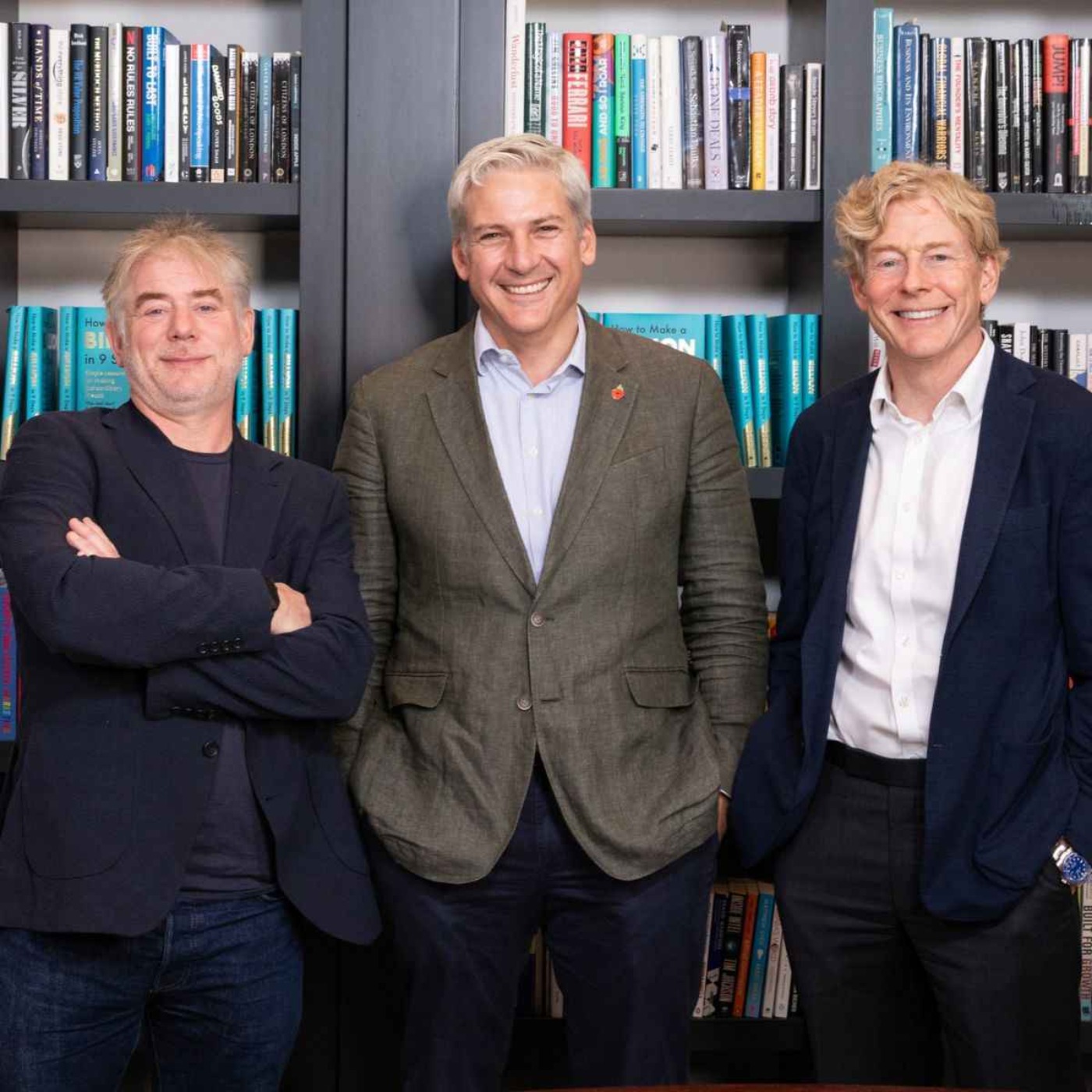
How do you build a £1 billion business in the UK? James Whittaker, Deutsche Bank’s head of wealth management business in the UK and Nordics, asked two founders who succeeded – Sir Richard Harpin, founder of HomeServe and host of the Business Leader podcast, and Greg Jackson, founder and CEO of Octopus Energy. Do founders need to study at university, think globally, stay focused on the core business or even do without an HR department in order to achieve unicorn status? Jackson argues for more investment in British businesses, warns of a £2 trillion gap in pension fund investment in British companies and calls for a 100-day plan to fix it. Harpin calls for stamp duty on shares to be scrapped to revive the London Stock Exchange, explains why he refused to sue a HomeServe copycat in India, and argues for investment to help scale-ups accelerate from £100m to £1bn. Plus: why entrepreneurship “isn’t good for you” and “it’s not a rational decision”, AI’s impact on the next generation of unicorns, and the businesses on the UK Billion Pound Business list they most admire. Take a look at the list of UK Billion Pound Businesses here (https://www.businessleader.co.uk/ukbpb) and sign up to our free weekly newsletter at businessleader.co.uk/newsletters (https://www.businessleader.co.uk/newsletters). Hosted on Acast.
Episode information is provided by the publisher. Listening takes place on the publisher’s service.
If you’re a business owner, then you know the power of developing and executing a world-class marketing strategy. But how do you go about creating the world-class marketing plan that will set you apart from your competition? How do you find and convey your unique selling proposition? Uploaded 08-10-19 Marketing isn’t just about doing something unique – it’s about adding more value than anyone else in the game. Doing more for your customer than anyone else. And in this episode, we’re taking you to Business Mastery, where you’ll hear Tony speak with Darcy: a woman who is struggling to find her niche, even despite an impressive resume of clients. Darcy runs a successful production company that works with some of the biggest companies around the world. But up to this point, Darcy has relied on word-of-mouth to propel her business’s growth. And while her referrals have gotten her up to a certain point, it’s not enough to create the massive impact that she longs for. She needs a world-class
The legal profession is standing at its most pivotal crossroads in centuries. Artificial Intelligence is reshaping the practice, business, and liability profile of the global legal sector. But when the gavel comes down, who will ultimately be holding it, human hands or artificial code? AI’s impact on law is not a new conversation. Five years ago, the Law Society predicted that by 2030, everyone might have access to a 'free' legal assistant, akin to a Siri for law. That same projection warned of a potential de-skilling of the workforce and a complete overhaul of legal compensation models. So today are those predictions becoming operational realities? What are the pros and cons of letting Artificial Intelligence into our legal world and how do we capitalise on the benefits while safeguarding our legal institutions, the rule of law and society itself? Joining our host, Tom Parker, is Ross McNairn, Co-Founder and CEO of Wordsmith, Professor Richard Susskind CBE, Author and President of the
You've gotten very good at pretending you don't feel it. Uploaded 21-08-26 Maybe it's a conversation with someone you love. Someone you work for. A partner, a parent, a friend who's been quietly taking more than they give. Or the hardest one of all — a conversation with yourself, the one where you finally admit something you've refused to say out loud for years. You know exactly which one I'm talking about. You felt it the moment I said the word. A name came up, or a face, and your stomach did something small and unpleasant, and you pushed it back down where it's been living. That flinch is the most honest thing that's happened to you all day. Here is the truth: the life you say you want — the freedom, the peace, the relationship, the income, the respect — there's a very good chance it's on the other side of one conversation you keep refusing to have. Not ten. One. This seminar unpacks the single mechanic behind a stuck life: the necessary conversation you keep treating like a locked d
How big could the gold system at Kirkland Lake Discoveries' Murdock Project become? CEO Stefan Sklepowicz joins Trevor Hall at the Deutsche Goldmesse in Frankfurt to discuss the company's expanding gold discovery in Ontario's Abitibi Greenstone Belt, including a recent drill intercept of 9.2 meters grading 10.5 g/t gold at Murdock West. With mineralization now identified across a 1.7-kilometer east-west footprint, management is prioritizing the discovery's overall scale before defining a maiden resource estimate. Sklepowicz explains the potential for a large bulk-tonnage gold system with higher-grade zones, the company's aggressive drilling strategy, and plans to expand its core processing capabilities to accelerate exploration results. The conversation also covers approximately 30 pending drill holes, the potential for a maiden resource in 2027, and how a C$21 million treasury positions Kirkland Lake Discoveries to continue advancing the project through a challenging market for junior
This episode was sponsored by Cardiff LightSpeed VT: https://www.lightspeedvt.com/ Dropping Bombs Podcast: https://www.droppingbombs.com/ Today's Dropping Bombs episode features Ran Grushkowsky, the Berkeley dropout who sold his first company at 16, exited fintech, and lasted two and a half weeks in retirement. Now he runs MassPay, a profitable, bootstrapped payments company on track to move $1 billion a month. Ran breaks down why prepaid cards and paper checks are losing to instant payouts, how AI routes every payment through the best bank in real time, and how paying people faster can turn a cost center into a profit center. Most companies treat paying people like a chore. Ran says that mistake gets expensive within two or three years. If your payout system hasn't changed lately, press play before it costs you. Connect with Ran LinkedIn: https://www.linkedin.com/in/rangrushkowsky X: https://x.com/egblue Additional Resources MassPay: https://masspay.io (https://masspay.io/) MassPay on
Clark dives into an alarming new study from the American Heart Association linking popular energy drinks to serious cardiac issues (https://nypost.com/2026/11/07/health/energy-drinks-linked-to-heart-attacks-cardiac-arrest-in-young-adults-study/?preferred_app=nypost) in young adults, breaking down the risks behind the massive caffeine spikes and unregulated stimulants flooding store shelves. Plus, the era of constant job hopping (https://www.kiplinger.com/personal-finance/careers/costs-of-job-hopping-staying-put-pays-off?lrh=72f38a53da1d858f1a5e4054a55410d9173306dca3f7de1790f09727af0cd14d) is officially catching up to workers: Clark explains why chasing short-term pay bumps may now be stalling your career, putting you first in line for layoffs, and why playing the long game with company roots can protect both your wallet and your future. Plus, Christa shares your #AskClark questions and Clark gives his take. All this and more on the November 23, 2026, episode of The Clark Howard Show. S
Cécile Coutens, President of Royal Canin, talks to Sir Richard Harpin about how a French vet's idea became a pet nutrition business sold in 120 countries, and what it takes to scale it inside Mars. Coutens has spent 23 years at Mars and is the first woman to lead Royal Canin. She talks about the shift from brand management to running a business, leading a global team, building trust with vets in a social media world, and where pet care goes next. She also explains how Royal Canin has grown to more than twice its size in the 11 years since she joined, how she thinks about competition from fresh-food challengers and Mars' own brands, and how she looks for curiosity when recruiting. Across nutrition and vet care, she says, Mars serves around half of the world's pets. On leadership, she says it is "more powerful when it's shared" and “diversity drives results”, and she empowers her ten-strong team to act as co-presidents rather than function heads. And, what does she feed her own cat and a
Eva Alexandridis is the co-founder of 111SKIN, the luxury clinical skincare brand favoured by Lady Gaga, Margot Robbie, and Victoria Beckham, and stocked at Harrods, Selfridges, and Bergdorf Goodman. In this episode, Alexandridis joins Sir Richard Harpin to trace her journey from growing up behind the Iron Curtain in Bulgaria, to working at Silicon Valley startups during the dot-com boom, to co-founding 111SKIN, the doctor-driven skincare brand, with her husband plastic surgeon Dr. Yannis Alexandridis, in London. Alexandridis reveals why she refused to sell 111SKIN anywhere but her husband's Harley Street clinic for the first few years, and what changed her mind after years of resisting outside investment, leading her to agree to Estée Lauder taking a minority stake. She shares her advice for founders on patience, scaling, and avoiding the "fast beauty" trap and reflects on treating every failure as a learning opportunity. Alexandridis also explains why she deliberately avoided over-ex
Removing outdated rules is worthwhile even when it reduces some existing protections.
Share your view, then see how readers voted. No sign-in required. This poll is shared across stories.
Do you agree or disagree?
Common Quandary
A Common Quandary to discuss
Another conversation to explore, separate from this news story.
Your neighbor keeps playing music at midnight. How many friendly warnings do they get?
A neighbor regularly plays music late enough to disturb your sleep. Friendly requests help briefly, but a formal complaint could threaten their lease in a building with few affordable options.
How far should empathy extend when someone repeatedly ignores your needs?