Israel Warns of Iranian Chemical Weapons, NATO Warns Poland, and the New Congress | Mike Drop Newsroom
22 min
Listen through the publisher, then discuss the episode here or arrange an in-person Roundtable. Your city determines where to meet.
Roundtables are designed for groups of four, with a shared subject and room for everyone to speak. Come for discussion, with no dating expectation.
Democrats won control of Congress, putting war funding for the Iran conflict on the table, while Israel warns that Iran is weighing chemical weapons. MIKE DROP NEWSROOM | 4 NOVEMBER 2026 Democrats won control of both the House and Senate on Tuesday. Current government funding runs out December 11, and the new Congress is sworn in January 3, with Democrats promising bills to end the Iran war. Meanwhile, Israel has told the U.S. and Gulf states that Iran is considering chemical weapons if full-scale fighting resumes, though some U.S. officials doubt the intelligence. Mike Ritland breaks down why the short window before the funding deadline could raise the risk to U.S. troops, what a chemical weapons threat would mean for forces in the region, and why both parties should treat the election as a lesson, not a victory lap. Also covered: an update on the EUCOM warning to troops and families in Europe, Poland reinforcing its border with Russia after a warning from NATO's top commander, and Trump saying $4 billion a year in military aid to Israel will end. Is Israel's chemical weapons warning a credible threat, or a push to pull the U.S. back into the fight? Tell us in the comments. Want ad-free Newsroom updates? 0:00 Democrats win Congress; war funding deadline December 11 0:45 Mike's take on the election 9:15 Update: the EUCOM warning in Europe 11:50 Israel warns Iran is weighing chemical weapons 16:20 Poland reinforces its border after NATO warning 18:55 Trump says $4 billion a year in aid to Israel will end 20:30 Wrap-up Privacy & Opt-Out: https://redcircle.com/privacy
Episode information is provided by the publisher. Listening takes place on the publisher’s service.
This week on The Necessary Conversation, it's Chad, Haley, and Mary Lou. Bob is still recovering but sent in a video message about Trump calling Putin his friend that we watch together. 🇷🇺 Trump held the first-ever three-way talks with Putin and Xi, called it a "12 out of 10," and produced nothing. Then at a press conference he called Putin his friend — and when asked if Putin is a friend to America, the president of the United States said, "I can't speak to America." That same day, Trump's friend Putin launched massive strikes into Ukraine, hit Poland with two missiles — an act of war against a NATO ally — then struck near a Ukrainian restaurant and drone-bombed the first responders, killing a 7-year-old child and a 20-year-old paramedic. We watch Bob's video and ask Mary Lou: is Russia our friend? 🇨🇳 The House Foreign Affairs Committee revealed Trump's Commerce Department approved nearly 880,000 advanced AI chips for Chinese military-linked companies including Alibaba, Tencent, a
For review: 1. Iraq has reached a compromise with the powerful Iran-backed militia Kataeb Hezbollah, three senior security officials said, after Prime Minister Ali al-Zaidi readied security forces to move against the group. Reflecting the gravity of the situation, Iraqi Shiite political sources said Esmail Qaani, commander of Iran’s elite Revolutionary Guards’ Quds Force, arrived in Baghdad late on Monday to help defuse tensions with Kataeb Hezbollah, Tehran’s most powerful militia ally in Iraq. 2. Lebanese President Joseph Aoun launched a lengthy rebuke of Iran in an Independence Day address, arguing that the Islamic Republic does not have the right to interfere in Lebanon’s internal affairs, as it long has via support for its local terror proxy, Hezbollah. 3. Yemen’s Houthis launched strikes on the Saudi capital Riyadh on Saturday, after vowing reprisals for a “special operation” by the Saudi-led coalition fighting them. The coalition later said it had “intercepted and destroyed” thr
November 20, 2026 On November 19, Trump met with Xi Jinping and Vladimir Putin in Shenzhen, China, The fact that the president of the US would meet with leaders of China and Russia was bizarre since both China and Russia have been helping Iran in its current fight against the US, Trump appeared to want the fanfare and President Xi played that up, Putin wanted the meeting because it would suggest that Russia was a great power, although it is far from being so and Putin’s war on Ukraine is going poorly, The meeting’s purpose seemed to be to produce propaganda for each of the three leaders, Beyond the propaganda is the larger story of the destruction of the post-World War II rules-based international order, In its place is the idea of dividing the world into spheres of influence, The three leaders met for 90 minutes and issued only a vague "joint declaration toward peace," which vowed to reform the UN and weaken the International Criminal Court, where Putin is already under indictment for
Melania Trump faced fresh questions over the Jeffrey Epstein files, while Hakeem Jeffries confronted growing resistance to his bid for House Speaker. In an exclusive interview with Don, Rep. Robert Garcia discussed the battle for Democratic leadership, the fight to release millions of pages of Epstein-related documents, and his plans to hold the Trump administration accountable. Garcia addressed the possibility of subpoenaing First Lady Melania Trump as questions continued over her past acquaintance with Ghislaine Maxwell and claims made by Jeffrey Epstein. Meanwhile, Democrats faced an internal leadership showdown. Progressive lawmakers were withholding support from Hakeem Jeffries, Ayanna Pressley's name was being floated as a possible alternative, and Senator Chris Van Hollen was challenging Chuck Schumer for Senate leadership. Don also examined the White House's warning to Democrats pursuing investigations and asked whether the incoming congressional majority was prepared to use it
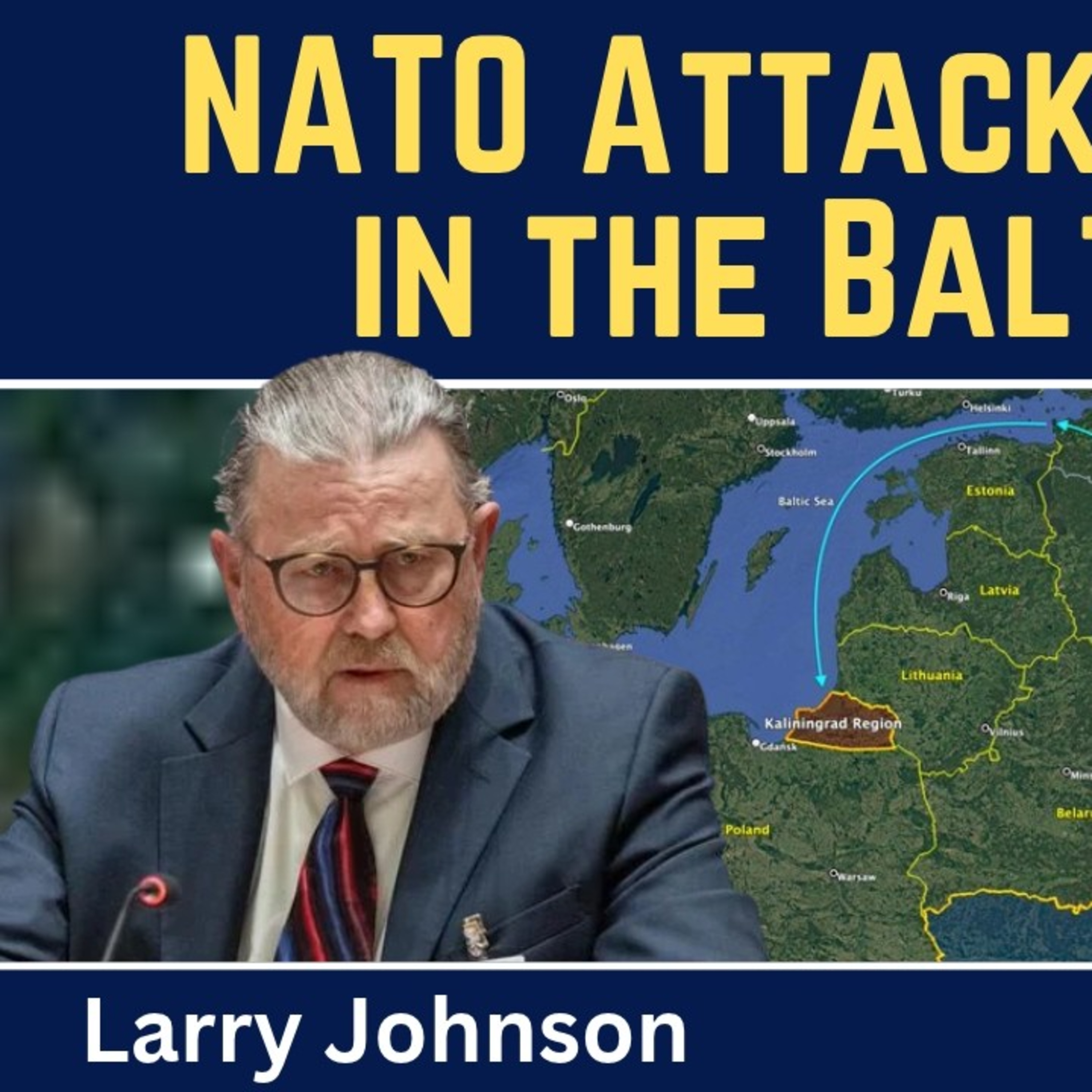
Larry Johnson is a former CIA intelligence analyst who also worked at the U.S. State Department's Office of Counterterrorism. Johnson discusses the attack on a Russian cargo ship in the Baltic Sea, and the air alarms going off in Kaliningrad. Read Larry Johnson's Sonar21: https://sonar21.com/Follow Prof. Glenn Diesen: PayPal: https://www.paypal.com/paypalme/glenndiesenBuy me a Coffee: buymeacoffee.com/gdiesengGo Fund Me: https://gofund.me/09ea012fBuy Diesen merchandise: https://diesen-shop.fourthwall.com/en-nokBooks by Prof. Glenn Diesen: https://www.amazon.com/stores/author/B09FPQ4MDL 00:00 Escalating Tensions in the Baltic Sea02:45 NATO's Role and Russia's Response05:52 The Shift in European Attitudes Towards Russia09:11 Cultural Influences on Perceptions of Russia11:44 The Consequences of Military Escalation15:06 The Irrelevance of Europe in Global Politics25:49 Reassessing Global Power Dynamics32:44 The Role of Europe in a Changing World39:19 The Impact of Economic Interests on Pol
A wave of major technology outages is raising troubling questions about America's cybersecurity, aging infrastructure, and readiness for a new era of artificial intelligence. Are these isolated technical failures, or warning signs of a much larger national security problem? John Solomon and Amanda Head welcome Ohio Congressman and former Army Ranger Warren Davidson, who discusses recent disruptions involving the FAA, Microsoft, and other critical systems. Davidson calls for greater transparency from government agencies and technology companies, questions whether America's infrastructure is adequately protected against emerging cyber threats, and examines how artificial intelligence could be used both to strengthen defenses and exploit vulnerabilities. The conversation also turns to immigration and national security, with Davidson raising concerns about individuals who entered the country illegally, potential gaps in government screening systems, and the surveillance powers used to moni
Iran fired on Bahrain again Saturday and says this time it was aiming at the American Patriot crews that protect U.S. bases there. MIKE DROP NEWSROOM | 22 NOVEMBER 2026 ABC News reported that Iran's Revolutionary Guard said its Saturday attacks targeted U.S. Patriot air defense sites in Bahrain, home of the Navy's 5th Fleet. The U.S. has not confirmed any hits. Bahrain said a civilian industrial facility caught fire; reports on injuries are still unsettled. U.S. Central Command called an IRGC claim that it damaged a U.S. F-16 false, saying all U.S. fighter jets in the region are safe and accounted for. Mike Ritland breaks down why Iran would announce that it's going after the crews themselves, how this fits a steady escalation since November 13, and why sitting in place with no decision may be the worst option for the troops in harm's way. Also covered: the U.S. and Israel weighing a new assault on Iran, two tankers hit on the U.S.-guarded side of the Hormuz route, a report on China's
Iran says it shot down a U.S. drone over the Strait of Hormuz as CBS News reports the U.S. and Israel are weighing a new assault on Iran. MIKE DROP NEWSROOM | 21 NOVEMBER 2026 Iranian state TV claimed Saturday that Iran downed a U.S. drone near Qeshm Island; the U.S. has not confirmed it. CBS News reported, citing sources, that the U.S. and Israel are considering a new assault in the short term, driven by Israeli concern over how fast Iran is rebuilding its missile production and moving sites underground. President Trump told Israel's Channel 12 he is not rushing any decision. At the same time, the New York Times reported Israeli warnings that Iran has made progress on chemical and biological weapons and could use them against U.S. officials, though some U.S. officials doubt those warnings. Mike Ritland breaks down why a single intelligence source shouldn't drive a decision this big, how corroboration works when lives are on the line, and what would actually change his mind. Also cover
Hours after U.S. fighter jets struck Iranian missile launch sites on Qeshm Island, drones came at American bases in Bahrain and Kuwait, and Iran's army chief is promising a more decisive response to the next U.S. move. MIKE DROP NEWSROOM | 18 NOVEMBER 2026 Central Command says IRGC one-way attack drones launched toward Bahrain were intercepted with no damage to U.S. equipment and no injuries to American personnel. ABC News counts it as Iran's third strike on Bahrain in about a week. Kuwait's air defenses were also knocking down drones overnight, Al Jazeera reported, though Kuwait has not said where they came from. Mike Ritland breaks down what it means that Kuwait is now in the picture, including Ali Al Salem Air Base, the base U.S. forces launched from during the 2003 invasion, why the real question is how many incoming drones our air defenses can handle at once, and why nobody can explain the strategy behind waiting. Also covered: three carrier groups and new mines in the Strait of H
People of different beliefs should be able to cooperate without agreeing on fundamental questions.
Share your view, then see how readers voted. No sign-in required. This poll is shared across stories.
Do you agree or disagree?
Common Quandary
A Common Quandary to discuss
Another conversation to explore, separate from this news story.
Someone reserves the best gym machine with a towel. When may you move it?
At a crowded gym, a towel has occupied the most popular machine for fifteen minutes while its owner chats across the room. Gym rules prohibit reserving equipment, but everyone occasionally steps away between sets.
How long may convenience masquerade as continued use?