English-language podcasts

Hidden Killers With Tony Brueski | True Crime News & Commentary

Lindsay Clancy and Lori Vallow: What Each Judge Got Wrong

62 min

Listen through the publisher, then discuss the episode here or arrange an in-person Roundtable. Your city determines where to meet.

Roundtables are designed for groups of four, with a shared subject and room for everyone to speak. Come for discussion, with no dating expectation.

Lindsay Clancy's judge took a juror at his word after getting two notes from his foreperson saying the man wouldn't follow the law. Lori Vallow Daybell's judge took her lawyer away while she sat in a mental hospital. On November 2nd, both cases were in front of courts that could change the outcome. In Massachusetts, prosecutors confirmed they'll retry Clancy but won't say the charge. The holdout juror had a phone during deliberations, his questionnaire is sealed, and Sullivan won't investigate. In Idaho, the Supreme Court heard argument on whether removing Mark Means violated Lori's right to choose her own attorney. Her lawyer admits Means made a mistake that forces the appeal onto the hardest test in the law and told the justices she knows a win could bring back the death penalty. Motta and Dreeke on all of it. Listen Anywhere You Get Podcasts: https://pod.link/1655749292 Want to comment and watch this podcast as a video? Instagram https://www.instagram.com/hiddenkillerspod/ Facebook https://www.facebook.com/hiddenkillerspod/ Tik-Tok https://www.tiktok.com/@hiddenkillerspod X Twitter https://x.com/tonybpod #LindsayClancy #LoriVallowDaybell #HiddenKillers #BobMotta #RobinDreeke #TrueCrime #PlymouthCourt #IdahoSupremeCourt #MurderTrial #Retrial

Episode information is provided by the publisher. Listening takes place on the publisher’s service.

Listen at the source ↗

Featured places to meet in Palo Alto, CA

Explore these places and arrange a conversation through ThinkMatch.

City guide for Palo Alto, CA

More from Hidden Killers With Tony Brueski | True Crime News & Commentary

Hidden Killers With Tony Brueski | True Crime News & Commentary

Sandra Birchmore Conviction Exposes WHAT About Old Cases?!

27 min

Matthew Farwell’s conviction settled the federal case against him. It did not settle what may have happened to evidence, what other officers knew, or how many cases depended on his work as a Stoughton police detective. Tony Brueski is joined by retired FBI agents Jennifer Coffindaffer and Robin Dreeke to connect two questions that belong together: could there be more arrests in the Sandra Birchmore case, and should prosecutors review the cases Farwell once investigated? These are not the same question, and neither has an automatic answer. William Farwell, Matthew’s twin, testified under federal immunity. Former Stoughton deputy chief Robert Devine has contested an oversight board’s findings concerning the “Marty Riggs” Facebook account, saying he was hacked. Neither has been charged in Sandra’s death. Coffindaffer lays out what investigators would need: corroborated communications, authenticated account access, consistent timelines and proof of each person’s conduct. Knowing somebody i

Discuss this episode

Hidden Killers With Tony Brueski | True Crime News & Commentary

Alex Murdaugh’s Shirt: The Test That Changes WHAT?!

39 min

Alex Murdaugh's murder retrial has a new question hanging over it, and it starts with a shirt. The defense says SLED's lead agent, David Owen, described blood spatter to the grand jury even though the agency's own lab had found no human blood in tested stains. It also challenges his claim that shotguns at Moselle were loaded like the weapon used to kill Paul. At the November 13 hearing, Judge Debra McCaslin heard the arguments and did not toss the charges. She said she would try to issue a written decision by November 20. Before adjourning, she asked whether prosecutors could return to a grand jury and keep the April 5, 2027 retrial date. That's a practical question, not a verdict about anyone's honesty. Creighton Waters argued that Owen's statements were not intentionally deceptive and that the spatter expert continued to stand by his interpretation. The State also points to the kennel video and other evidence it says supports the indictment. The defense counters that the grand jury s

Discuss this episode

Hidden Killers With Tony Brueski | True Crime News & Commentary

A Clerk Cost Alex Murdaugh His Verdict. A Trust Fight Holds Up Nick Reiner's Lawyer.

61 min

Alex Murdaugh's murder conviction is gone because the Supreme Court found his court clerk, Becky Hill, put her fingers on the scales of justice. Nick Reiner can't bring back the lawyer he wants because the woman running his trust is holding the money until a court decides whether he can inherit from the parents he's accused of killing. Eric Faddis, a defense attorney and former prosecutor, takes on both in this full episode. For Alex, that means the no-blood lab result on his T-shirt, the lead state investigator's grand jury testimony that wasn't true, and why Hill was never charged over the jury. For Nick, it's whether about $558,000 that came due before his parents died is already his, what a private lawyer can do that a public defender can't, and why his heroin history could hurt an insanity defense. Both men are presumed innocent. Alex goes back on trial in April. Listen Anywhere You Get Podcasts: https://pod.link/1655749292 Want to comment and watch this podcast as a video? Instag

Discuss this episode

Community Poll

Public spaces should allow peaceful disagreement while preventing intimidation.

Share your view, then see how readers voted. No sign-in required. This poll is shared across stories.

Do you agree or disagree?

Choose one answer

Common Quandary

A Common Quandary to discuss

Another conversation to explore, separate from this news story.

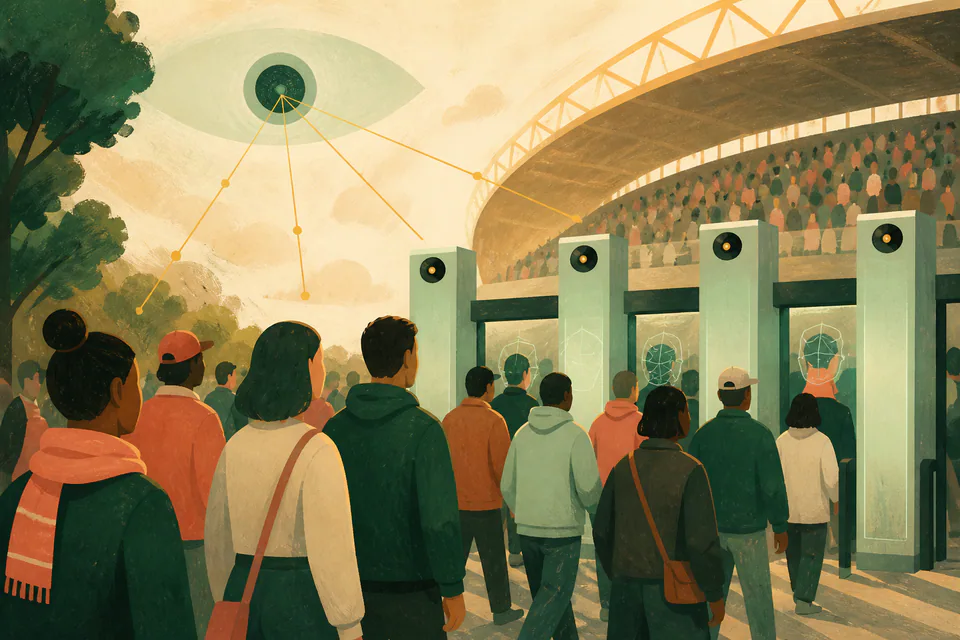
The stadium can ban violent fans by scanning every face at the gate. Would you walk in?

A stadium can use facial recognition to identify people banned for violence and shorten security lines. Every visitor would be scanned, error rates are not zero, and the resulting biometric data could become useful to police or advertisers.

How much privacy may a crowd be asked to trade for collective safety?

Explore this quandary