"Maybe We Shouldn't Be Saying Words like 'Deep Red' Anymore"
56 min
Listen through the publisher, then discuss the episode here or arrange an in-person Roundtable. Your city determines where to meet.
Roundtables are designed for groups of four, with a shared subject and room for everyone to speak. Come for discussion, with no dating expectation.
After what seems like years of defeat after defeat, Democrats are still reeling from this week’s midterms results. The party has repainted the House, the Senate, and numerous Governor's mansions and state capitols blue. But how did we get here? Chris invites MS NOW’s Director of Elections and Analytics, Kabir Khanna, to the show to answer all the election questions that have kept him up at night. What was the defection rate for Republicans? Why did corruption finally resonate with voters? Can we consider any states red or blue anymore? And will life always be this sweet for the Democratic party? Hosted by Simplecast, an AdsWizz company.
Episode information is provided by the publisher. Listening takes place on the publisher’s service.
For nearly a year, a group of friends regularly explored the abandoned buildings of Taunton State Hospital in Massachusetts. They'd been through nearly every part of the property, but one basement remained a mystery, sealed behind a chained and padlocked door. Eventually, curiosity got the better of them. Armed with bolt cutters and flashlights, six friends made their way into the dark basement. At the far end, they discovered disturbing markings and what appeared to be bloodstains. Then one of them claimed something had touched her—and things quickly became terrifying. A piercing screech, flashlights suddenly going dark, and a frightening encounter with shadowy figures sent the group scrambling for the exit. They had spent months exploring the hospital without experiencing anything like it. Had they finally encountered something paranormal, or was there a reason that basement had been locked away? #RealGhostStoriesOnline #TauntonStateHospital #HauntedAsylum #AbandonedHospital #ShadowF
Runaway government spending, rising costs, and a new wave of legal battles over constitutional rights. With Democrats preparing to take control of Congress and several state governments, Republicans are confronting a very different political landscape. John Solomon and Amanda Head welcome Montana Senator-elect Kurt Alme, who says Washington must get serious about reining in spending, lowering inflation, and making everyday life affordable again. Already preparing for his arrival in the Senate, Alme discusses his priorities for protecting Montana's way of life, keeping taxes low, creating good-paying jobs, and working across party lines when possible. He also addresses the challenges Republicans face in the minority, the remaining lame-duck session, and concerns about efforts to expand the Supreme Court and eliminate the filibuster. Then, Southeastern Legal Foundation President Kimberly Hermann joins the show with a warning about potential policy reversals in states where Democrats have
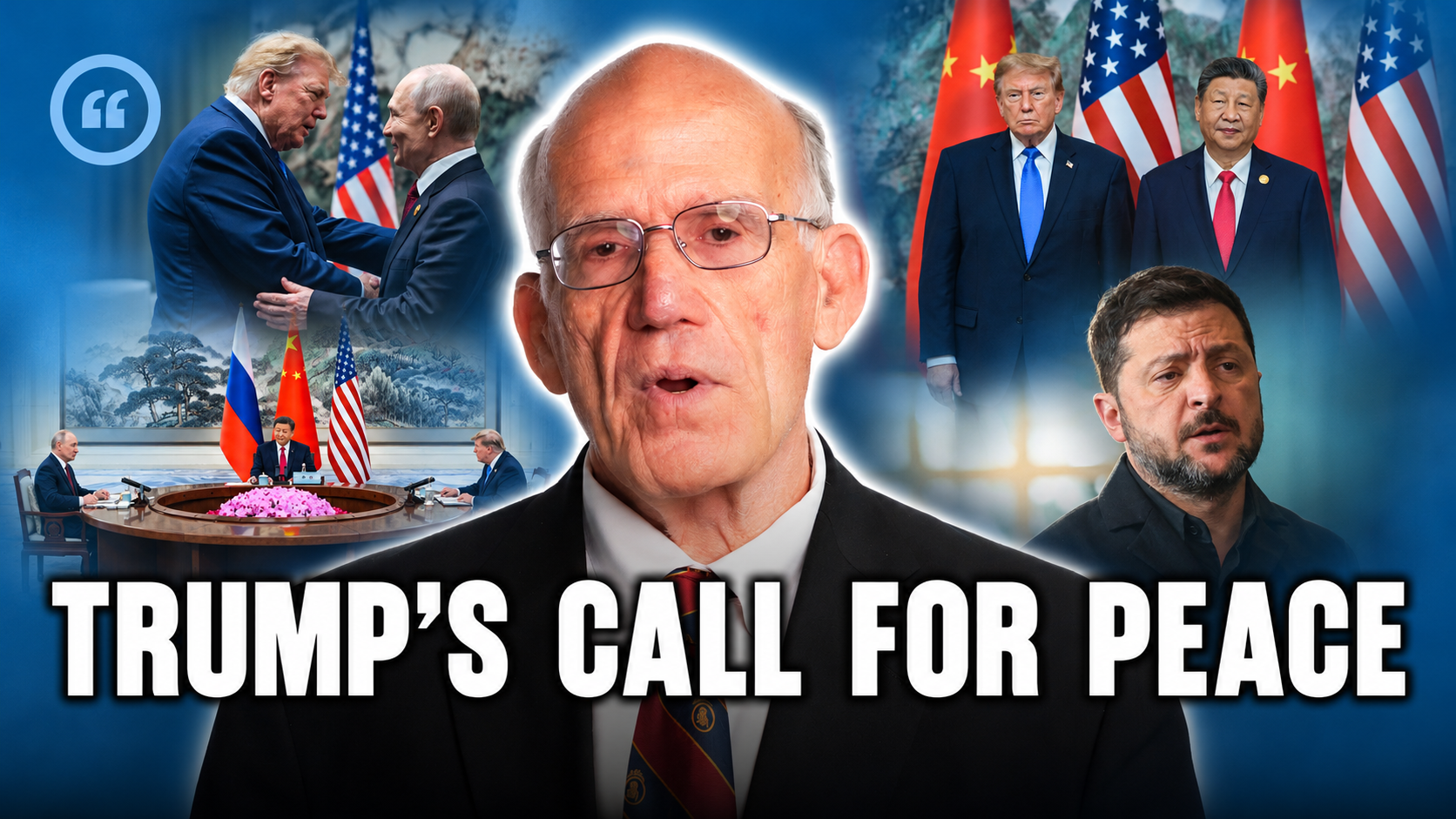
President Donald Trump's first ever trilateral summit with Vladimir Putin and Xi Jinping raises questions about the future of the war in Ukraine and whether a peace agreement could finally be within reach. Victor Davis Hanson and Sami Winc examine the summit on today’s edition of “Victor Davis Hanson: In His Own Words,” discussing Russia's declining influence, potential territorial concessions in Ukraine, and Europe's frustration over Trump's peace negotiations. Hanson criticizes Hillary Clinton's attacks on Trump's diplomacy; he also argues that European leaders have weakened their influence by neglecting defense spending and relying on American military protection. They discuss Elon Musk's shifting political allegiances, and Hanson warns that distancing himself from MAGA may not protect him from Democrat investigations. They also discuss the potential economic benefits of artificial intelligence and the challenges facing Hakeem Jeffries as Democrats prepare to take control of the Hou
After some life updates (which is all the people really want to hear anyway), Jonah Goldberg turns his hand to ruminating on Trump’s villainous stupidity, the trilateral summit with Vladimir Putin and Xi Jinping, nuclear policy, New York City’s supermarkets, socialist contempt for the middle class, GDP, Ro Khanna, the Bulwark squabble, recent tech failures, the National Popular Vote Interstate Compact, and magical thinking about politics. Show Notes: —LFG AO Pod (https://thedispatch.com/podcast/advisoryopinions/should-lame-ducks-hibernate/) —Special Event: Advisory Opinions: Live! (https://www.capcitycomedy.com/shows/393484) —Mamdani on supermarkets (https://x.com/MorePerfectUS/status/2123188786926391338/video/1) —Irving Kristol in The Public Interest: “Rationalism in Economics” (https://www.nationalaffairs.com/public_interest/detail/rationalism-in-economics) —American Compass’ postelection survey (https://americancompass.org/post-midterm-survey/) —Dan Senor Remnant (https://thedispatc
Could an AI model ever be conscious? And if it could, how would we know? The Interface hosts, Thomas Germain and Jessica Maddox, unpack the theories with philosopher Jeff Sebo, director of the Center for Mind, Ethics, and Policy at New York University. Jeff does not claim that AI is conscious, and he is clear that nobody knows. His case is that the possibility is serious enough to study properly and prepare for now, rather than scrambling after the fact, as we did with animals and the climate. Along the way, he explains what consciousness and sentience actually mean, why “it’s just software” is not the end of the argument, and why the idea makes so many people so angry. Tom and Jess push him on the big objections - shouldn’t we fix problems impacting humans first, and can we trust AI companies to answer any of this?
Episode 676 of the Sports Media Podcast with Richard Deitsch features Jon Lewis, editor and founder of Sports Media Watch and Austin Karp, the media writer for Sports Business Journal. In this podcast, we discuss Troy Aikman's recent comments about Joe Buck, saying "Joe’s always wanted a one-man booth"; ESPN chairman Jimmy Pitaro discussing Buck and Aikman at the SBJ Media Innovators conference; whether these new comments will impact the Super Bowl; the bidding for the men's World Cup, with Amazon, Netflix and Fox/Univision submitting bids; ESPN wanting the World Series; the NFL and Fox getting 12.15 million viewers on a Sunday morning for Lions-Patriots; the NFL admonishing on-air hosts Mike Florio and Chris Simms for joking allusions to Nazi Germany; Dianna Russini's second show; the "Madden" movie getting massively panned and more.
America is investing in artificial intelligence more than any technology ever. But while AI is everywhere in society nowadays, the technology – and therefore the future of our economy – is controlled by just a few dozen people. Which leads to the question: can we trust the current infrastructure of the AI industry as it continues to evolve its learning mechanisms? Writer and podcaster Kevin Roose rejoins the program to give us a roadmap on how we got to today and why people need to start thinking about AI in the same way the world looked at the advent of nuclear weapons during World War II. “ We now see the mushroom clouds,” warned Roose. “ You have to take the risk seriously.” NOTE: This episode was recorded before news about Jensen Huang's alleged affairs broke publicly and before his ouster from Nvidia. Hosted by Simplecast, an AdsWizz company.
“Due process is not something that you grant people because you like them,” Rachel Maddow reminded an audience at George Washington University. This past weekend, she joined Chris to talk about her new book, “Department of Fate: The Promise, the Power, and the Collapse of America's Most Consequential Institution,” and to reflect on the ways in which President Trump has weaponized the Department to target political enemies. The two also considered whether we can expect a return to the rule of law thanks to the midterms’ “blue wave.” Hosted by Simplecast, an AdsWizz company.
This week Americans are voting for thousands of candidates, but one issue has dominated almost everybody’s campaign: affordability. And one thing that millions of Americans have struggled to afford for decades is healthcare. This political moment just might be a window of opportunity to make high quality, affordable, universal healthcare a reality in America. The latest season of “The Big Dig” podcast looks at how Mitt Romney and Ted Kennedy made Romneycare happen in Massachusetts in the early 2000s – prefiguring Obamacare. The Peabody Award-winning host of “The Big Dig,” Ian Coss, joins Chris to imagine a future where Congress can achieve policy-driven change that has long been standard internationally. “Where is the laboratory right now for the next time that actual national health reform is possible?” asked Coss. “ I find myself thinking about, where is the energy? Where is that alignment happening right now?” Hosted by Simplecast, an AdsWizz company.
Travel providers should disclose meaningful environmental impacts alongside prices.
Share your view, then see how readers voted. No sign-in required. This poll is shared across stories.
Do you agree or disagree?
Common Quandary
A Common Quandary to discuss
Another conversation to explore, separate from this news story.
You paid extra for the aisle seat. Must you trade with a parent?
You reserved and paid extra for an aisle seat on a long flight. A parent asks you to trade for a middle seat so they can sit beside their young child after the airline separated them.
When does another person's predicament become your responsibility?