Listen through the publisher, then discuss the episode here or arrange an in-person Roundtable. Your city determines where to meet.
Roundtables are designed for groups of four, with a shared subject and room for everyone to speak. Come for discussion, with no dating expectation.
Today's Post - https://bahnsen.co/4A5IXRo David recaps a volatile market session in which the Dow finished up while the S&P 500 and Nasdaq reversed to close lower, extending October’s sharp rotation and market broadening as mega-cap AI/tech names fell while most stocks and sectors rose. He highlights big declines in Nvidia, Meta, and Google, Intel’s steep drop, and OpenAI raising less than targeted at a lower valuation as potentially important for AI financing and broader credit narratives, pushing back on claims the S&P is now “cheap.” He notes the 10-year yield falling to 4.91%, oil dropping 8% (with energy still the top 5-year gainer), a major $6.3B Binance hack, and Fitch reporting a 6.3% private credit default rate. He previews election-focused investor implications, reviews GDP/ISM and housing/rent data, discusses shifting December hike odds and the Fed’s sensitivity to financial conditions, and explains why today’s CDS risks differ from 2008. Upcoming: Apple earnings, heavy reporting week, and Friday jobs report. 00:00 Welcome and Agenda 00:52 Market Reversal and Rotation 02:59 Mag Seven Drag Explained 04:22 AI Funding and Valuation Risks 07:18 Rates Sectors and Energy Surprise 08:48 Crypto Hack and Private Credit Check 10:31 Election Preview and Investor Webinar 12:11 GDP ISM Housing and Fed Outlook 16:28 Oil Midstream and Earnings Week 16:52 Ask TBG CDS and Systemic Risk 20:27 Week Ahead and Sign Off Links mentioned in this episode: DividendCafe.com (https://dividendcafe.com/) TheBahnsenGroup.com (https://thebahnsengroup.com/)
Episode information is provided by the publisher. Listening takes place on the publisher’s service.
November 20, 2026: Melissa Lee and the Fast Money traders unpack a brutal market sell-off, NVIDIA’s latest concerns, what's next for Anthropic, Bitcoin’s break below $59,000, and whether healthcare can still offer shelter. The key takeaway: traders see possible near-term bounces, but they remain cautious about unresolved risks in AI, rates, credit, and market leadership. Hosted by Simplecast, an AdsWizz company.
In this video, Disability Attorney Walter Hnot of the Disability Resolution Law Firm goes over EM 24059 and how it will change your access to social security benefit communications. Americas Most Viewed Disability Attorney Like the content? Review us here: https://g.page/r/CcwyektC7nCPEAg/review . If the link does not work, Google: Disability Resolution, P.A. Welcome to the largest Social Security Disability Tutorial Video Library On Earth. PRIVATE ONE HOUR SESSION PHONE CALL THIS IS HOW YOU CAN GIVE BACK TO HELP GROW THE CAUSE: Option 1: Leave 5 |==================5 STAR REVIEWS==================| Google (Search Disability Resolution Orlando, FL)- https://www.google.com/search?authuse... (https://www.google.com/search?authuse...=) AVVO (Search Walter Hnot) - https://www.avvo.com/attorneys/32817-... BBB (Search Disability Resolution Orlando, FL)- https://www.bbb.org/us/fl/orlando/pro... MARTINDALE (Search Walter Hnot Orlando, FL) - https://www.martindale.com/attorney/w... Option 2: Don
Commodities, precious metals, and broader equity markets are caught in a sharp sell-off fueled by a surging U.S. dollar, aggressive Federal Reserve rhetoric, and year-end tax-loss selling. In this Weekend Edition of The KE Report, hosts Cory and Shad speak with Mike Larson (Editor-in-Chief at MoneyShow) and Brien Lundin (Editor of The Gold Newsletter) to separate short-term market panic from long-term fundamentals. Both guests share how they are navigating extreme sentiment swings, fading crowded trades, and identifying overlooked bargains across the resource sector. Segment 1 & 2 - Mike Larson, MoneyShow Editor-in-Chief, kicks off the show to unpack the sharp pullbacks across precious metals, copper, critical minerals, energy, and AI-driven tech stocks, exploring how a surging U.S. dollar and shifting Federal Reserve expectations are driving recent market volatility. Tune in as we discuss whether the recent downturn signals lasting chart damage or a contrarian opportunity to lean agai
November 20, 2026; 3pm: Closing Bell covers a sharp Wall Street sell-off led by AI and semiconductor stocks, with the Nasdaq down more than 5%, NVIDIA under pressure, Anthropic sliding after its IPO, and Bitcoin breaking below $60,000. John Ford and CNBC guests examine leverage, valuation resets, consumer strength, private credit, volatility, and what investors should watch next. Hosted by Simplecast, an AdsWizz company.
Crypto News: Bitcoin, altcoins, and the crypto market crash along with stocks, gold, and silver. Will we see a recovery soon? ️ Learn Crypto with Expert Commentary - http://MyCryptoCourse.com (http://mycryptocourse.com/) iTrustCapital Representative: [email protected] ⭐️ Trade crypto perps with a free $25 bonus on Kalshi. ♂️Merlin - http://tinyurl.com/MerlinTCYouTube “I am a Merlin partner and get compensated for purchases made through links in this content"this content"Follow on social media: ️ X(Twitter) - https://x.com/thinkingcrypto ️ Facebook - https://www.facebook.com/thinkingcrypto/ ️ LinkedIn - http://linkedin.com/company/thinking-crypto ️ Instagram - https://www.instagram.com/thinkingcrypto/ ️ TikTok - https://www.tiktok.com/@thinkingcrypto5 ️ Threads - https://www.threads.net/@thinkingcrypto ️ Website - https://www.ThinkingCrypto.com/ (https://www.thinkingcrypto.com/) Business Inquiries [email protected]⏰ Time Stamps ⏰ 00:00 (https://rumble.com/v7inwo8-da
One week after the U.S. midterm elections, join Valérie Beaudoin, one of Canada's most respected commentators on U.S. politics, for a discussion on how Canadian policymakers and officials are digesting the results in Washington. From the new balance of power in Congress to the potential implications for Canada-U.S. relations, trade economic growth, and cross-border policy priorities, we'll explore what the election outcome could mean for Canada in the months ahead. Recorded on November 10, 2026. -- Optique canadienne sur les élections américaines de mi-mandat – Valérie Beaudoin Pour une version avec des sous-titres français, veuillez consulter Une semaine après les élections de mi-mandat aux États-Unis, Valérie Beaudoin, l’une des commentatrices de la politique américaine les plus respectées du Canada, discute des façons dont les décideurs canadiens et Ottawa ont réagi aux résultats à Washington. Du nouvel équilibre des pouvoirs au Congrès aux répercussions possibles sur les relations
Today's Post - https://bahnsen.co/4AJNLfU David Bahnsen discusses how CEO scandals and departures affect investors, using a recent Nvidia CEO scandal as a catalyst while noting his firm has never owned Nvidia. He argues market reactions often reflect more than the CEO story, citing other uncertainties around Nvidia as well as broader AI ecosystem risks. He contrasts scandal with tragedy through Steve Jobs’ illness and Apple’s successful succession to Tim Cook, and explores different CEO roles (strategist vs operator) with examples including Lou Gerstner at IBM and leadership transitions at Microsoft. He adds that timing and circumstance matter for leaders, using political and business analogies (Reagan, Clinton, George W. Bush, Jack Welch). Bahnsen concludes investors can’t fully know CEO character flaws, so they should prioritize board governance, accountability, and succession planning to minimize distractions and protect long-term value creation. 00:00 Welcome and Setup 00:29 Nvidia
Brian Szytel reviews a sharp market decline on Thursday, November 19, with the Dow down nearly 1,000 points, the S&P 500 down about 1.8%, and the Nasdaq down about 1.9%, marking a sixth consecutive negative S&P session. He discusses Anthropic’s IPO, which opened roughly 34–40% above its offering price but faded into the 90s, and argues that despite the AI narrative, valuations remain stretched, citing revenue multiples and limited profitability. He outlines a long-term framework for growth-versus-value cycles and suggests higher real rates, more traditional Fed policy, and constrained balance-sheet actions could favor value. He answers a question on earnings drivers, emphasizing hyperscaler AI CapEx (increasingly debt-financed) as a key profit catalyst, while deficit spending nets out after trade deficits and savings. He also notes FOMC minutes tilting hawkish, higher jobless claims, and a weaker Philly Fed survey. 00:00 Market Selloff Recap 01:19 Anthropic IPO Whiplash 01:50 Valuation
Brian Szytel delivers the November 18 Dividend Cafe update after a third down day: the Dow fell 561 points, the S&P 500 slipped about 0.25%, and the Nasdaq rose 0.4% on a cybersecurity rally tied to recent Microsoft and FAA disruptions. Despite a positive year for major indexes, he notes increased discernment around AI; Nvidia earnings beat expectations but the stock traded lower, and the upcoming Anthropic IPO is expected near the high end around $80 with only about 6% floated and potential future selling pressure as lockups expire. Economic data showed housing starts in line at 1.3 million but pending home sales missed badly at -4.7%, with higher rates expected to persist. He highlights broader market weakness beneath the surface, modestly wider credit spreads (~30 bps), and explains forward vs. trailing market multiples. 00:00 Market Recap and Index Moves 01:02 AI Buzz NVIDIA and Anthropic IPO 02:10 Housing Data and Rates Outlook 02:43 Breadth Credit Spreads and Investor Take 03:39
Platforms should prioritize preventing harassment even when this limits some expression.
Share your view, then see how readers voted. No sign-in required. This poll is shared across stories.
Do you agree or disagree?
Common Quandary
A Common Quandary to discuss
Another conversation to explore, separate from this news story.
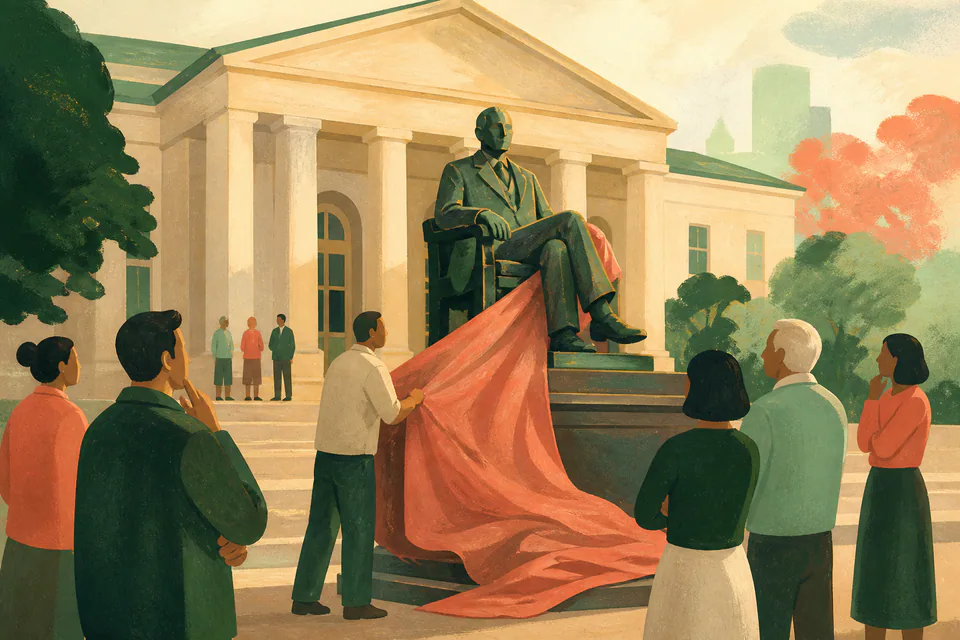
A disgraced billionaire's name is on the beloved campus library. Does it come down?
A major donor funded a beloved public building decades ago. New evidence shows they also caused serious harm that was legal and accepted by many peers at the time. Removing the name may jeopardize future donations.
What does an institution owe the truth when its history funded the present?