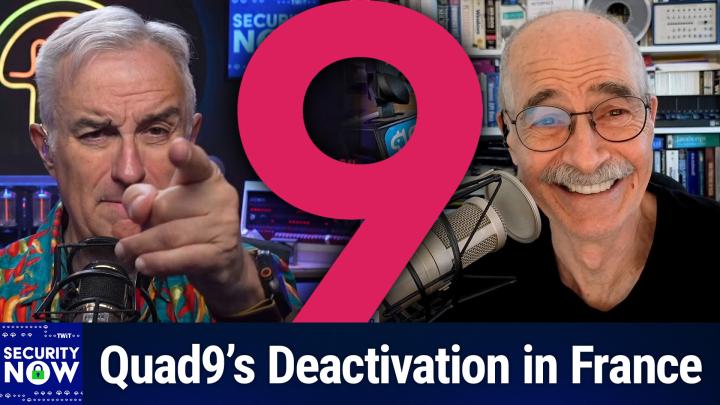
AI-powered pen testing frameworks like ARTEX are now fueling real-world cyberattacks at unprecedented speed and scale, making the internet actively hostile for organizations of every size. Steve and Leo both examine the chilling reality of automated, always-on adversaries and the constant scramble to keep up. An overview of the past several weeks of widespread outages The "Reverse Engineer Anything" craze hits a road bump. Quad9 withdraws its DNS service from France. What's next? California sues OpenAI over Hugging Face and more. More critical vulnerabilities in Synology. PHP vulnerabilities, round two. Google and Anthropic reduce their disclosure windows. A listener uses Mythos, discovers unexpected bugs. SpinRite boots on 97 different UEFI PCs. ARTEX - The inevitable happened, and it's bad. Show Notes - https://www.grc.com/sn/SN-1106-Notes.pdf Hosts: Steve Gibson (https://twit.tv/people/steve-gibson) and Leo Laporte (https://twit.tv/people/leo-laporte) Download or subscribe to Securi
As organizations accelerate AI adoption, a new security challenge is emerging: AI Agent Collisions. Autonomous and semi-autonomous agents are increasingly operating across business applications, accessing sensitive data, invoking APIs, and taking actions on behalf of users and organizations. Without visibility into which agents exist, what they can access, and how they interact, organizations risk creating unintended access paths, conflicting actions, data exposure, and gaps in security oversight. James Robinson, CISO at Netskope, joins Business Security Weekly to explore the emerging problem of AI Agent Collisions, why traditional security approaches may fall short, and how CISOs can build an effective strategy for discovering, classifying, governing, and securing AI agents. James will discuss how organizations can select the right AI Agent Platforms to establish consistent controls, prevent unintended agent interactions, and protect their most critical applications as the enterprise
AI news on autonomous exploit agents, states fighting the sale of kids' chatbot data, and an AI that named the likely artist of an 1808 sketchbook. The show opens with a highway-billboard prompt that makes Claude Code-built Shorts splash screens readable at a glance. Then it turns to cybersecurity: Palo Alto Networks' Unit 42 found the gap between attacker commands falling from 24 seconds to 1.4 seconds, Google reported the first AI exploit agent it has seen work end to end, and OpenAI and Anthropic are adding insider-spy defenses. Child safety comes next, with 42 states and the District of Columbia challenging the auction of Character.AI users' private chats, harmful messages to children from the Talkie chatbot, New York's five-year ban on AI in toys, Tidal removing AI-generated tracks, and Pinterest's new teen controls. Astra 6.2 named the Vicomte de Chabot as the likely artist of an anonymous 1808 sketchbook held at Yale, which leads into capability overhang: AI results, from quantu
Tejas Bhakta, CEO of vertically integrated inference provider Morph, joins Madison Kanna to discuss orchestrating up to 12 concurrent AI agents using custom terminal muscle memory, eye tracking, and voice-to-text. He breaks down why startups get trapped in toxic GPU prepay contracts, how AI kernel writing is suddenly making AMD viable for inference, and why frontier models are forcing software engineers into “ego death” while creating more fake jobs post-AGI. MTS chronicles the singularity, live. Monitoring the situation of tech and AI. Follow MTS: Spotify |https://open.spotify.com/show/4HUNNmV1pjV7CW6Lphm1rM Apple |https://podcasts.apple.com/us/podcast/mts/id1891088763 – Brought to you by: Mongo DB - Anyone can prototype an agent. Lovable - Turn ideas into software people love with Lovable. Start today at https://lovable.dev/ Visithttps://factory.com/ Neon (by Databricks) - Scale your startup on Neon. The Postgres backend for apps and agents. Head over to http://getvcx.com (http://get
Can you turn the lessons you learn from experience into a repeatable system for making better decisions? Ray Dalio argues that writing down the principles behind your decisions, testing them against history, and eventually turning them into algorithms can help. In this archive conversation, Ray joins a16z’s Alex Rampell and Sonal Chokshi to discuss decision-making under uncertainty, learning from mistakes, and why understanding cause and effect matters more than blindly trusting a black-box model. They also get into radical open-mindedness, judging people on process rather than outcomes, building teams around complementary strengths, and why knowing what you don’t know may be more valuable than what you do. Resources: Follow Ray Dalio on X:https://x.com/RayDalioX Blog (https://blog.x.com/en/insights/finance-tweets-of-the-month--april-2017) Follow Alex Rampell on X:https://x.com/arampellAndreessen Horowitz (https://a16z.com/author/alex-rampell/) Follow Sonal Chokshi on X:https://x.com/s
In this podcast episode, Brad Arkin joins James Wilson to discuss how security leaders should respond when the mood changes. The rush to adopt AI meant finding ways to let the business move fast, but lately a little more caution seems to be creeping back in. The pair explore how to spot those shifts, know when to start making a fuss, and change approach without simply mirroring the boss’s latest concern. Show notes
Street design should prioritize pedestrians and public transport over private cars.
Share your view, then see how readers voted. No sign-in required. This poll is shared across stories.
Do you agree or disagree?
Common Quandary
A Common Quandary to discuss
Another conversation to explore, separate from this news story.
You are vegetarian, but the leftover steak is headed for the trash. Do you eat it?
A vegetarian avoids buying meat because of animal welfare concerns. At work events, untouched meat is routinely thrown away, and eating it would neither increase demand nor cause another animal to be harmed.
Should a moral practice be judged by its consequences or its consistency?