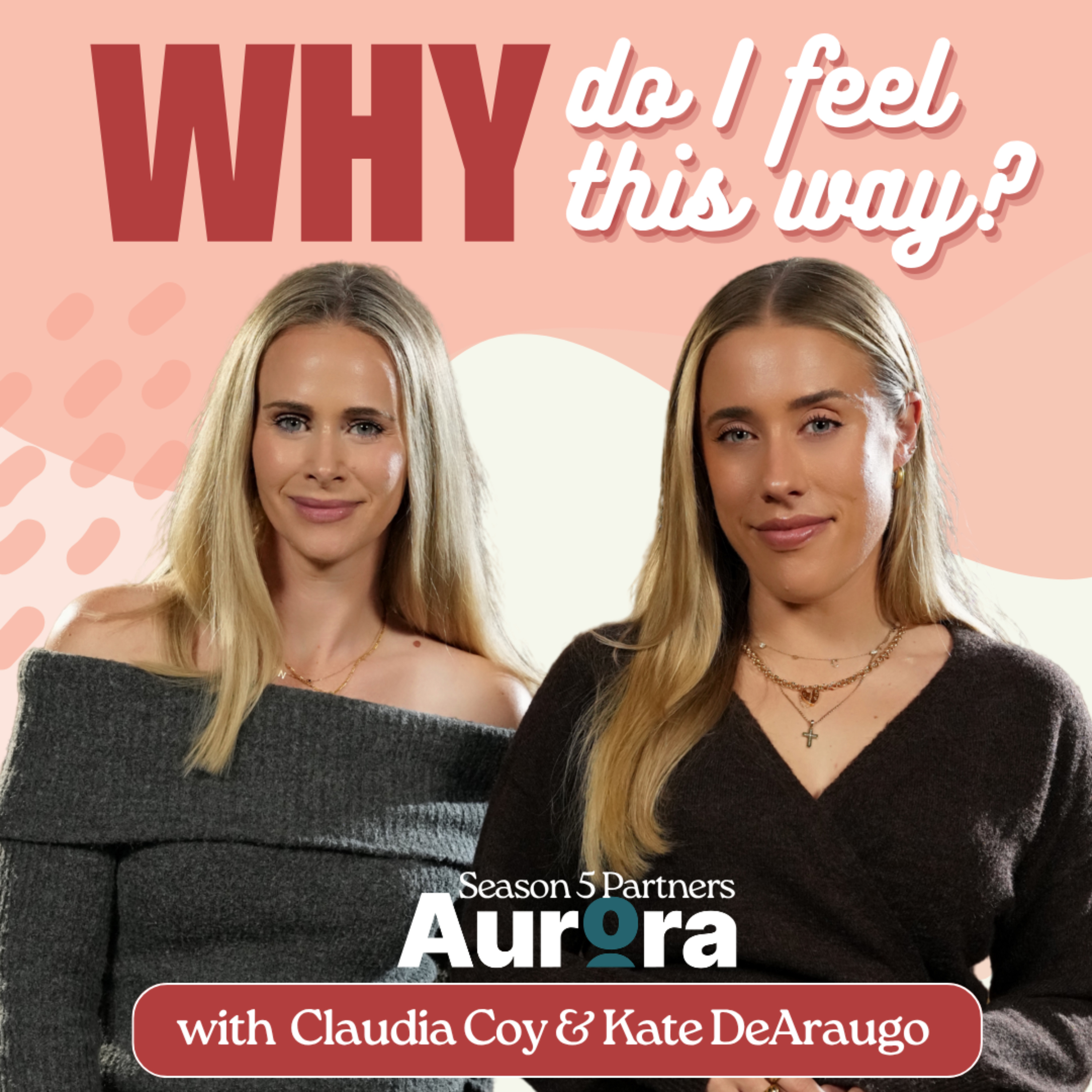
The Addiction Underneath the Addiction: Food Noise, Shame and Weight-Loss Medication
38 min
Listen through the publisher, then discuss the episode here or arrange an in-person Roundtable. Your city determines where to meet.
Roundtables are designed for groups of four, with a shared subject and room for everyone to speak. Come for discussion, with no dating expectation.
This episode contains lived-experience discussion of eating disorders and purging, urges to relapse, body shame, weight loss and prescription weight-management medication, methamphetamine and other drug dependence, compulsive behaviours, and mental-health recovery, and includes strong language. Kate DeAraugo and Claudia Coy are back, just the two of them, for an honest catch-up about what's still there when the loudest addiction is gone. Claudia marks 18 months since she last purged, and tells the story behind her butterfly tattoo: the promise she made herself when she got it, and the moment it helped. Kate explains why shame is still her core trigger, even with an Australian Idol win and a life full of people who love her: the spiral that follows her out of every social situation, and the phone call that makes it evaporate. And they share something they've never said publicly: why Season 1 was recorded twice, and what being that honest gave back to them both. Then Kate goes underneath the addiction. The drugs, she says, were just a symptom: when she put them down, the void was still there, and finding the other ways she fills it, from social media to spending, has become a game of whack-a-mole. She talks openly about the weight-loss medication that finally quietened the food noise she'd lived with her whole life, stepping back on stage in a body she isn't ashamed of, and the shame that still tells her she took the easy way out. Claudia raises the debate about people with a platform who are on weight-loss medication and don't say so. Kate and Claudia discuss their own lived experience. Medication and recovery decisions are individual; speak with a qualified health professional and do not start, stop or change prescribed treatment based on this conversation. Season 5 is presented by Aurora Healthcare. aurorahealth.com.au If this brings anything up for you: Butterfly National Helpline: 1800 33 4673 National Alcohol and Other Drug Hotline: 1800 250 015 Lifeline: 13 11 14
Episode information is provided by the publisher. Listening takes place on the publisher’s service.
You've gotten very good at pretending you don't feel it. Uploaded 21-08-26 Maybe it's a conversation with someone you love. Someone you work for. A partner, a parent, a friend who's been quietly taking more than they give. Or the hardest one of all — a conversation with yourself, the one where you finally admit something you've refused to say out loud for years. You know exactly which one I'm talking about. You felt it the moment I said the word. A name came up, or a face, and your stomach did something small and unpleasant, and you pushed it back down where it's been living. That flinch is the most honest thing that's happened to you all day. Here is the truth: the life you say you want — the freedom, the peace, the relationship, the income, the respect — there's a very good chance it's on the other side of one conversation you keep refusing to have. Not ten. One. This seminar unpacks the single mechanic behind a stuck life: the necessary conversation you keep treating like a locked d
TONGUE: A Cognitive Hazard: https://a.co/d/6GU1oFe Uploaded 23-11-25 You’ve been walking around thinking you’re seeing the world, but really you’re just seeing whatever your language lets you have. Once you catch it in the act, it feels like finding a glitch in your own brain. Until this hits you, you don’t realize how much of your life has been pre-chewed, pre-labeled, and handed to you like baby food. And yeah, I’m about to show you the part that makes people sit in silence for a minute and rethink everything. Reality’s been on autopilot while language has been editing your perception like a drunk film editor. Every emotion, every memory, every “truth” you think you discovered—turns out most of it was installed, not chosen. Go ahead and watch the live demo in this video and feel how fast your mind slaps a label on anything it sees, like it’s terrified of raw experience. Once you try even two seconds of not naming something, you’ll feel the world punch through your skull in a way you
Text me what you thought of the show (https://www.buzzsprout.com/1959372/fan_mail/new) Can working night shifts affect your fertility, ovulation or IVF success? After speaking with numerous women trying to fall pregnant while working shifts, including those undergoing expensive IVF treatment, I wanted to explore what the research actually tells us. In this episode of A Healthy Shift, we discuss how night shifts, disrupted sleep and circadian misalignment may affect reproductive health. We cover: Why the fertile window is so short. Shift work, reproductive hormones and menstrual irregularities. What research says about night shifts, fertility and IVF outcomes. The roles of sleep, stress, nutrition, weight and exercise. Practical steps for women trying to conceive while working shifts. Research links shift work with menstrual irregularities, but evidence that night shifts directly cause infertility or reduce IVF success remains uncertain. If you're trying to get pregnant while working ni
Imagine if every big change in our lives came with a whole community stepping up beside us… In this episode, I sit down with Dr Arne Rubinstein, former GP and emergency doctor, founder of the Rites of Passage Institute, and a man who's spent more than 30 years walking young people across the threshold into adulthood. Arne's work began around a fire at his very first men's gathering, listening to a hundred men wrestle with the same handful of wounds. Then in the Emergency Dpt, he kept meeting teenagers who'd pushed it one step too far... kids trying to become adults with nobody there to hold them. He came to believe every young person will go through a rite of passage either way. The question is whether we leave them to create their own, or gather around and help. We talk about why our culture is so good at turning away from the big moments - from first periods to menopause to death - and what opens up when we turn towards them. We explore: Separation, transformation and integration, an
Have you ever tried something so hard, failed, and then tried again anyway? Meet Tony Hawk, the boy who turned his restless energy into skateboarding history! Growing up in sunny San Diego, California, Tony was a frustrated kid until his brother gave him a scratched-up blue skateboard. It was pure magic! By age 14, he was a fearless professional skater inventing wild, sky-high tricks on massive wooden ramps. Imagine being at the 1999 X Games, watching Tony attempt the ultimate, "impossible" trick: the 900! That's two and a half dizzying spins high in the air. Crash after crash, he fell ten times. But on his eleventh try? He landed it perfectly, while the crowd went absolutely wild! That same year, his smash-hit video game made him a superstar all around the world. But Tony didn't just want fame. He wanted every kid to have a safe place to ride, fall, and get back up. Through his charity, he has helped build hundreds of free public skateparks everywhere! Grab your helmet and drop in as
Get the 200+ Page Optimal Living Daily Workbook (PDF) - Free. Want to turn today's episode into an actionable plan? Episode 4233: Kate Galliett explains three reasons we make health, fitness and life harder than they need to be: ignoring how the body works as a connected system, trusting only extreme intensity, and leaking the energy that fuels motivation and discipline. She makes the case that appropriate effort, not maximum effort, is the only sustainable path to lasting results. Read along with the original article(s) here: https://fitforreallife.substack.com/p/why-you-make-everything-harder-than Quotes to ponder: "The better way is to give appropriate effort and get appropriate results. This is the only sustainable way." "If you try and live at the extremes, you will constantly ping-pong back and forth from one extreme to the other." "Just imagine - you might not actually lack discipline after all, you just might be leaking energy that feeds your ability to be disciplined." We spen
This episode contains clinical and lived-experience discussion of compulsive sexual behaviour and pornography, infidelity and betrayal trauma, domestic and family violence, family homicide, suicide and suicidal thoughts, sexual offending, child sexual abuse and child abuse material, STI transmission, eating disorders and purging, substance use, and childhood trauma. It is general information, not individual medical, treatment or legal advice. Kate DeAraugo and Claudia Coy welcome back one of the show's very first guests, Cara Crossan, who has spent two decades working with sex and love addiction, the people caught in it, and the partners left behind. Cara explains what sex addiction actually is and why it's rarely about the sex: it's about escape, connection, relief and the chase. She talks about how online pornography has changed the field, why Australia's new barriers to porn sites matter, and why love addiction can be the most complex of all. Kate shares the warning Cara once gave h
This episode contains lived-experience discussion of homelessness and sleeping rough, coming out as trans, family rejection, suicidal thoughts, self-harm, substance use and getting sober, a mental-health unit admission, violence, PTSD and an unnoticed death in public, and includes strong language. Kate DeAraugo and Claudia Coy are joined by Chris Vagg, the founder of Pass It On Clothing, and Emma, who spent eight to nine months sleeping rough on Sydney's streets before building a different life. Kate knew Chris years ago, and when they reconnected she found he'd changed direction completely. Chris tells how Pass It On began when his partner cleared out his wardrobe, and how one question he asked Emma, in her Eels jersey at Martin Place, made her think. He explains why the only difference between us and someone experiencing homelessness is a key to a safe place at night, why saying hello can make someone feel human instead of like street furniture, and why, when you're homeless, you des
Scarce treatments should be allocated by medical need rather than ability to pay.
Share your view, then see how readers voted. No sign-in required. This poll is shared across stories.
Do you agree or disagree?
Common Quandary
A Common Quandary to discuss
Another conversation to explore, separate from this news story.
You scratched a borrowed heirloom and repaired it perfectly. Do you confess?
You borrow a family heirloom for an event and accidentally leave a small scratch. A careful repair makes it almost invisible, and its owner happily accepts it back without noticing anything.
What is confession for when the harm has already been repaired?