Listen through the publisher, then discuss the episode here or arrange an in-person Roundtable. Your city determines where to meet.
Roundtables are designed for groups of four, with a shared subject and room for everyone to speak. Come for discussion, with no dating expectation.
In 1992, a young band called Seo Taiji and Boys performed on a TV talent show and transformed Korean pop music forever. Mixing hip-hop, rock and dance with bold social lyrics, they challenged conventions and sparked a cultural shift that helped shape the global K-pop phenomenon. Jeon Young Rok, a legendary Korean singer who witnessed their historic debut, takes us back to that groundbreaking performance. He tells the BBC’s Julie Yoonnyung Lee about the shock and excitement surrounding Seo Taiji and Boys, the reaction among young Koreans and how their influence continues to shape K-pop today. (Photo: Seo Taiji and Boys perform at the 8th Golden Disk Awards Credit: Jtbc Plus/ImaZinS Editorial)
Episode information is provided by the publisher. Listening takes place on the publisher’s service.
Why is the manosphere so appealing to young men? What does it actually mean to be a good man? To join our journaling club, with 10,600 + others, subscribe to my imperfect email - https://www.theimperfects.com.au/sign-up-to-our-newsletter/ Journalist Marc Fennell joins us in the studio to talk about the manosphere: what is it? what are its consequences? and how can we talk to our kids about it? Marc explores with Hugh, Ryan and Josh why the manosphere is so appealing to young men, especially those who think they have little value to offer, and Josh questions what his reaction would have been, if he had of been exposed to the manosphere at a vulnerable time. We look at ‘toxic masculinity,’ and the impact of being right versus making change, and in a moment of vulnerability, Marc discusses the importance of self reflection of your own behaviour. Chapters: Chapters 00:00:00 – Marc Fennell on the Manosphere [TRAILER] 00:01:01 – Ryan’s doppelganger (and media buff etc) 00:04:24 – The State o
This week, producer Tim joins Nancy and Nick Clark for Eurotrash at the Young Vic, with Ben Whishaw and Kathryn Hunter as a son and mother on a deeply peculiar road trip through Switzerland, essentially two brilliant actors being very weird indeed. Then Nancy holds the fort for Eugene O’Neill’s Desire Under the Elms at the Almeida, after illness, flights and scheduling mishaps keep everyone else away. A farmer brings home a much younger wife, she falls for his son, and things go about as well as you’d expect in an O’Neill play. Plus, Nick Curtis talks to playwright extraordinaire Natasha Gordon as her superb debut play Nine Night returns at the Kiln. They discuss the Jamaican mourning tradition behind its story of family, grief and celebration, and Gordon sets the record straight about being called the first Black woman to have a play in the West End. And the ridiculously delightful Francesca Mills answers our five questions as she stars alongside Jill Halfpenny and Paul Chuckle in The
A new James Bond was announced, and Guy gets excited— only for that excitement to turn into disappointment over Cookie and Young Owen not having watched a single Bond movie. Plus, with the release of Grand Theft Audio VI, Young Owen educates Guy on the game, and why it’s a big deal. Tune in for that, and MORE on this week's Bonus Benson. !
Imagine if every big change in our lives came with a whole community stepping up beside us… In this episode, I sit down with Dr Arne Rubinstein, former GP and emergency doctor, founder of the Rites of Passage Institute, and a man who's spent more than 30 years walking young people across the threshold into adulthood. Arne's work began around a fire at his very first men's gathering, listening to a hundred men wrestle with the same handful of wounds. Then in the Emergency Dpt, he kept meeting teenagers who'd pushed it one step too far... kids trying to become adults with nobody there to hold them. He came to believe every young person will go through a rite of passage either way. The question is whether we leave them to create their own, or gather around and help. We talk about why our culture is so good at turning away from the big moments - from first periods to menopause to death - and what opens up when we turn towards them. We explore: Separation, transformation and integration, an
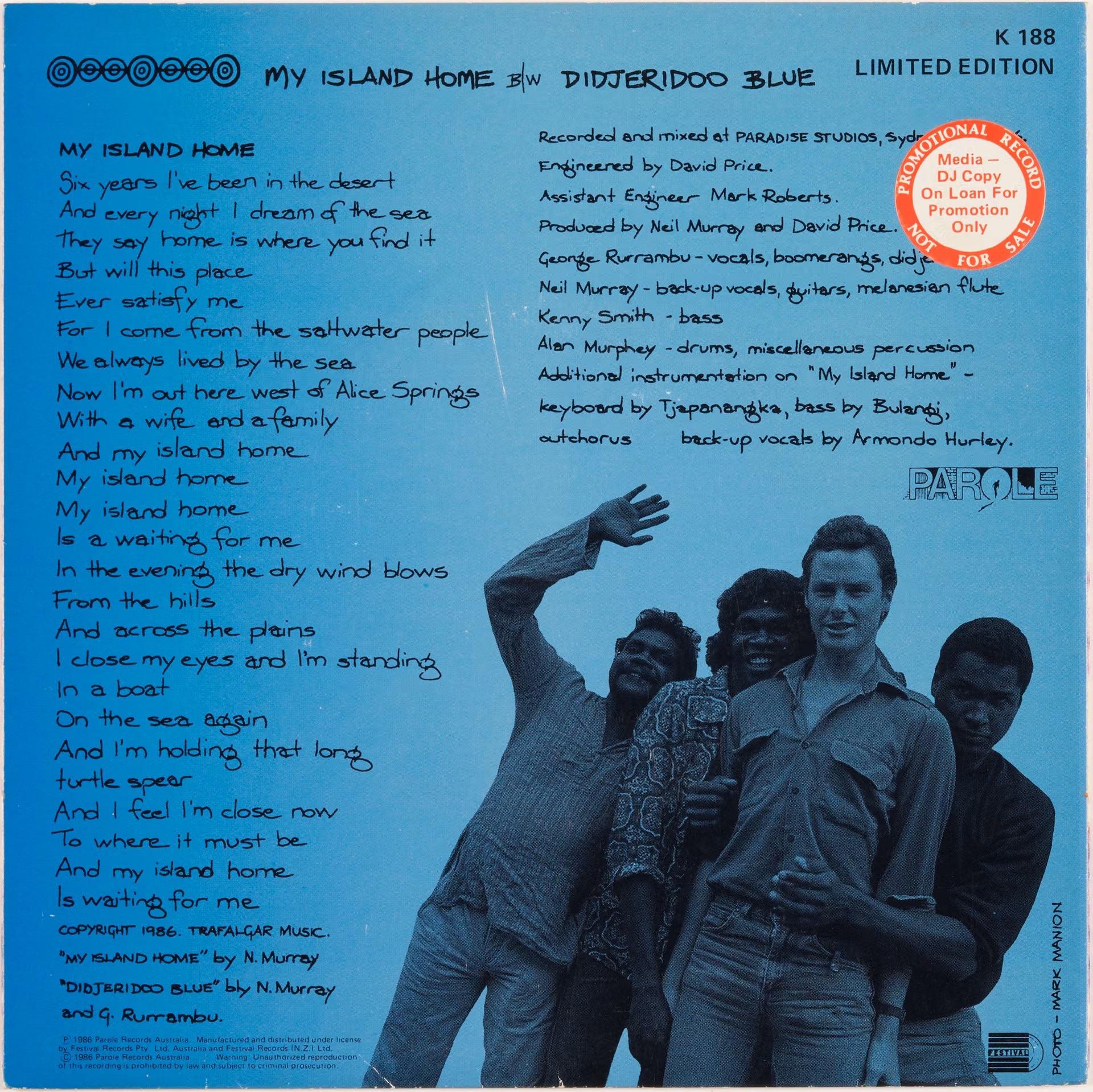
My Island Home came to Neil Murray on a bus, when he was thinking about Galiwin’ku, the island home of his Warumpi Band bandmate George Burarrwanga, and his own home country in western Victoria. This month, it was among the first 10 songs selected for the inaugural National Songbook (https://www.nfsa.gov.au/stories/deep-dives/national-songbook?gad_campaignid=24434697280&gad_source=1&gbraid=0AAAAAoyuqE8IloqWPu7EV-y2rDtcfF5WC&hsa_acc=4074694733&hsa_ad=830541886523&hsa_cam=24434697280&hsa_grp=202695137678&hsa_kw=nfsa+songbook&hsa_mt=p&hsa_net=adwords&hsa_src=g&hsa_tgt=kwd-2511061033177&hsa_ver=3), an annual collection “to honour songs that profoundly shape Australia's culture, identity and collective memory”. Neil speaks with Julian about the My Island Home story, Christine Anu's 1995 cover, and the songs he thinks should be included in the Songbook in the future. Neil will be playing (https://www.neilmurray.com.au/pages/itin.html) at The Presynct in Nambour on November 26, The Royal in N
Alan Milburn wants to scrap Pip for under-25s and replace the Universal Credit health element with a new youth allowance. He says the plan could get 440,000 young people into work within a decade and eventually save £3.6 billion a year. With 981,000 young people not in education, employment or training, nobody disputes the scale of the problem. They disagree about its cause. Milburn insists this is not a generation lacking resilience. Yet his own report finds that benefit claims have outpaced any rise in ill health, and it warns of overdiagnosis of ADHD and autism. Michael Simmons puts that contradiction to Milburn directly. He also asks whether the National Insurance and minimum wage rises are pricing young people out of the jobs they need most. Can welfare reform get a generation back to work – or is the deeper problem a loss of resilience that no policy can fix? This episode is brought to you by Raymond James. Combining deep insights into who you are with our financial expertise, th
In 1976, the world was introduced to the underdog boxer Rocky Balboa. The film, which pitted an unknown challenger against the heavyweight champion of the world, made its star and writer, Sylvester Stallone, a household name. Stallone had written the script in three and a half days, but despite enthusiasm from producers for the story, he struggled to convince them to give him the part. Made with a small budget and on a tight deadline, the movie won three Academy Awards, including best picture. Produced by Tim O’Callaghan using interviews Sylvester Stallone has given to the BBC.
In 1984, doctors in the USA controversially transplanted a baboon heart into a baby girl when they couldn’t find a human donor. The baby, known as Baby Fae, had been born three weeks early and had been diagnosed with 100% lethal hypoplastic left heart syndrome. The surgery was led by Dr Leonard Bailey, who spoke to Rebecca Kesby in 2012 about the efforts to save Baby Fae. (Photo: Baby Fae listening to her mother's voice in the isolation unit. Credit: Loma Linda Hospital)
A new action-adventure computer game - designed in Scotland - became a surprise global hit in 1997. But Grand Theft Auto also courted controversy and sparked debate over violence and drugs in video games. In 2013, Paul Schuster spoke to Brian Baglow - one of the original team behind the launch. (Photo: Grand Theft Auto: Vice City 2003. Credit: John Ewing/Portland Press Herald via Getty Images)
Individuals should control whether organizations share their personal information.
Share your view, then see how readers voted. No sign-in required. This poll is shared across stories.
Do you agree or disagree?
Common Quandary
A Common Quandary to discuss
Another conversation to explore, separate from this news story.
The stadium can ban violent fans by scanning every face at the gate. Would you walk in?
A stadium can use facial recognition to identify people banned for violence and shorten security lines. Every visitor would be scanned, error rates are not zero, and the resulting biometric data could become useful to police or advertisers.
How much privacy may a crowd be asked to trade for collective safety?