The Day I Discovered the Anger I Never Knew I Had - Wednesday: Maamar Yafeh Sha'ah Achas #5
115 min
Listen through the publisher, then discuss the episode here or arrange an in-person Roundtable. Your city determines where to meet.
Roundtables are designed for groups of four, with a shared subject and room for everyone to speak. Come for discussion, with no dating expectation.
You Are Hashem Having a Human Experience This Chabad Chassidic discourse is the ultimate manual for healing trauma, addiction, and emotional pain. This is the fifth of a series of classes on the Maamar (discourse) Yafeh Sha'ah Achas (מאמר יפה שעה אחת) by the Miteler Rebbe, published in Maamarei Admur Haemtzarei (מאמרי אדמו"ר האמצעי קונטריסים). The class was presented by Rabbi YY Jacobson on Wednesday, 8 Kislev, 5787, November 18, 2026. View Source Sheets: https://portal.theyeshiva.net/api/source-sheets/10033
Episode information is provided by the publisher. Listening takes place on the publisher’s service.
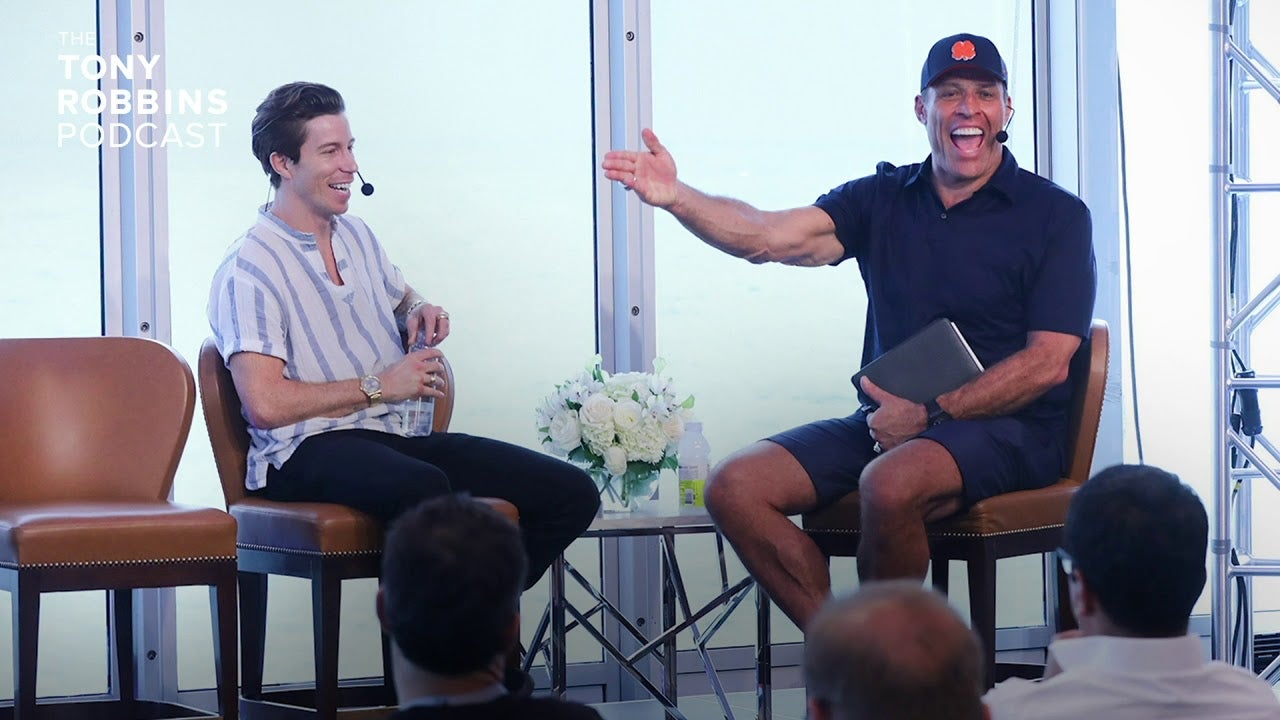
Tony Robbins uncovers the art – and science – of the comeback in this interview with snowboard legend Shaun White. As a three-time Olympic gold medalist and world record holder, Shaun knows a thing or two about success. He turned snowboard pro at 13 and skateboard pro at 16. He has the most wins of anybody in the history of the extreme sports event the X Games. Uploaded 29-06-20 His phenomenal wins didn’t come without a fight. How can you take those hits and come back? The answer lies in a deep sense of self-belief. Shaun started life with asthma and a heart defect that required surgery, but his parents never put boundaries on what he could accomplish. He says, “From the get go I believed I could do it. I saw the pros and I knew I could get to that point.” You too can create this deep belief in yourself using the tips at https://www.tonyrobbins.com/building-confidence/how-to-believe-in-yourself. Shaun also used his failures as fuel. Instead of being defeated, losing drove his desire to
Seventeen decisions from tribunals in Tasmania, New South Wales, the ACT and Queensland and from the Trade Marks Office in the Tribunals edition of Wednesday 25 November 2026, nine with headnotes and four more worked examples from synopses. When a tribunal will keep a disciplined property agent's name out of the published reasons; who has standing to seek review of a liquor licensing decision; retaliatory termination notices; why rent reduction comes first in the ACT; and a run of trade mark rulings on bad faith and on descriptive versus allusive marks. Tribunals Desk: naming a disciplined practitioner (lead; headnoted). Property Agents Board v Ld (No.2) [2026] TASCAT 152 - s 81(2)(d) Tasmanian Civil and Administrative Tribunal Act 2020 (Tas) confers a broad evaluative discretion to restrict publication for any sufficient reason, without necessity or exceptional circumstances, informed by the protective purpose of discipline; open justice is the starting point and reputational harm alo
Growing up in a large colonial home, she was accustomed to strange occurrences, but one childhood experience remained particularly frightening. One evening, as she was getting ready for bed, she noticed an enormous, unusually detailed shadow on her bedroom wall. It appeared to be a witch, silently moving the religious figurines on her brother's dresser. But when she looked directly at the dresser, nothing was there. Terrified, she waited for her grandmother to come say goodnight. When she finally arrived, her reaction was almost as disturbing as the shadow itself. She refused to look at the wall and behaved in a way her granddaughter had never seen before. The following morning, a brief conversation suggested that her grandmother knew far more about the mysterious figure than she'd ever admitted. #RealGhostStoriesOnline #GhostStories #ShadowFigures #HauntedHouse #ParanormalEncounters #ChildhoodHaunting #GhostlyApparitions #UnexplainedShadows #TrueGhostStories #ParanormalActivity Love r
⭕️ NCI GRAD SCHOOL: https://nci.university/home-v2 Uploaded 21-05-26 There are 17 sentence structures that make another person's brain do the persuading for you. You don't argue. You don't push. You deliver the architecture and their own neurology finishes the job. These aren't scripts or phrases. They're machines. Each one was discovered independently — by Socrates, by trial lawyers, by hostage negotiators, by cult leaders — across 2,400 years, by people who never met and never read each other's work. They all found the same invisible thing. In this lecture I break all 17 into the four families nobody has ever mapped before: — Sentences that make the listener argue your position for you — Sentences that collapse resistance without pushing through it — Sentences that install an identity the person's own brain will defend long after you leave — Sentences that make a decision feel like it already happened Not one of them tells anyone what to think. Not one argues a position. Not one pers
Military bases are full of old buildings, forgotten corners, and stories that get passed from one generation of soldiers to the next. Daniel had never paid much attention to any of that. Then, during an overnight security shift, he noticed a lone soldier moving through one of the oldest sections of the base. The uniform looked wrong. The man ignored every attempt to get his attention. And he seemed determined to reach a building that had been mostly unused for years. At first, Daniel assumed there had to be a simple explanation. By the second night, he wasn’t so sure. Because the same figure appeared again. And once Daniel began asking questions, he learned there was a reason other soldiers knew exactly which building he meant. #MilitaryGhost #HauntedMilitaryBase #GhostStories #Paranormal #SoldierGhost #Apparition #HauntedHistory #Unexplained #MilitaryHaunting #GhostSoldier #Hauntings #Ghosts Love real ghost stories? Want even more? Want even more? Stay connected with us on social: Ins
In some religions, people believe in reincarnation or an afterlife, but in medicine, life is generally considered to end when the heart stops beating. Recently though, researchers have challenged that view. In November 2024, American biologists Peter A Noble and Alex Pozhitkov published groundbreaking findings in The Conversation under the title “Biobots arise from the cells of dead organisms − pushing the boundaries of life, death and medicine.” They showed that, under certain conditions, dead cells can not only survive but also reorganise and form new multicellular structures. And that discovery suggests the existence of an intermediate state where biological organisms are neither fully alive nor completely dead. Scientists are now referring to this as the "third state." Doesn’t death occur when the brain stops functioning? How would that even be possible if the person is deceased? What are the implications of the third state? In under 3 minutes, we answer your questions! To listen t
What Does It Feel Like to Burn in Hell? Can I Trust the G-d Who Created It? Can I Trust the G-d Who Created Hell? Are There Really Fires in Hell? How can we heal our trauma around paradise and purgatory? For many of us, the words Gan Eden and Gehenna evoke a terrifying picture of God and the afterlife. Even when we question that picture intellectually, our bodies may still brace for punishment every time we make a mistake. This class returns to the very language that frightened us, including the Talmud’s teaching that earthly fire is one-sixtieth of the fire of Gehenom. Through the Mitteler Rebbe’s maamar, we explore purgatory as the experience of having our own lives reflected back to us with a clarity we can't always perceive in this world. There is the pain of losing a mask we mistook for our skin. And there is the deeper grief of discovering how much of our passion went into securing a feeling of love or validation at the cost of our own truth. Why can an affair feel so alive to a
Yaakov and Esav Reveal Two Radically Different Ways of Experiencing Life When Yaakov and Esav reunite after twenty years, two seemingly similar expressions reveal two radically different experiences of existence. Esav declares, יש לי רב—I have plenty. Yaakov declares, יש לי כל—I have everything. How could Yaakov make such an audacious statement? His life was hardly devoid of pain, loss, or unfulfilled needs. And how can we proclaim daily in Grace After Meals, דורשי ה' לא יחסרו כל טוב, that those who seek Hashem lack nothing good? In a breathtaking insight, the Sfas Emes opens an entirely new understanding of abundance. When you connect to the infinite divine spark that constitutes the inner essence of all reality, you are touching everything. Just as the genetic blueprint of an entire organism is contained within a single nucleated cell, the infinite is present within every fragment of existence. Yaakov was not merely declaring his satisfaction with what he possessed; he was expressing
The Pain of Saying Goodbye to Fakeness: When All Illusions Disappear and You Encounter Who You Really Are What really happens to us after we die? What are Gan Eden and Gehenna? Are heaven and hell two different destinations, or two radically different experiences of the same reality? In this extraordinary class, exploring the profound teachings of the Mitteler Rebbe, Rabbi YY Jacobson takes us on a remarkable journey into the soul's experience after death, describing what unfolds when the body falls away and the soul encounters the unfiltered truth of its existence. Every thought, word, desire, craving, action, and experience generates spiritual energy that never disappears. After death, the soul encounters the reality it has created, without the protective veil of denial. Heaven and hell are not merely external rewards and punishments; they are the soul's experience of its own accumulated reality. The soul, which is inherently Divine and infinite, longs to dissolve into its Source. Bu
Keeping a league competitive is more important than maximizing rewards for its strongest teams.
Share your view, then see how readers voted. No sign-in required. This poll is shared across stories.
Do you agree or disagree?
Common Quandary
A Common Quandary to discuss
Another conversation to explore, separate from this news story.
Your family connection could get your child into their dream school. Do you use it?
A university argues that considering family ties builds loyalty and encourages donations that fund scholarships. Critics say the preference preserves inherited advantage and takes places from stronger applicants.
Can benefits to the whole institution justify an unequal admissions advantage?