The Election of 1860 and the Road to Disunion: Crash Course US History #18
20 min
Listen through the publisher, then discuss the episode here or arrange an in-person Roundtable. Your city determines where to meet.
Roundtables are designed for groups of four, with a shared subject and room for everyone to speak. Come for discussion, with no dating expectation.
In which John Green teaches you about the election of 1860. As you may remember from last week, things were not great at this time in US history. The tensions between the North and South were rising, ultimately due to the single issue of slavery. The North wanted to abolish slavery, and the South wanted to continue with it. It seemed like a war was inevitable, and it turns out that it was. But first, the nation had to get through this election. You'll learn how the bloodshed in Kansas and the truly awful Kansas-Nebraska Act led directly to the decrease in popularity of Stephen Douglas, the splitting of the Democratic party, and the unlikely victory of a relatively inexperienced politician from Illinois, Abraham Lincoln. Lincoln's election would lead directly to the secession of several southern states, and thus to the Civil War. John will teach you about all this, plus Dred Scott, Roger Taney, and John Brown. Hey teachers and students - Check out CommonLit's free collection of reading passages and curriculum resources to learn more about the events of this episode. The Lincoln and Douglass debates of the 1850s fueled the argument over state's rights to decide on slavery and culminated when the two ran against one another in the Election of 1860: https://www.commonlit.org/texts/the-election-of-1860 In response to Lincoln's election, the South seceded from the Union and the Civil War began: https://www.commonlit.org/texts/the-south-secedes Learn more about the Dred Scott Decision in Crash Course Black American History #16: https://www.youtube.com/watch?v=9VffLWl8asY Chapters: Introduction: The Civil War 00:00 The Fugitive Slave Law 0:45 Railroads 2:26 The Kansas-Nebraska Act 3:04 How the Republican Party Formed 3:54 Public Opinion on Free vs. Slave States 4:22 The New Republican Party Gains Traction 5:45 How Kansas Became a State 6:31 The Dred Scott Decision 7:32 Mystery Document 9:14 John Brown & Harpers Ferry 10:25 The Election of 1860 11:13 The Start of the Civil War 12:14 Credits 13:40
Episode information is provided by the publisher. Listening takes place on the publisher’s service.
This week, producer Tim joins Nancy and Nick Clark for Eurotrash at the Young Vic, with Ben Whishaw and Kathryn Hunter as a son and mother on a deeply peculiar road trip through Switzerland, essentially two brilliant actors being very weird indeed. Then Nancy holds the fort for Eugene O’Neill’s Desire Under the Elms at the Almeida, after illness, flights and scheduling mishaps keep everyone else away. A farmer brings home a much younger wife, she falls for his son, and things go about as well as you’d expect in an O’Neill play. Plus, Nick Curtis talks to playwright extraordinaire Natasha Gordon as her superb debut play Nine Night returns at the Kiln. They discuss the Jamaican mourning tradition behind its story of family, grief and celebration, and Gordon sets the record straight about being called the first Black woman to have a play in the West End. And the ridiculously delightful Francesca Mills answers our five questions as she stars alongside Jill Halfpenny and Paul Chuckle in The
Jim dives deep into the myth of sudden success, showing how every breakthrough is born from discipline, focus, and quiet preparation Key Topics From This Motivational speech: The illusion of overnight success vs. years of preparation How small daily disciplines lead to massive breakthroughs The power of pressure and pattern recognition Strategic patience and the compounding effect Why discipline beats motivation every time This powerful Jim Rohn motivational speech uncovers the hidden layers of success. It teaches that behind every public victory is a private history of struggle, practice, and persistence. Jim explains how preparation, not luck, creates the moment—and how to align your actions daily with your vision, stacking up small wins until momentum carries you to your breakthrough. This Jim Rohn Motivational speech Is Perfect For: Anyone feeling stuck or waiting for the “perfect” opportunity Entrepreneurs and business owners looking for real growth strategies Students or professi
Have you ever tried something so hard, failed, and then tried again anyway? Meet Tony Hawk, the boy who turned his restless energy into skateboarding history! Growing up in sunny San Diego, California, Tony was a frustrated kid until his brother gave him a scratched-up blue skateboard. It was pure magic! By age 14, he was a fearless professional skater inventing wild, sky-high tricks on massive wooden ramps. Imagine being at the 1999 X Games, watching Tony attempt the ultimate, "impossible" trick: the 900! That's two and a half dizzying spins high in the air. Crash after crash, he fell ten times. But on his eleventh try? He landed it perfectly, while the crowd went absolutely wild! That same year, his smash-hit video game made him a superstar all around the world. But Tony didn't just want fame. He wanted every kid to have a safe place to ride, fall, and get back up. Through his charity, he has helped build hundreds of free public skateparks everywhere! Grab your helmet and drop in as
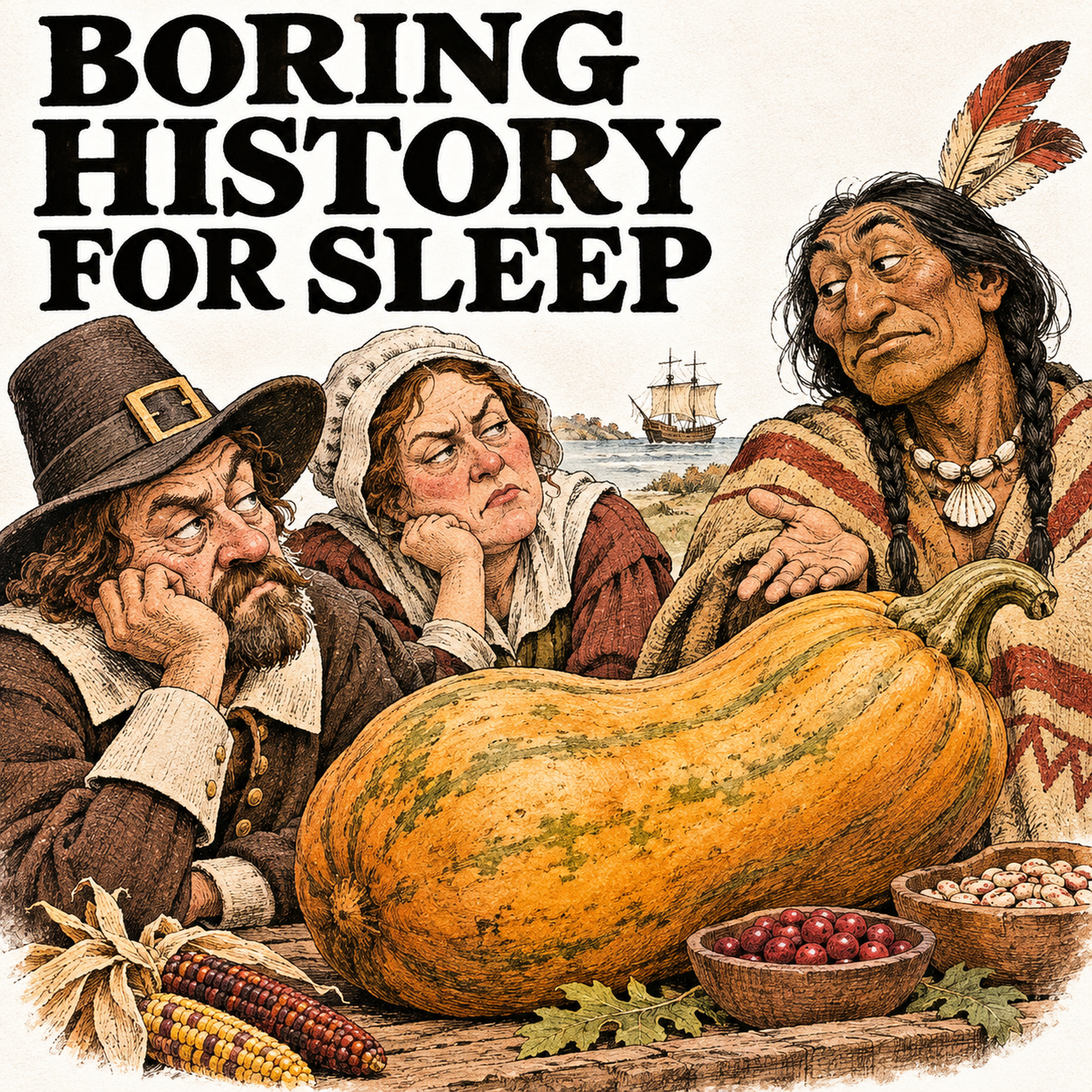
In 1620, a small ship called the Mayflower crossed the Atlantic carrying English settlers in search of a new life. Their arrival in North America became one of the most familiar stories in American history, but the reality behind the legend was far more complicated than the traditional Thanksgiving tale suggests. Discover why the Pilgrims left England, what their dangerous voyage was really like, and how they survived their first winter in an unfamiliar land. Explore their encounters with the Wampanoag people, the role of Tisquantum, also known as Squanto, and the assistance that helped the struggling settlers establish their colony. Uncover what happened at the harvest gathering of 1621, who actually attended, what was served, and how this event became connected to the modern Thanksgiving holiday. Follow the history beyond the familiar celebration and discover the people, cultural encounters, and historical realities behind the Mayflower story. Boring History for Sleep — Soft stories
Join NCI University today to master human behavior and influence: Uploaded 02-11-22 Too much time has passed, and I've wanted a map for human influence and persuasion, so I built one - and it works everywhere. THE FOCUS VIDEO: https://www.youtube.com/watch?v=n5poKK4lR5c Join me at an upcoming course! Looking back, everyone can locate failure and success. What most people don't realize is that you can also trace back success and failure to human behavior factors alone. These skills are so vital to life that I've dedicated my life to exploring and building this field into a transformational system that will radically transform the RESULTS you get from the world. I hope to see you in the next one! ️ C Chapters: 0:00 - Introduction 1:43 - The essence of mapping human Behavior TAGS: persuasion, influence, psychology, Chase Hughes, behavior panel, Scott rouse, greg Hartley, mark Bowden, Spidey, hypnosis, profiling, body language, sales
Merriam-Webster's Word of the Day for November 22, 2026 is: copacetic • \koh-puh-SET-ik\ • adjective Copacetic (less commonly spelled copasetic or copesetic) describes things that are very satisfactory. // Worry not: I assure you that everything’s copacetic. See the entry > (https://www.merriam-webster.com/dictionary/copacetic) Examples: “We will be blessed with a second lunar eclipse on this night, but it won’t quite be total: at maximum, a little more than 90 percent of the moon will fall into Earth’s shadow. The event will start at 10:35 P.M. EDT, and the maximum eclipse will occur just after midnight. It won’t be as cool as the March eclipse, but the timing will be a lot more copacetic.” — Phil Plait, Scientific American, 9 Jan. 2026 Did you know? Copacetic (with many variant spellings) is probably better known for competing theories of its origin than for any record of unconscious everyday use in American English. The first written occurrence of the word thus far detected (as copa
The majority of the universe is made up of a currently mysterious entity that pervades space: dark energy. We don’t know exactly what it is, but we do know that dark energy accelerates the expansion of space. We think this means the Universe will expand forever, even as our view of it shrinks while space expands faster all the time. Check out the Crash Course Astronomy solar system poster here: http://store.dftba.com/products/crashcourse-astronomy-poster If you want to learn more about the creation and death of the universe, watch Crash Course Big History here: https://youtube.com/playlist?list=PL8dPuuaLjXtMczXZUmjb3mZSU1Roxnrey -- Chapters: Introduction: The Expanding Universe 00:00 The Expansion of Space is Accelerating 2:17 What is Dark Energy? 4:19 Will the Universe Expand Forever? The Geometry of the Universe 5:20 The Cosmic Horizon of the Observable Universe 6:50 Review 10:20 -- GEOMETRY OF THE UNIVERSE RESOURCES Geometry: Expanding faster than light: General expansion: -- PBS Di
Have you ever wondered where cured meats like salami or pepperoni get their bright red color? Of course its from organic chemistry! A chemical called nitric acid gives them that bright color, while also increasing their shelf. It's also involved in some other interesting reactions. In this episode of Crash Course Organic Chemistry we'll see how nitrous acid reacts with primary amines to form diazonium salts, we'll learn about alkyldiazonium salts and aryldiazonium salts, and see what conditions are necessary for nucleophilic aromatic substitutions. Series Sources: Brown, W. H., Iverson, B. L., Ansyln, E. V., Foote, C., Organic Chemistry; 8th ed.; Cengage Learning, Boston, 2018. Bruice, P. Y., Organic Chemistry, 7th ed.; Pearson Education, Inc., United States, 2014. Clayden, J., Greeves, N., Warren., S., Organic Chemistry, 2nd ed.; Oxford University Press, New York, 2012. Jones Jr., M.; Fleming, S. A., Organic Chemistry, 5th ed.; W. W. Norton & Company, New York, 2014. Klein., D., Organ
Like a trendy dance, a fighting combo, or a secret handshake, organic reactions can be broken down into simpler steps. In this episode of Crash Course Organic Chemistry, we’ll specifically be looking at alkene addition reactions, and with each new reaction ask ourselves three questions to help us puzzle through the mechanism and understand what’s going on. Episode Sources: Le Couteur, P, Burreson, J. Napoleon’s Buttons: 17 molecules that changed history., Penguin, New York, 2004, Chapter 1. Whipps, H., “How the Spice Trade Changed the World,” https://www.livescience.com/7495-spice-trade-changed-world.html Last accessed, 3/28/2020. Henriques, Martha, “How spices changed the ancient world,” http://www.bbc.com/future/bespoke/made-on-earth/the-flavours-that-shaped-the-world/ Last accessed, 3/28/2020. Hashimoto, K., Yaoi, T., Koshiba, H., Yoshida, T., Maoka, T., Fujiwara, Y., Yaamoto, Y, Mori, K., “Photochemical Isomerization of Piperine, a Pungent Constituent of Pepper”, Food Sci. Technol.
New competition formats should improve the experience for players as well as audiences.
Share your view, then see how readers voted. No sign-in required. This poll is shared across stories.
Do you agree or disagree?
Common Quandary
A Common Quandary to discuss
Another conversation to explore, separate from this news story.
A coworker tells you their salary in confidence—and proves everyone else is underpaid. Do you share it?
A coworker privately tells you their salary and asks you not to repeat it. You later realize the figure is strong evidence that several equally experienced colleagues are being underpaid.
When does fairness outweigh a promise of confidentiality?