Listen through the publisher, then discuss the episode here or arrange an in-person Roundtable. Your city determines where to meet.
Roundtables are designed for groups of four, with a shared subject and room for everyone to speak. Come for discussion, with no dating expectation.
In 1994, government trade ministers and ambassadors from around the world gathered in Marrakesh, Morrocco to sign the agreement that created the World Trade Organization (WTO), the body that helps countries trade with each other by agreeing common rules and settling trade disputes. Twenty-three thousand pages, one hundred and twenty delegates and last-minute negotiations. The build up to the signing the Marrakesh agreement was challenging. Said El Hachimi was a young Moroccan trade official helping organise the historic summit. He tells Gill Kearsley about the huge logistical challenges, the royal banquet he almost missed, and witnessing a new era in global trade begin. (Photo: The signing of the Marrakesh agreement. Credit: Abdelhak Senna/AFP via Getty Images)
Episode information is provided by the publisher. Listening takes place on the publisher’s service.
The Happy Family by Hans Christian Andersen — A Calming Bedtime Story for Sleep & Insomnia | Books at Bedtime Drift off to sleep with The Happy Family by Hans Christian Andersen, a cosy, gently comic fairy tale read aloud by Martin Hewlett on Books at Bedtime, the sleep story series from Calming Anxiety. The burdock leaf is the largest green leaf in the country, big enough for an apron and almost as good as an umbrella. In the garden of an old, empty estate the burdocks have grown unchecked into a whole forest, and there live the last two great white snails. They are quite sure the forest was planted just for them, and that the grandest fate in the world is to be taken to the castle, boiled black and laid on a silver dish, as their ancestors were. Having no children of their own, the old couple adopt a little common snail and raise him as their son. When the rain drums on the burdock leaves, they snuggle into their houses and agree that they must be the most noble creatures alive. But
Imagine if every big change in our lives came with a whole community stepping up beside us… In this episode, I sit down with Dr Arne Rubinstein, former GP and emergency doctor, founder of the Rites of Passage Institute, and a man who's spent more than 30 years walking young people across the threshold into adulthood. Arne's work began around a fire at his very first men's gathering, listening to a hundred men wrestle with the same handful of wounds. Then in the Emergency Dpt, he kept meeting teenagers who'd pushed it one step too far... kids trying to become adults with nobody there to hold them. He came to believe every young person will go through a rite of passage either way. The question is whether we leave them to create their own, or gather around and help. We talk about why our culture is so good at turning away from the big moments - from first periods to menopause to death - and what opens up when we turn towards them. We explore: Separation, transformation and integration, an
Pull up a stool in Tobaro as the Master Tavern Keeper, Sedrik, and Heinrich clear up a classic mix-up: this isn’t Kadon the Shackler, master of beast-binding scrolls. Instead, we’re heading into the frozen, unforgiving Badlands in -1147 I.C. to trace the rise of a young Lodringen shaman who would come to be known as Kadon the Eternal. Follow the dying steps of Alcadizaar, Nehekhara’s last living king, as poison from the Fellblade claims him beside the Blind River, leaving behind Nagash’s Crown of Sorcery. When a curious shaman stumbles upon the remarkably preserved remains, placing that dark diadem upon his head sparks a chain of events: a bewitched tribe, a burial mound built over a leyline nexus, and the first sinister steps toward a necromantic empire. Featuring tavern banter, skeptical pushback from Sedrik, and immersive soundscapes of the Badlands, this episode sets the stage for the dark legacy of Kadon.
The International Court of Justice has found Myanmar responsible for genocide against the Rohingya, in one of the most significant legal judgements since the Genocide Convention was adopted after World War II. It is the first time that the court has found a state responsible for committing genocide. The ruling centres on the military's 2017 campaign in Rakhine State, which drove more than 740,000 Rohingya into neighbouring Bangladesh. ABC Asia editor Karishma Vyas joins Geraldine Doogue to explain how the case was won, why proving genocidal intent matters, and why lawyers and governments around the world will be studying the judgement closely. They also examine reports of secret talks between the Trump administration and Myanmar's military leadership, and what Washington's interest in rare earth minerals reveals about the shifting balance of power between the United States and China. Plus, Donald Trump, Xi Jinping and Vladimir Putin gather in Shenzhen for an extraordinary three-way sum
Most listeners know the phrase and have never heard that it was a real job. This title tells them what the job was in nine words, keeps "Devil's Advocate" up front as the searchable anchor, and leaves the 1983 changes and the office's new name for the episode. READ or DOWNLOAD the full transcript of this episode: https://weirddarkness.tiny.us/yzdyte6c FEATURED STORIES IN THIS EPISODE: In an effort to test one of his theories on social behavior, psychologist Muzafer Sherif released twenty-two 12-year-old boys into a sparsely supervised wilderness camp — and then covertly provoked them to fight each other. (The Robbers Cave Experiment) *** Witch hunts and trials. They didn’t end in Salem – they live on even today in Papua New Guinea. (Papua New Guinea Witchcraft) *** A man in Japan sees small, childlike ashen white aliens. (Childlike Aliens) *** How can a holy book such as the Christian bible bring bad luck? One paranormal museum in West Virginia has the answer with an infamous display o
This week Adrienne and Oli start with Adrienne's latest Substack piece, “The Wellness Police Are Ruining Wellness.” Your breakfast doesn’t have enough protein, your oat milk latte is causing inflammation, and don’t even think about that glass of wine - Adrienne argues the conversation has moved from encouraging healthy habits to policing other people’s choices, and that all the finger-wagging could push people away from good advice altogether. Then it’s on to the Global Wellness Summit and they ask the question: should the answer be separate spaces for women, or changing how men behave? Want more? Hosted on Acast.
In 1976, the world was introduced to the underdog boxer Rocky Balboa. The film, which pitted an unknown challenger against the heavyweight champion of the world, made its star and writer, Sylvester Stallone, a household name. Stallone had written the script in three and a half days, but despite enthusiasm from producers for the story, he struggled to convince them to give him the part. Made with a small budget and on a tight deadline, the movie won three Academy Awards, including best picture. Produced by Tim O’Callaghan using interviews Sylvester Stallone has given to the BBC.
In 1984, doctors in the USA controversially transplanted a baboon heart into a baby girl when they couldn’t find a human donor. The baby, known as Baby Fae, had been born three weeks early and had been diagnosed with 100% lethal hypoplastic left heart syndrome. The surgery was led by Dr Leonard Bailey, who spoke to Rebecca Kesby in 2012 about the efforts to save Baby Fae. (Photo: Baby Fae listening to her mother's voice in the isolation unit. Credit: Loma Linda Hospital)
A new action-adventure computer game - designed in Scotland - became a surprise global hit in 1997. But Grand Theft Auto also courted controversy and sparked debate over violence and drugs in video games. In 2013, Paul Schuster spoke to Brian Baglow - one of the original team behind the launch. (Photo: Grand Theft Auto: Vice City 2003. Credit: John Ewing/Portland Press Herald via Getty Images)
Schools should restrict personal phone use during lessons.
Share your view, then see how readers voted. No sign-in required. This poll is shared across stories.
Do you agree or disagree?
Common Quandary
A Common Quandary to discuss
Another conversation to explore, separate from this news story.
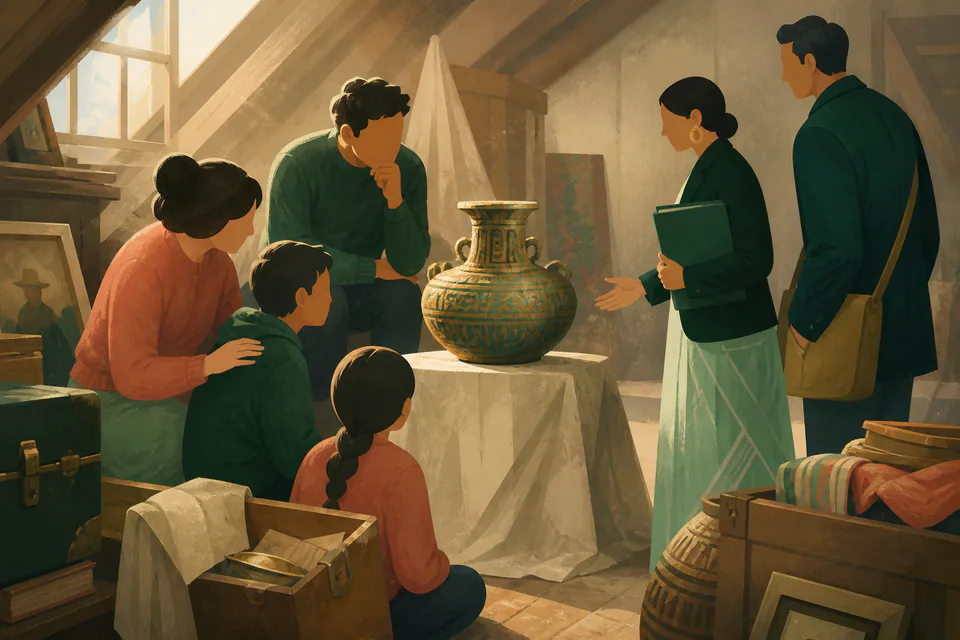
Your grandfather brought home an ancient artifact. A museum wants it back. Do you surrender it?
In your grandfather's attic you discover a beautiful ancient object he brought home while working overseas decades ago. Your family treasures it and his papers suggest the rules were murky. A museum from that country says it belongs to their collection and asks for its return.
Can a family inherit clear ownership of something acquired through unclear power?