Listen through the publisher, then discuss the episode here or arrange an in-person Roundtable. Your city determines where to meet.
Roundtables are designed for groups of four, with a shared subject and room for everyone to speak. Come for discussion, with no dating expectation.
All aboard the Story Train! Conductor Birdie is taking us to Dourville, a gloomy town where nobody smiles. Inventor Trixie has a clever idea to turn those frowns upside down with her colorful, sparkling toothpastes!
Episode information is provided by the publisher. Listening takes place on the publisher’s service.
For years, Jack knows one story that nobody outside his old high school seems to have heard. His social studies teacher told it on Halloween, and Jack remembers the detail that made a classroom full of teenagers go quiet. Somewhere under a building in Nebraska, a lightbulb came on, and Mr. Mays could see the children. Years later, Jack buys his old teacher a drink. He’s hoping to hear the story again. This time, Mr. Mays lets slip the name of a town. On a road trip with a friend, Jack finally has the chance to see how much his teacher made up for the benefit of a few high school kids. Finding an old building outside Broken Bow would settle part of it. To settle the rest, one of them will have to go downstairs.
Surrounded by sparkling rhinestones and neon ribbons, ten-year-old Barbie faces a major hiccup when a sticky glitter jam stalls her fashion show's crystal runway lift. With upbeat smiles and smart teamwork, Barbie, Teresa, and Nikki work in harmony to free the frozen gears and get the stage moving again. As deep indigo twilight settles over the coastline, the busy studio quiets down into a calm, sleepy stillness. Breathing in the sweet scent of vanilla and fresh cotton, Barbie snuggles into her plush loft bed and drifts into sweet dreams. Thank you for being part of our community! ️ Privacy & Opt-Out: https://redcircle.com/privacy
Imagine running an empire of ten million people without ever writing down a single word! Welcome to Tawantinsuyu, the massive Inca Empire hidden high up in the towering Andes Mountains! In 1438, a brilliant ruler named Pachacuti transformed the mountain town of Cusco into a glittering capital city shaped exactly like a giant puma. But how did they keep track of everything without pencils or paper? They used a genius math system made of colorful knotted strings called a quipu! To send important messages, they didn't use horses or wheels. Instead, they relied on superhuman relay runners called chasqui, who sprinted across scary woven grass suspension bridges and could travel 150 miles in a single day! They even built giant green staircase farms right into the steep mountainsides to grow huge amounts of freeze-dried potatoes. And guess what? They kept a very fluffy, squeaky pet in their kitchens for dinner—guinea pigs! Although the Spanish explorer Francisco Pizarro eventually brought dow
What is everything made of? Think of the chair you’re sitting on, the water you drink, and even you! In this episode, Asher and Kristen are joined by Connor from California. Together they hop aboard the Culture Train to discover the story of the periodic table of elements. First we travel back to the snowy winter of 1869 in St. Petersburg, Russia. A chemistry professor named Dmitri Mendeleev is working late into the night on his textbook. Scientists at the time knew about 63 elements, and it all felt like one enormous, messy list to memorize. We tiptoe through his creaky, lamp-lit study and watch him compare how heavy each element’s atoms are and how each one behaves. He even leaves empty spaces for elements no one has found yet! Then we zoom back to the present to visit Ms. Nielsen’s chemistry classroom. She shows us the giant periodic table on her wall and explains how Mendeleev’s big idea grew into the table scientists all over the world use today. Meet Mrs. Nielsen Teresa Nielsen t
Nine days after the Directorate garrison holding Westmere, the canal capital of a settled world three years under occupation, stopped answering its radios, a six-man team of the Federal Army's special reconnaissance slips across the outer canals at night to map what changed before the Federal assault on the city goes in. Every checkpoint is still manned: on the bridges the sentries stand where they died in the first minutes, crushed face-first onto the muzzles of the rifles they turned on one another, and those rifles hang in the empty air where they were aimed, with no hand on them. Something in Westmere exists only along the line of a loaded, aimed weapon: the moment a barrel rests on a living body for one slow breath, a taut strand of red cartilage, ringed like a windpipe and hooked every hand's width, runs from the muzzle to the target, the gun locks in the air as if bolted there, and the strand winches the target down its line, through anything and anyone in the way, until bone me
People leaving prison should receive practical help finding housing and work.
Share your view, then see how readers voted. No sign-in required. This poll is shared across stories.
Do you agree or disagree?
Common Quandary
A Common Quandary to discuss
Another conversation to explore, separate from this news story.
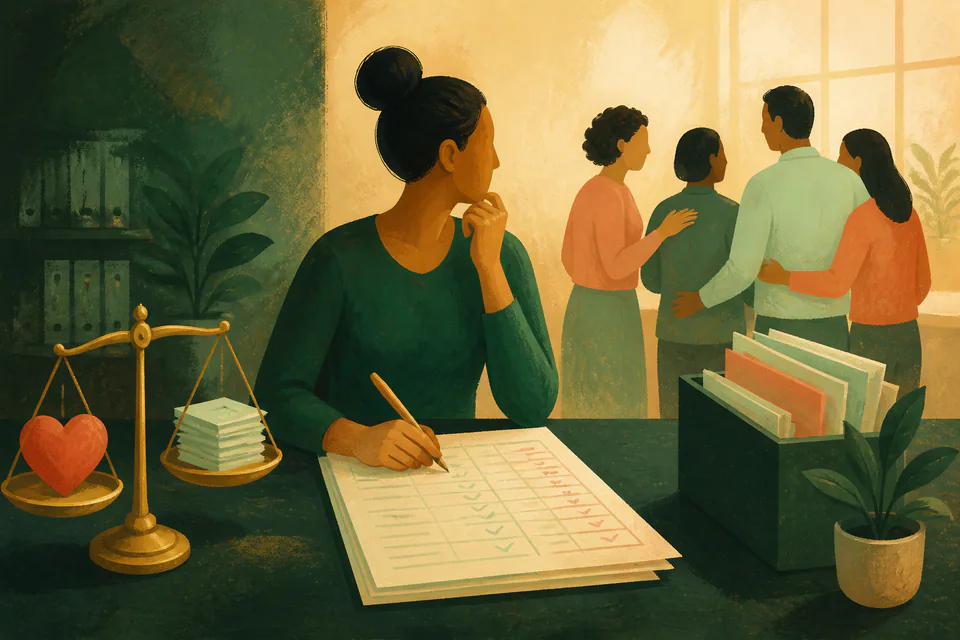
Your coworker bends a dumb rule to help people. Do you report it?
An underpaid coworker quietly bends a company rule to help colleagues receive benefits they were technically denied. No customer is harmed, but the records are inaccurate and you are asked to certify them.
Where should loyalty end when a rule seems unjust?