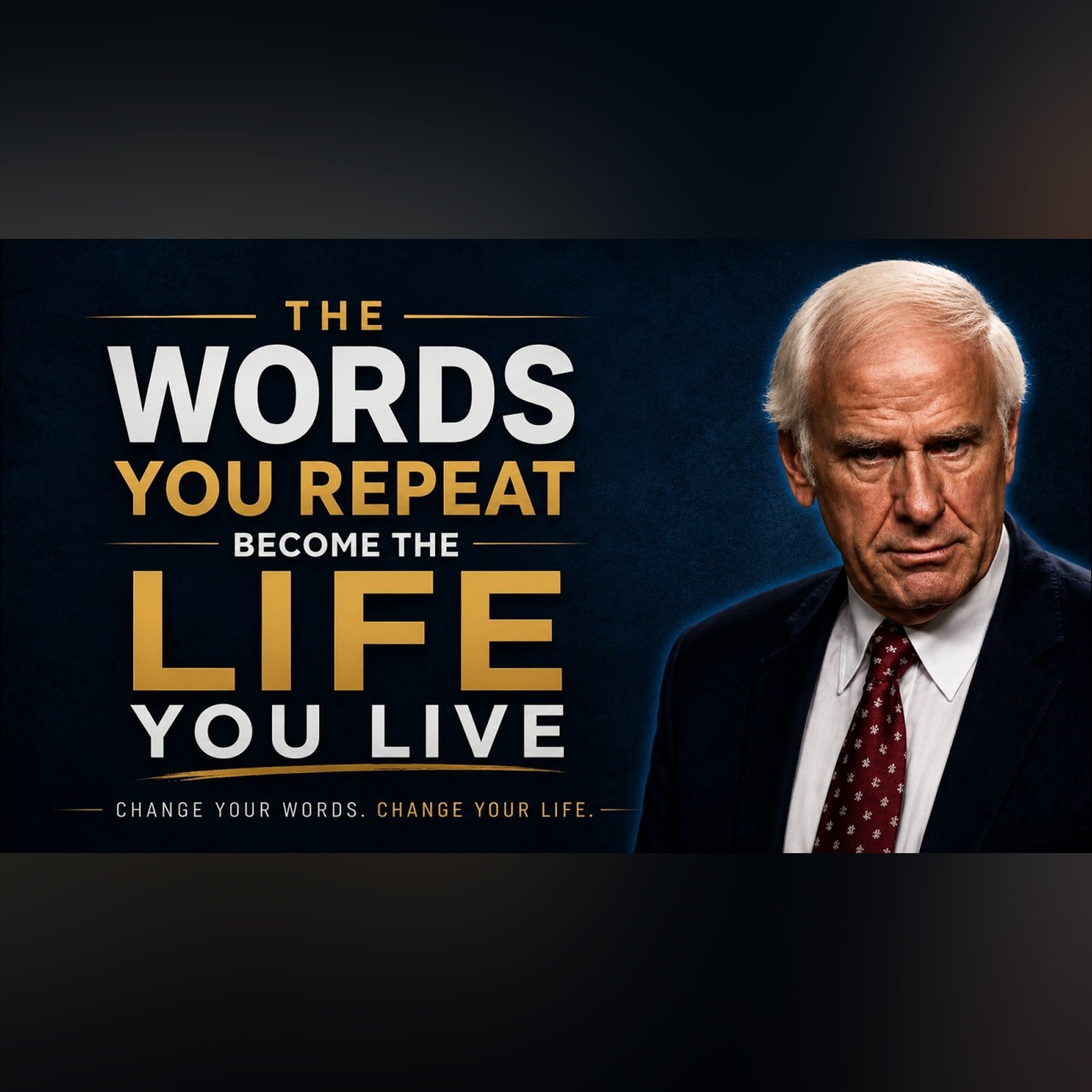
The Words You Repeat Become the Life You Live | Jim Rohn Motivation
Listen through the publisher, then discuss the episode here or arrange an in-person Roundtable. Your city determines where to meet.
Roundtables are designed for groups of four, with a shared subject and room for everyone to speak. Come for discussion, with no dating expectation.
Everyone has one. A phrase you repeat so many times a day that it stopped feeling like a statement and started feeling like a fact. "I'm just not good with people." "I've never been able to save money." "I'm too old to change now." Uploaded 05-09-26 You've said yours so many times you don't experience it as a choice anymore. You experience it as a description. You think you're reporting the weather. You're not reporting it. You're making it. Every time you say a thing about yourself, you lay another brick in a wall. And after enough years, you find yourself living inside a house you built one sentence at a time, wondering how on earth you ended up in such a small room. Here is the truth: the words you repeat are not neutral. They are instructions. They are architecture. Behavior follows belief, and belief follows repetition. This seminar unpacks the single mechanic behind how a repeated sentence quietly builds — or dismantles — a life. CHAPTERS 0:00 Intro — The phrase you repeat until it feels like a fact 2:06 Behavior follows belief, belief follows repetition 2:38 The mechanism — attention collects evidence to confirm 4:53 The disguise of the word "realistic" 6:44 A fact versus a verdict 7:52 The firewall between the problem and the person 9:46 The path across the field of grass 11:59 Why pasting a beautiful sentence over an ugly one fails 14:05 The young man who scheduled his failures 16:10 Is it true, or is it just something I say? 19:25 When the sentence is protecting you 22:54 What to do come Monday morning ATTENTION IS AN EVIDENCE MACHINE Say a thing about yourself often enough and your mind treats it as settled. Once it's settled, it stops hunting for counter-proof and starts gathering confirmation. The man who says he never catches a break isn't lying — he's trained himself to notice every closed door and walk right past every open one. The words come first. Then the blindness. Then the small life that seems to prove the words right. THE GROOVE THE FEET WORE A path across a field is never built. It forms because feet keep walking the same way. First a faint trail, then a rut so deep that new feet don't even choose their route. Your repeated words are those feet. The good news hides inside the bad: the mechanism doesn't care which direction you point it. The rut doesn't know it's a rut. THE SENTENCE THAT KEEPS YOU SAFE Some limiting sentences aren't just painful — they're protective. A predicted failure feels safer than an unpredicted one, because at least you felt in control. That's why positive thinking bounces off. The way out is a quiet conversation with the frightened part of you that's been keeping you small in the name of keeping you safe. WHAT TO DO THIS WEEK - For one week, just catch. Don't change anything, don't force positivity. - Become a witness to your own speech, out loud and inside your head. - Write down the sentences you repeat about yourself. - Ask of each one: is that actually true, or is it just something I say? - Replace one verdict with a modest, believable sentence — not a triumphant leap. — Inspired by the teachings of Jim Rohn. #jimrohn #motivation #selfdevelopment #discipline #selftalk
Episode information is provided by the publisher. Listening takes place on the publisher’s service.
Listen at the source ↗