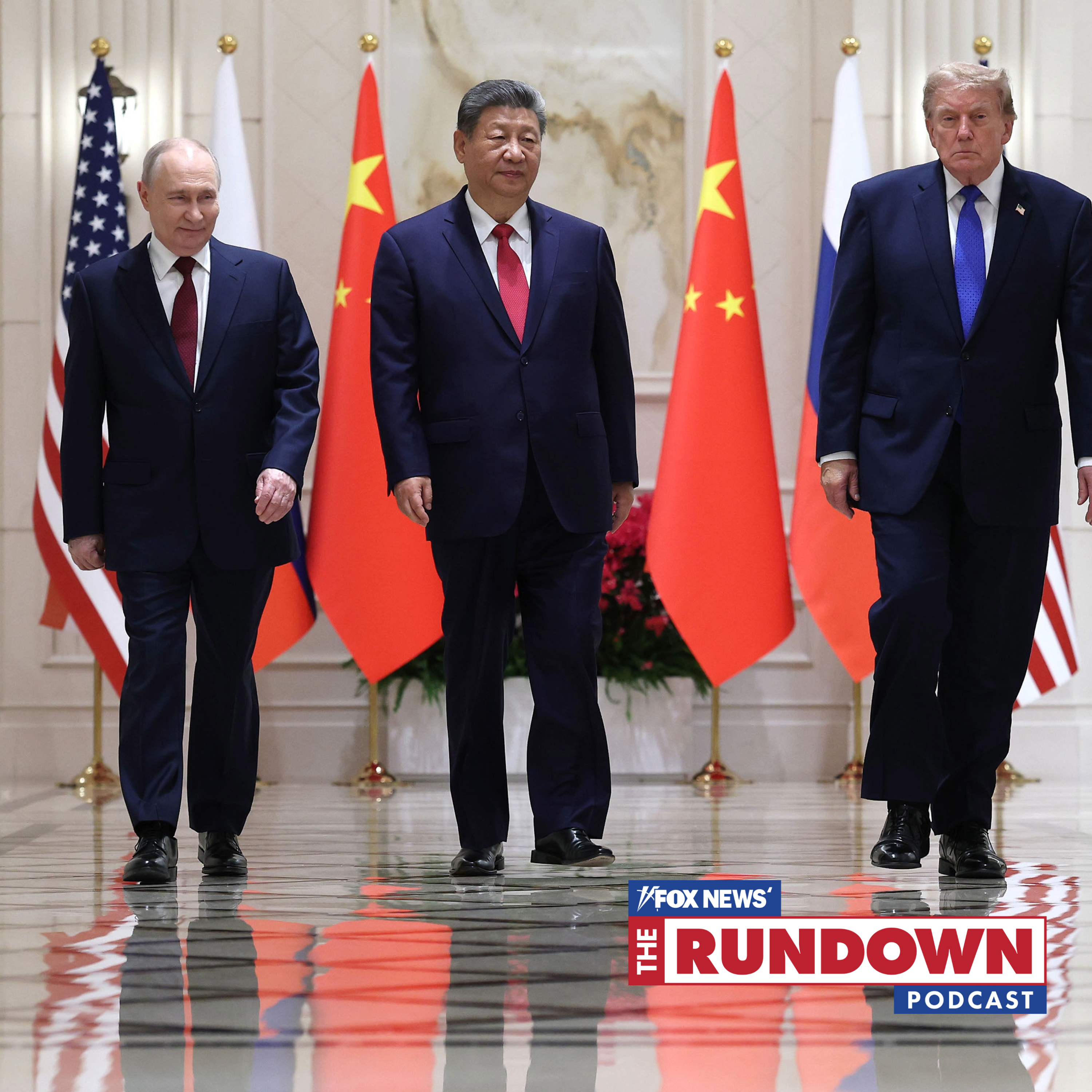
Three Superpowers, One Room: What Came Out of Shenzhen?
32 min
Listen through the publisher, then discuss the episode here or arrange an in-person Roundtable. Your city determines where to meet.
Roundtables are designed for groups of four, with a shared subject and room for everyone to speak. Come for discussion, with no dating expectation.
Following President Trump’s trip to Asia and a first-ever trilateral meeting with the leaders of China and Russia, foreign policy experts are weighing what was accomplished on the world stage. Former national security advisor to Vice President Dick Cheney and Heritage Foundation senior research fellow Stephen Yates joins The Rundown to analyze the summit’s outcomes on Taiwan, Ukraine, Iran, and strategic arms talks. Yates also explains how new rare-earth agreements with U.S. allies and export controls on AI chips balance Trump’s warmer rhetoric toward Beijing. Later, widespread tech outages across major platforms and government systems raise urgent questions about whether U.S. digital infrastructure is prepared for the artificial intelligence era. Former Cybersecurity and Infrastructure Security Agency (CISA) director Bridget Bean breaks down how rapid software patching can trigger cascading system failures, the growing cyber threats posed by China and Iran, and how organizations can defend against weaponized AI tools.
Episode information is provided by the publisher. Listening takes place on the publisher’s service.
A wave of major technology outages is raising troubling questions about America's cybersecurity, aging infrastructure, and readiness for a new era of artificial intelligence. Are these isolated technical failures, or warning signs of a much larger national security problem? John Solomon and Amanda Head welcome Ohio Congressman and former Army Ranger Warren Davidson, who discusses recent disruptions involving the FAA, Microsoft, and other critical systems. Davidson calls for greater transparency from government agencies and technology companies, questions whether America's infrastructure is adequately protected against emerging cyber threats, and examines how artificial intelligence could be used both to strengthen defenses and exploit vulnerabilities. The conversation also turns to immigration and national security, with Davidson raising concerns about individuals who entered the country illegally, potential gaps in government screening systems, and the surveillance powers used to moni
November 20, 2026 On November 19, Trump met with Xi Jinping and Vladimir Putin in Shenzhen, China, The fact that the president of the US would meet with leaders of China and Russia was bizarre since both China and Russia have been helping Iran in its current fight against the US, Trump appeared to want the fanfare and President Xi played that up, Putin wanted the meeting because it would suggest that Russia was a great power, although it is far from being so and Putin’s war on Ukraine is going poorly, The meeting’s purpose seemed to be to produce propaganda for each of the three leaders, Beyond the propaganda is the larger story of the destruction of the post-World War II rules-based international order, In its place is the idea of dividing the world into spheres of influence, The three leaders met for 90 minutes and issued only a vague "joint declaration toward peace," which vowed to reform the UN and weaken the International Criminal Court, where Putin is already under indictment for
At the trilateral meeting of the leaders of the United States, Russia and China, in Shenzhen this week, Donald Trump was keen to emphasise that they were making history. While wars continue to roil Ukraine and the Middle East, the three leaders sat down to discuss nuclear weapons, boosting petroleum production, reform of the United Nations and their dislike of the International Criminal Court. So was this a Yalta 2.0 as some parts of the media have suggested, or will this meeting soon be forgotten as just another wild moment from final years of Trump's presidency? Guest: Margaret MacMillan, emeritus professor of international history at Oxford University and the University of Toronto
President Donald Trump's first ever trilateral summit with Vladimir Putin and Xi Jinping raises questions about the future of the war in Ukraine and whether a peace agreement could finally be within reach. Victor Davis Hanson and Sami Winc examine the summit on today’s edition of “Victor Davis Hanson: In His Own Words,” discussing Russia's declining influence, potential territorial concessions in Ukraine, and Europe's frustration over Trump's peace negotiations. Hanson criticizes Hillary Clinton's attacks on Trump's diplomacy; he also argues that European leaders have weakened their influence by neglecting defense spending and relying on American military protection. They discuss Elon Musk's shifting political allegiances, and Hanson warns that distancing himself from MAGA may not protect him from Democrat investigations. They also discuss the potential economic benefits of artificial intelligence and the challenges facing Hakeem Jeffries as Democrats prepare to take control of the Hou
This week on The Necessary Conversation, it's Chad, Haley, and Mary Lou. Bob is still recovering but sent in a video message about Trump calling Putin his friend that we watch together. 🇷🇺 Trump held the first-ever three-way talks with Putin and Xi, called it a "12 out of 10," and produced nothing. Then at a press conference he called Putin his friend — and when asked if Putin is a friend to America, the president of the United States said, "I can't speak to America." That same day, Trump's friend Putin launched massive strikes into Ukraine, hit Poland with two missiles — an act of war against a NATO ally — then struck near a Ukrainian restaurant and drone-bombed the first responders, killing a 7-year-old child and a 20-year-old paramedic. We watch Bob's video and ask Mary Lou: is Russia our friend? 🇨🇳 The House Foreign Affairs Committee revealed Trump's Commerce Department approved nearly 880,000 advanced AI chips for Chinese military-linked companies including Alibaba, Tencent, a
In this episode of The President’s Daily Brief: President Trump meets face-to-face with Vladimir Putin and Xi Jinping in a historic summit bringing together the leaders of three nuclear superpowers. Peter Doran of the Foundation for Defense of Democracies joins us to examine each leader's objectives and what could come next. Ukraine launches a devastating attack on Russia's Kerch Bridge, sending a section of the strategically important crossing into the sea. Open Source Intelligence Analyst Ryan McBeth joins us to explain the operation and its implications for Russia's war effort. YouTube: youtube.com/@presidentsdailybrief (https://youtube.com/@presidentsdailybrief) Aura Frames: Life is amazing. Remember that with Aura Frames. Additional $5 off at https://auraframes.com/pdp/PDBwith Promo Code PDB Spring Sleep: Thanks to today’s sponsor, Spring Sleep: an FDA-cleared, prescription-only device for primary snoring and mild obstructive sleep apnea.
Some strange things are happening out in space and down here on Earth. Earlier this week, astrophysicist Neil deGrasse Tyson joined Aishah Hasnie (https://www.youtube.com/watch?v=yor7TRWw67k) to unpack a fast-moving object known as 1998 KY26 orbiting the Sun, UAP discussions, and the physics behind what a first alien encounter might actually look like. Tyson broke down why its trajectory doesn't follow standard gravity alone, weighed theories ranging from space junk to the Yarkovsky effect, and shared insights from his book Take Me to Your Leader: Perspectives on Your First Alien Encounter. They also dove into growing concerns around artificial intelligence, tech vulnerabilities, and why Tyson says global guardrails are essential—plus why he’d choose the future if he had a time machine. The conversation was full of laughs and interesting perspectives on space and the potential for extraterrestrial life, but it was too long for our regular midweek Rundown. So, on today's FOX News Rundow
Rep. Ilhan Omar’s (D-MN) immigration history is facing fresh scrutiny after federal agents searched her Washington, D.C., home in October, with new reports detailing subpoenas to relatives. There are also reports that her congressional staffers have been requested to speak about the possibility they were told to change the birth year listed in public biographies. This week, a federal judge in Washington, D.C. may have paved the way for the way to unseal the criminal search warrant and related documents against Rep. Ilhan Omar. Where do we stand on this investigation? FOX's Alexis McAdams speaks with Minnesota Republican Congressman Tom Emmer who says this isn't about background or beliefs, it is about facing consequences for criminal activity. Click here to Follow the FOX News Rundown: Evening Edition: https://link.podtrac.com/fnr_podeve Photo Credit: FOX Digital
Following sweeping midterm victories that are reshaping the balance of power in Washington, Democrats are already facing a fierce intraparty battle over leadership & leverage. FOX News Sunday Anchor and Host of the Livin’ the Bream Podcast Shannon Bream joins to discuss Hakeem Jeffries’ path to the Speaker’s gavel, Senate leadership dynamics involving Chuck Schumer, Chris Van Hollen, and John Fetterman’s 2028 outlook, and how a multi-day NSA outage and President Trump’s push for bipartisan deals could test both national security and party loyalty. Astrophysicist Neil deGrasse Tyson joins White House correspondent Aishah Hasnie to investigate 1998 KY-26, a mysterious object orbiting the sun whose trajectory isn’t following standard laws of gravity. Drawing from his new book, Take Me to Your Leader: Perspectives on Your First Alien Encounter, Tyson explains how humans could use math to communicate with extraterrestrials and challenges congressional UFO whistleblowers to bring forward har
Countries should consider serious effects on people abroad when setting domestic policies.
Share your view, then see how readers voted. No sign-in required. This poll is shared across stories.
Do you agree or disagree?
Common Quandary
A Common Quandary to discuss
Another conversation to explore, separate from this news story.
One coffee, four hours, last table. Can the café ask you to leave?
A neighborhood café has become a popular remote workplace. Some guests buy one drink and occupy tables for hours, while families and friends regularly leave because they cannot sit together.