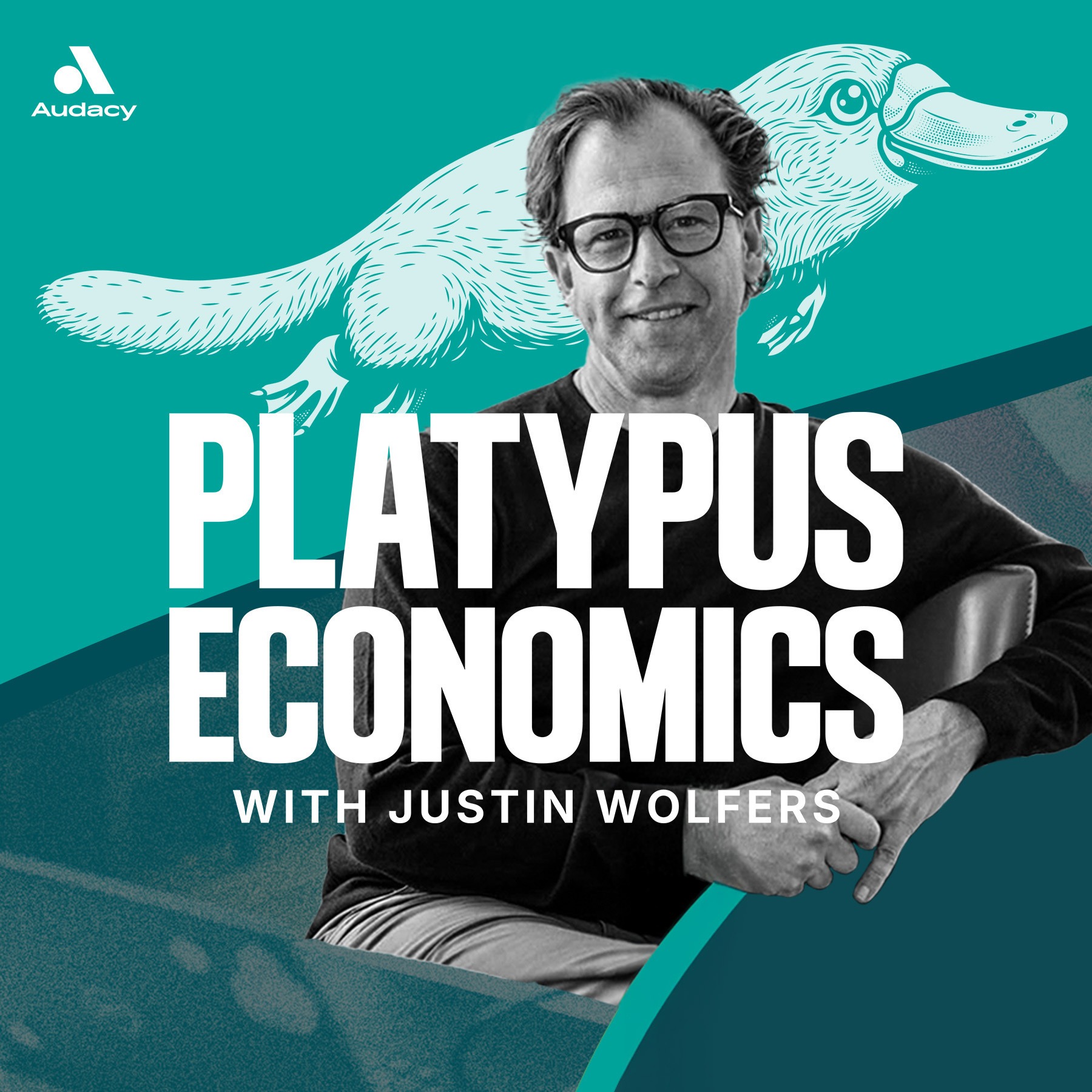
Trump’s Economy Was Self-Inflicted, and Voters Noticed
38 min
Listen through the publisher, then discuss the episode here or arrange an in-person Roundtable. Your city determines where to meet.
Roundtables are designed for groups of four, with a shared subject and room for everyone to speak. Come for discussion, with no dating expectation.
Did Americans just fire Trump as their economic manager? Justin Wolfers joins fellow Sydneysider Maddie Hale on The Trump Report to unpack a midterm that voters made about the economy. Inflation is stuck above target, and Justin worries it’s taking on a life of its own. He argues the damage is entirely self-inflicted: tariffs, a war with Iran that closed the Strait of Hormuz, a sharp drop in immigration and a record peacetime deficit. He also explains why household debt numbers sound scarier than they are. What matters is what the debt buys. Then they turn to the midterms. Voters didn’t just punish high gas prices. They punished incompetence: a trade war with Canada that gains America nothing, chaos on tariffs, and a Congress that has been missing for a year and a half. Justin explains why trading partners have stopped taking tariff threats seriously when every deal is signed in pencil. Finally, Justin looks at Elon Musk’s $474 million midterm loss. Musk spent in the wrong states. And on election night, his stock lost about $70 billion. That’s roughly 150 times what he spent. So the lesson a billionaire takes away may be that he should have spent more. on YouTube on Substack the Podcast Watch The Trump Report Follow on Social Media @PlatypusEconomics and @JustinWolfers
Episode information is provided by the publisher. Listening takes place on the publisher’s service.
This week on The Necessary Conversation, it's Chad, Haley, and Mary Lou. Bob is still recovering but sent in a video message about Trump calling Putin his friend that we watch together. 🇷🇺 Trump held the first-ever three-way talks with Putin and Xi, called it a "12 out of 10," and produced nothing. Then at a press conference he called Putin his friend — and when asked if Putin is a friend to America, the president of the United States said, "I can't speak to America." That same day, Trump's friend Putin launched massive strikes into Ukraine, hit Poland with two missiles — an act of war against a NATO ally — then struck near a Ukrainian restaurant and drone-bombed the first responders, killing a 7-year-old child and a 20-year-old paramedic. We watch Bob's video and ask Mary Lou: is Russia our friend? 🇨🇳 The House Foreign Affairs Committee revealed Trump's Commerce Department approved nearly 880,000 advanced AI chips for Chinese military-linked companies including Alibaba, Tencent, a
Your best hours. The ones where your mind is sharp, where your energy is high, where you could build something remarkable if you pointed yourself at it. Where do those hours go? Uploaded 16-09-26 I've asked a lot of people that question over the years. And when they're honest, the answer is almost always the same. Their best hours go to someone else. They spend the top of their morning building someone else's business, chasing someone else's numbers, advancing someone else's vision. And what's left for their own dream? The scraps. The tired hours. The hours after the good ones are already spent. I'm not telling you to walk out of your job tomorrow. I'm telling you most people have never even noticed the trade they're making. Here is the truth: not every hour is equal, and you have been handing your sharpest, freshest hour to work that isn't the work of your own life — and calling it being responsible. This seminar unpacks the single mechanic behind why your own dream never moves: you s
What will you do when the going gets tough? How will you react to economic winter, changes in the market and other events beyond your control? Will you shrink back in fear and adopt an attitude of scarcity – or will you power forward and learn how to take advantage of the moment? Uploaded 28-04-20 In this video, Ryan Deiss, CEO of Digital Marketer, best-selling author and expert investor, shares what you can do to not only continue to grow your business, but to grow as a human being as well. There are ways to make the most of hard times as a business leader, marketer, parent and friend. It’s all about turning your obstacles into opportunities. How can you do that? You must shift your focus. Instead of focusing on the negative, find the possibilities. You can head to https://www.tonyrobbins.com/career-business/where-focus-goes-energy-flows to learn how to get focused in this new environment. Tough economic times put most people in a mindset of scarcity and fear. They pull back. Business
Have you ever told someone, "Thanks a million!" or claimed you have "a million toys to clean up"? We use the word "million" all the time to mean "a whole lot," but have you ever stopped to wonder just how big a real million actually is? Join Mira and Finn on a mind-blowing math adventure as they discover the quiet power of giant numbers! Imagine counting one number every single second without ever stopping to eat or sleep. It wouldn't take a few hours or a long weekend—it would take you about eleven and a half days just to reach one million! And what about its giant neighbor, the billion? Counting to a billion the exact same way would take a whopping thirty-two years. That's a grown-up's whole life so far! In this amazing episode, we won't just look at numbers on a page; we’ll learn to feel their true size. Find out how much space a million grains of rice would take up, and discover exactly how far a million footsteps would carry you. Get ready to stretch your brain and learn why being
Have you ever tried something so hard, failed, and then tried again anyway? Meet Tony Hawk, the boy who turned his restless energy into skateboarding history! Growing up in sunny San Diego, California, Tony was a frustrated kid until his brother gave him a scratched-up blue skateboard. It was pure magic! By age 14, he was a fearless professional skater inventing wild, sky-high tricks on massive wooden ramps. Imagine being at the 1999 X Games, watching Tony attempt the ultimate, "impossible" trick: the 900! That's two and a half dizzying spins high in the air. Crash after crash, he fell ten times. But on his eleventh try? He landed it perfectly, while the crowd went absolutely wild! That same year, his smash-hit video game made him a superstar all around the world. But Tony didn't just want fame. He wanted every kid to have a safe place to ride, fall, and get back up. Through his charity, he has helped build hundreds of free public skateparks everywhere! Grab your helmet and drop in as
On 4th March 2023, UN member states agreed a historic treaty that had been over fifteen years in the making. The High Seas Treaty is the first ever treaty to protect the world’s oceans outside national boundaries. The aim is to meet the 30 by 30 biodiversity target, protecting 30% of the world’s oceans by the year 2030. Also known as the open sea or international waters, the high seas begin at the limit of countries’ exclusive economic zones. That means up to 370km, or 200 nautical miles, from the coastline. They account for 64% of the world’s oceans, and have been referred to as the last true wilderness, given how much mystery still lies within. Why is protecting the oceans so important? What measures are expected to come from the treaty? In under 3 minutes, we answer your questions! To listen to the last episodes, you can click here: How to make the most out of a rental property? (https://originals.bababam.com/do-you-really-know/202303090400-how-make-most-out-rental-property) What is
Are we in an AI stock bubble, or are investors betting on a genuinely bigger economy? Justin Wolfers examines AI stock valuations with Stacey Vanek Smith, separating what the technology could do for the economy from what investors might actually earn. A deliberately hypothetical valuation exercise shows why a trillion-dollar company isn't automatically absurd—but a breakthrough for society doesn't guarantee profits for shareholders. Competition can give you powerful tools at low prices while squeezing the companies selling them. The Thanksgiving turkey problem illustrates why a long run of good news can hide rare, severe risks. Justin connects that analogy to fat tails and the peso problem, then explains why spotting a bubble and successfully betting against it are different challenges. He also unpacks what the CAPE ratio can—and can't—tell you about whether stocks are overpriced. The stakes are your savings, not just Wall Street's scoreboard: Justin discusses an S&P 500 decline of 7.5
How does the federal budget deficit reach your wallet—and what would a fiscal crisis look like? Justin Wolfers answers your questions about the federal budget deficit, starting with the $2 trillion figure cited for fiscal 2026. He explains why acting early gives you time to plan for changes to taxes, retirement rules, and government services—and how lost lender confidence could force much sharper adjustments. on YouTube on Substack the Podcast Follow on Social Media @PlatypusEconomics and @JustinWolfers
Why is the US budget deficit $2 trillion when there’s no recession? Justin Wolfers explains why the US budget deficit reached $2 trillion in fiscal 2026: Washington collected $5.4 trillion and spent $7.4 trillion. At 6.2% of GDP, he argues, that’s the largest federal deficit outside a war or recession, even after adjusting for the economy’s size. You’ll learn the difference between this year’s borrowing and the debt built up over decades, then follow how aging, tax cuts, tariffs and reduced immigration shape the gap. Customs duties brought in $173 billion—a bucket next to a $2 trillion swimming pool. Justin also compares America’s borrowing with other countries to put those numbers in perspective. Why should you care? With about $32 trillion owed, a one-percentage-point rise in interest rates would eventually add roughly $320 billion a year to the government’s interest bill—about $1,000 per American. That’s not a bill mailed to your house, but it is an extra cost your government has to
Travel providers should disclose meaningful environmental impacts alongside prices.
Share your view, then see how readers voted. No sign-in required. This poll is shared across stories.
Do you agree or disagree?
Common Quandary
A Common Quandary to discuss
Another conversation to explore, separate from this news story.
The night before the wedding, your friend admits serious doubts. Do you tell their partner?
On the night before a wedding, your closest friend says they are unsure they should marry but insists it is ordinary panic. They make you promise secrecy and plan to proceed. Their partner asks you directly whether everything is okay.
When does loyalty require breaking a confidence before an irreversible choice?