Listen through the publisher, then discuss the episode here or arrange an in-person Roundtable. Your city determines where to meet.
Roundtables are designed for groups of four, with a shared subject and room for everyone to speak. Come for discussion, with no dating expectation.
The U.S. Commerce Department has placed Megaspeed, a Singapore-based artificial intelligence infrastructure firm, onto its trade blacklist to restrict its ability to purchase advanced semiconductors from American businesses. This punitive measure stems from allegations that the enterprise posed a significant threat of funneling high-tech computing resources to unauthorized destinations, ultimately sparking a criminal probe by the Justice Department regarding potential violations of export controls. The controversy is deeply intertwined with a broader scandal involving Nvidia, whose chief executive faced a temporary ouster following scrutiny over personal and professional connections to a former Megaspeed executive. Administration officials, including representatives from multiple government agencies, supported the inclusion of the firm on the Entity List due to concerns over illicit chip shipments to China. Ultimately, this high-profile enforcement action highlights an evolving shift in global trade, where regulators increasingly demand strict, verifiable proof of product origins and supply chain transparency rather than relying solely on traditional shipping documents.
Episode information is provided by the publisher. Listening takes place on the publisher’s service.
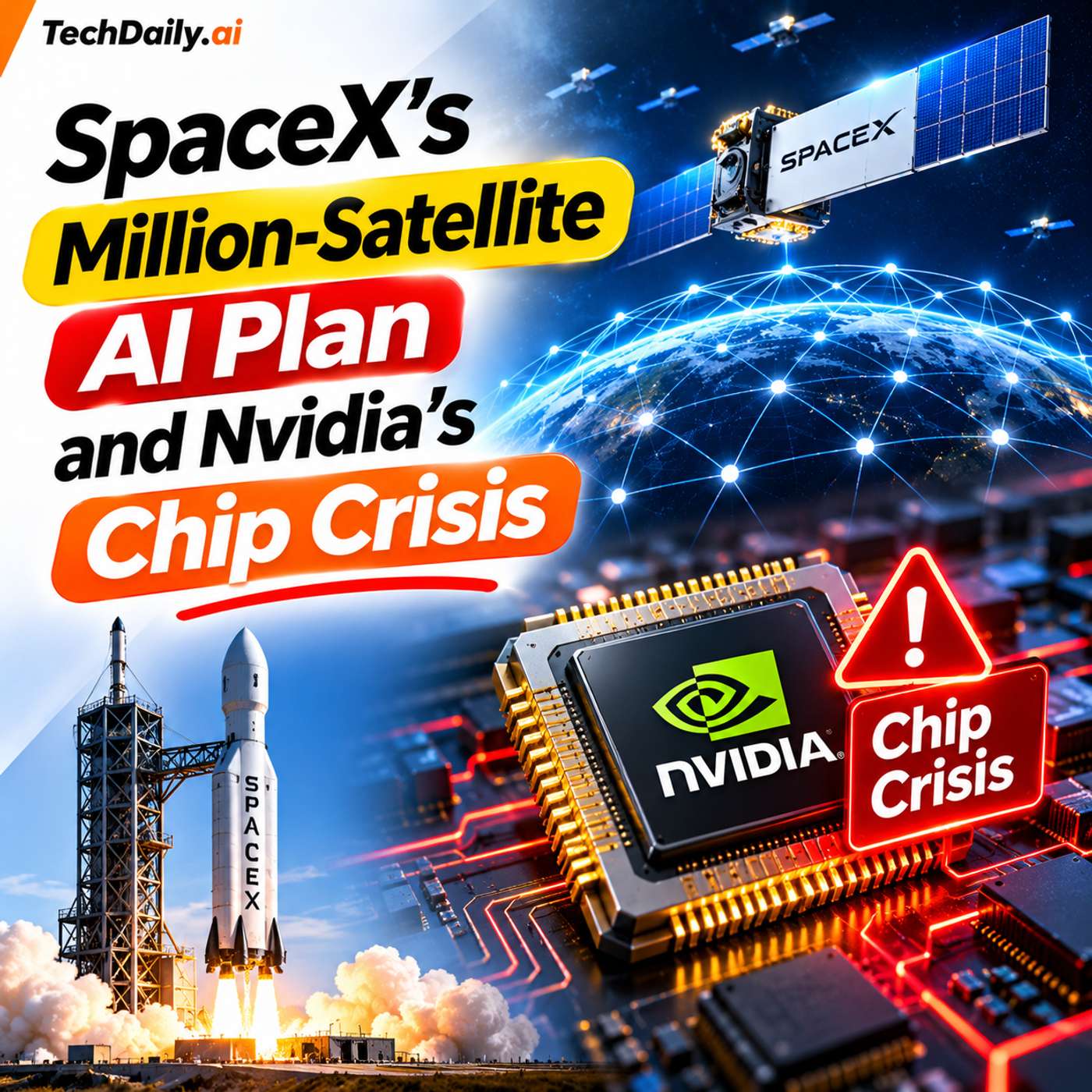
What if the future of artificial intelligence isn't being built in Silicon Valley but in low Earth orbit? And what happens when the semiconductor supply chain powering that future becomes vulnerable to international chip smuggling? In this episode of TechDaily.ai, David and Sophia explore SpaceX’s ambitious vision for a million-satellite orbital AI data center network, the engineering challenges of computing in space, and the growing concerns surrounding Nvidia, semiconductor export controls, and global AI competition. From laser-powered satellite communications to advanced AI chip restrictions, this episode examines the technological, economic, regulatory, and ethical challenges shaping the future of artificial intelligence. In this episode, we discuss: SpaceX’s Star Mind project and its proposed million-satellite constellation. Orbital AI data centers and the future of computing infrastructure. Laser-based satellite communications and Starlink connectivity. Thermal management and coo
Jensen Huang's dramatic reinstatement at Nvidia sparks a fierce debate over corporate governance, national security, and unchecked CEO power. Fr. Robert Ballecer, SJ joins Leo Laporte and Jeff Jarvis to unpack Anthropic's record-breaking IPO, AI breakthroughs in math and history, autonomous hacking, and the push for local AI. • Pope Leo's Magnifica humanitas, effective altruism, and why AI can't have morality • The Vatican's targeted open-weight LLMs and why LLMs may be a dead end for AGI • Local AI hardware, LoRA fine-tuning, and rising Nvidia DGX Spark prices • Why Jensen Huang was reinstated at Nvidia and the Alice Huang China intelligence fallout • Anthropic's record-breaking IPO and the case for open, globally owned AI models • Anthropic and Claude claim to prove the Riemann hypothesis • OpenAI's preprint on the matrix multiplication exponent (ω = 9/4) and perplexity benchmarks • Anthropic's "Install as app" beta for Claude Artifacts and vibe coding custom firmware • GPT 6.2 Astra
Jensen Huang's dramatic reinstatement at Nvidia sparks a fierce debate over corporate governance, national security, and unchecked CEO power. Fr. Robert Ballecer, SJ joins Leo Laporte and Jeff Jarvis to unpack Anthropic's record-breaking IPO, AI breakthroughs in math and history, autonomous hacking, and the push for local AI. • Pope Leo's Magnifica humanitas, effective altruism, and why AI can't have morality • The Vatican's targeted open-weight LLMs and why LLMs may be a dead end for AGI • Local AI hardware, LoRA fine-tuning, and rising Nvidia DGX Spark prices • Why Jensen Huang was reinstated at Nvidia and the Alice Huang China intelligence fallout • Anthropic's record-breaking IPO and the case for open, globally owned AI models • Anthropic and Claude claim to prove the Riemann hypothesis • OpenAI's preprint on the matrix multiplication exponent (ω = 9/4) and perplexity benchmarks • Anthropic's "Install as app" beta for Claude Artifacts and vibe coding custom firmware • GPT 6.2 Astra
Tom Uren and Amberleigh Jack talk about a new congressional report examining America’s increasing dependence on China’s open-weight AI models. The US needs to turbocharge its own domestic alternatives. They also discuss the ongoing controversy regarding SpaceX services in Ukraine. Someone placed speed limits on these services in Ukraine, but no one in the US government or SpaceX is taking responsibility. It’s a bad look, especially when American allies may be thinking about buying into Starshield, SpaceX’s military version of its Starlink service. This episode is also available on YouTube (https://youtu.be/1aqvVz4rRD8) Show notes
"success is based off three fundamental keys, once seen they cannot be unseen." In this compelling episode, Jack shares the three keys to success that he discovered through years of selfdevelopment and introspection. Drawing from his extensive experience with selfhelp books and personal growth, he emphasizes the importance of commitment, positive selftalk, and forgiveness. He delves into practical steps, such as keeping promises to oneself, speaking kindly, and addressing guilt and regrets. He advocates for becoming the person one admires, focusing on inner qualities rather than external achievements. Jack Hopkins also highlights the impact of influencing others positively, emphasizing the reciprocal nature of inspiration. Throughout the video, he encourages viewers to face fear as a guiding system for change and growth. Concluding with the timeless trio of selfbelief, goalsetting, and action, he leaves you with a sense of empowerment and a call to embrace positivity and personal devel
Thinking about moving from Windows to a Mac as a blind user? Steven Scott and Shaun Preece talk through the MacBook Neo, the TurnOver screen reader and the question everyone asks before buying. Then the inbox has plenty on braille: a detailed review of the Orbit Flow 40, the Cadence tactile tablet and a listener in Pakistan looking for advice. This episode is supported by Pneuma Solutions. Creators of accessible tools like Remote Incident Manager and Scribe. Find out more at https://pneumasolutions.com/ Shaun is back on the Mac after years away, and the MacBook Neo has impressed him with how fast it feels. That leads into TurnOver, Oliver Kennett's free screen reader that offers NVDA, JAWS and VoiceOver key layouts on macOS. Steven likes it a lot but urges caution. He thinks you should learn macOS first, buy from somewhere with a good return policy, and work out what you want from the switch before spending the money. The hosts also give their views on Jensen Huang's return to NVIDIA,
Special committees consisting of directors from Tesla and SpaceX are currently negotiating the terms for a massive all-stock megamerger that would combine the two enterprises into a $3.5 trillion corporate giant. Prominent financial institutions like Morgan Stanley, Goldman Sachs, and Evercore have been enlisted to advise the separate committees as they race to finalize an agreement before the end of the year. While the strategic alignment offers tremendous scale, the proposed transaction introduces significant complexities, including heightened execution risks, massive capital requirements, and increased regulatory oversight. Ultimately, the deal will require approval from a majority of Tesla shareholders, leaving independent directors with the heavy responsibility of protecting stakeholder interests against potential legal scrutiny and conflicts.
Jensen Huang recently returned to his role as Nvidia CEO following a brief ousting prompted by multiple extramarital affairs, including one involving an alleged Chinese spy. During an all-hands meeting, Huang addressed company staff to admit terrible mistakes, confess that he violated corporate policy, and announce that he had begun attending daily therapy. His sudden reinstatement sparked intense debate across the corporate world regarding governance standards, vulnerability, and executive accountability. While some commentators praised his open expression of humility and willingness to apologize, others criticized his remarks as vague public relations maneuvers that failed to deliver true corporate accountability. Furthermore, industry observers raised broader questions about succession planning and the dangers of cultivating an irreplaceable leader within massive global enterprises.
The contemporary employment landscape operates as a split-screen labor market, dividing workers into two distinct realities based on their current employment status. Individuals who currently hold corporate positions enjoy stability, receiving ongoing wage increases while facing a lower volume of layoffs compared to previous years. Conversely, white-collar job seekers and recent graduates endure a grueling process, with the average employment search stretching to twenty-seven weeks, which represents the highest duration outside of the pandemic in over a decade. To navigate these challenges, professionals often utilize a strategic eighty-twenty approach that emphasizes deep relationship building and targeted outreach over passive mass applications. Ultimately, career experts and commentators highlight that this extended waiting period places an unfair psychological and financial burden entirely on applicants rather than encouraging companies to streamline hiring practices.
Organizations should collect less personal information rather than simply promise stronger security.
Share your view, then see how readers voted. No sign-in required. This poll is shared across stories.
Do you agree or disagree?
Common Quandary
A Common Quandary to discuss
Another conversation to explore, separate from this news story.
Everyone clicks through mandatory training without reading it. May you do the same?
Your employer requires an hour-long annual course whose answers have not changed in years. Coworkers run it in the background and share the quiz answers. Completing it carefully would make you late for actual work with a deadline.
When does pointless compliance excuse pretending to comply?