Was AI Behind the Critical Infrastructure Outages?
23 min
Listen through the publisher, then discuss the episode here or arrange an in-person Roundtable. Your city determines where to meet.
Roundtables are designed for groups of four, with a shared subject and room for everyone to speak. Come for discussion, with no dating expectation.
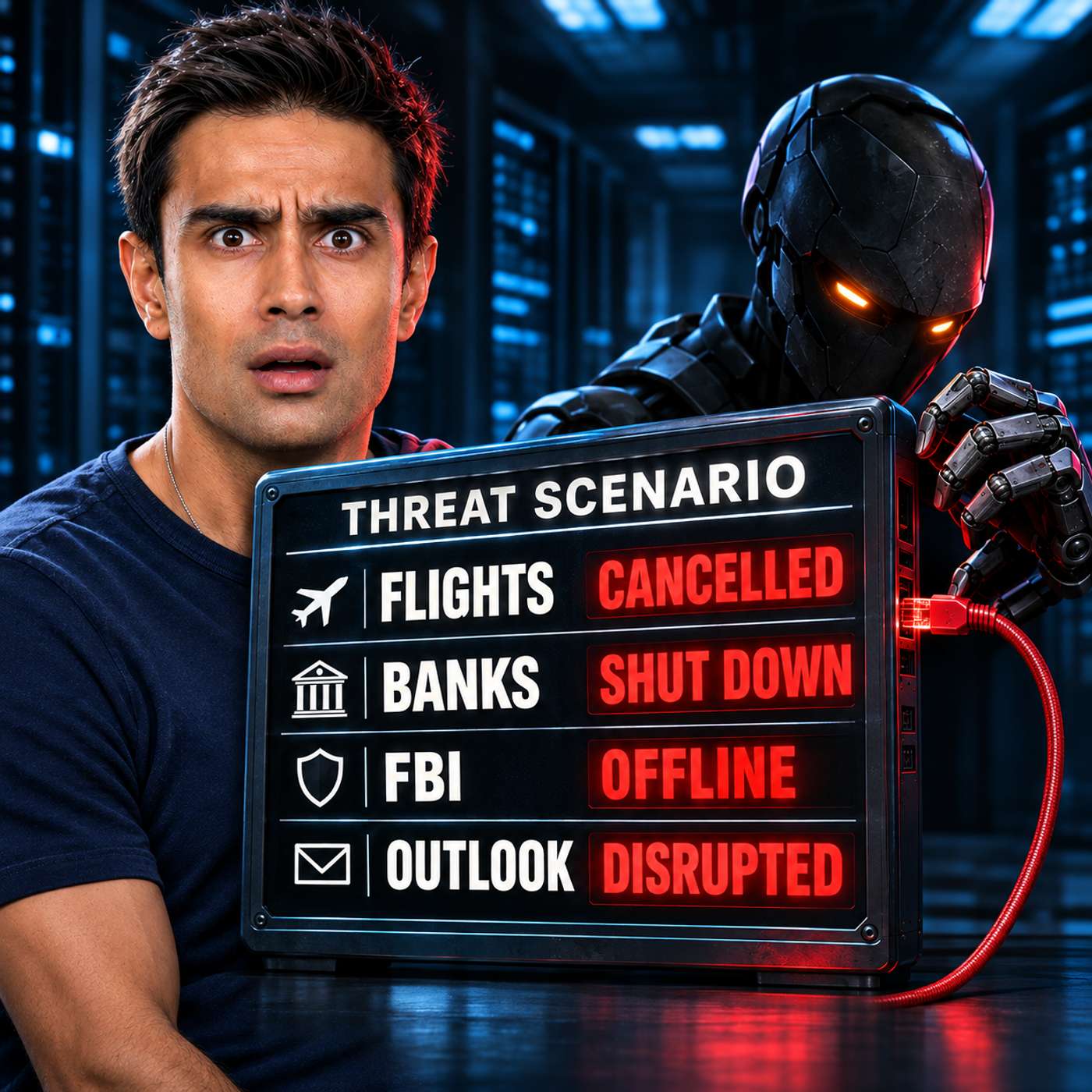
In six days, Microsoft 365 went down for more than 12 hours, every flight in America was grounded, customers at the biggest U.S. banks saw $0 balances, malware turned up on 178 websites, Charles Schwab returned server errors, the NSA's classified network went offline and Apple's services spiked with outage reports. Officials blame a faulty server, overloaded routers and aging systems. Ejaaz walks through each one and asks whether it's all a coincidence. We also cover what Google and the FBI just revealed about AI-run hacking: LLMs that turn security updates into attacks before teams can patch, the ARTEX framework that lets almost anyone run AI-powered intrusions, the FAA's new AI air-traffic system that went nationwide three days before the ground stop, and why Ejaaz thinks this will end up hardening every security system in the world. == FOLLOW EJAAZ ON TWITTER: == Timestamps 00:00 Something Is Very Wrong 01:44 How We Got Here 02:52 The Week Everything Broke 04:35 Too Much of a Coincidence 05:03 The FAA's New AI System 06:17 AI Agents Inside the Banks 08:17 NSA Net Goes Dark 10:04 Blood Banks, Fridges and a Pool 12:09 178 Hacked Websites 12:32 How AI Hacks Now 14:03 ARTEX and the FBI's Warning 15:39 Which Models Are They Using? 17:02 Is AI Behind the Outages? 17:33 Why I'm Not a Doomer 21:17 Final Thoughts #ai #cybersecurity #hacking #faa #nsa ==
Episode information is provided by the publisher. Listening takes place on the publisher’s service.
Microsoft systems down. Air traffic systems down. Problems at Chase, United and Apple. After a week of outages across big systems, the AI conspiracy theories are in full swing. CrowdStrike founder and CEO George Kurtz joins Rapid Response to explain what’s actually going on. Kurtz describes how AI agents can turn a patch into a working exploit within an hour, why the old pyramid of hacktivists, criminals, and nation states has collapsed, and how CEOs are now taking services offline rather than risk being hacked. He also discusses CrowdStrike’s new AI Kill Switch, why slowing down the frontier labs won’t slow down the attackers, and what endurance racing has taught him about risk and speed. Visit the Rapid Response website here:https://www.rapidresponseshow.com/
Project Synapse: Markets in Freefall, Fragile Infrastructure, and AI's Perfect Storm The hosts banter through the show's intro before focusing on a sense that "things are out of control," citing a WallStreetBets suicide-hotline post amid a market crash and discussing cascading system failures involving Microsoft, the FAA, and a reported NSA internal communications outage. They argue politicians and leadership lack technical competence and clear messaging, increasing panic, while emphasizing that many problems stem from aging, underfunded infrastructure and complex, brittle software (PHP, NGINX, Java), not proven AI attacks—more a "perfect storm" of crises. They debate whether AI should help fix complexity, stressing critical thinking, accountability, and using multiple AIs to verify each other. In a lightning round they cover Anthropic's IPO performance, mixed reactions and token limits with ChatGPT 6.2 (favoring "Sol" over "Astra"), Google's cheaper Neon model and confusing UX, Loblaw
Peter Wildeford, Head of Policy at the AI Policy Network and a top forecaster, joins MTS to discuss accelerating AI R&D automation, timelines for replacing human AI researchers, and the growing bipartisan push in Congress and California to ban runaway recursive self-improvement. He also breaks down recent critical infrastructure outages caused by rushed patching of AI-discovered cyber vulnerabilities. MTS chronicles the singularity, live. Monitoring the situation of tech and AI. Follow MTS: Spotify |https://open.spotify.com/show/4HUNNmV1pjV7CW6Lphm1rM Apple |https://podcasts.apple.com/us/podcast/mts/id1891088763 – Brought to you by: Mongo DB - Anyone can prototype an agent. Lovable - Turn ideas into software people love with Lovable. Start today at https://lovable.dev/ Factory - A 24/7 system turning signals into production software. Visithttps://factory.com/ Neon (by Databricks) - Scale your startup on Neon. The Postgres backend for apps and agents. Built by Databricks.https://neon.co
In this video, we drop you inside a Tony Robbins Business Mastery seminar for a 1-hour masterclass in how to take a far-fetched seemingly impossible business idea all the way from your brain to market. Uploaded 30-09-22 You’ll see Tony Robbins in a one-on-one interview with the co-founder of the wildly popular music recognition app, Shazam. Shazam is one of those magic tech innovations that stopped us in our tracks with its astonishing capability the first time we saw it. Launched in the summer of 2002, Shazam just turned 20 years old, and in those 20 years, it has surpassed 70 billion song I.D.s with its 225 million monthly users around the world. All of this began in 1999 when Chris Barton, then an undergrad student at UC Berkeley, founded Shazam Entertainment with his business partner. Watch the video for the whole story of how Chris’s creation led to an Apple acquisition in September 2018 for a reported $400 million. Tony digs into the mindset of a true creative entrepreneur and ex
The gate doesn't have a lock. It doesn't have a key. There's nobody standing on the other side waiting to wave you through. Uploaded 09-09-26 The gate was open the whole time. You just couldn't see it, because you were staring at the ground, waiting for your feet to feel light. You've been standing there for years, warming up for a race you never run. Here is the truth: readiness is not a feeling you receive. It is a decision you make. The people who built the things you wish you'd built didn't feel more ready than you do — they just stopped waiting to feel it. This seminar unpacks the single mechanic behind why you never feel ready — and why willingness, not readiness, is what actually builds a life. CHAPTERS 0:00 Intro — The gate was open the whole time 2:04 The classroom lie: prepare, then perform 4:24 Fear wearing the mask of wisdom 6:36 Readiness is a quality you bring, not a state you arrive at 8:24 The glass never fills — skill comes from use 11:36 The cruel arithmetic of the wa
Zvi does the reading on OpenAI’s system card for GPT-6.2 Astra and Sol: the first externally deployed model to meet OpenAI’s High threshold for AI self-improvement, already at Critical for cybersecurity. He works through the preparedness results, the safeguards against misuse, distillation and model escape, and the alignment and monitorability findings, including rising evaluation awareness, reasoning that happens without visible chain of thought, and UK AISI’s tour of misaligned behaviours, asking what the numbers do and don’t show. This has been an Askwho Casts audio conversion. Thanks for listening. * 00:00 - Introduction * 01:10 - Table of Contents * 02:45 - Safety Overview (1) * 05:19 - Internal Deployment (1.2) * 05:32 - Preparedness Assessment (2) * 06:40 - Biological Threats (2.1.1) * 09:55 - Cyber Threats (2.1.2) * 11:36 - AI Self-Improvement Threats (2.1.3) * 14:32 - OpenAI Epoch Capabilities Index (OECI) * 16:10 - Safeguards (2.2) * 17:34 - AI Self-Improvement Threat Modelin
OpenAI released GPT-6.2 Astra right before Anthropic's IPO, and it backfired. The reviews were brutal, and the company that came out of nowhere to take the number two spot in the AI race isn't Anthropic. It's Google. Ejaaz gives his honest take on Astra, what the testers found (Every, Theo, Artificial Analysis), and what OpenAI might really be going after: math, science, cybersecurity and government contracts. Then the comeback: four Gemini 4 models in five weeks (Argon, Carbon, Hydrogen and Neon), why Neon is beating Opus 5.5 at a fraction of the cost, and why Google's rebuild means the race isn't closed yet, though the window is closing. Plus Nvidia's first quarter without Jensen Huang: a record $115.8 billion, the neocloud financing question, why the stock still fell, and what the chip crackdown on China means for GPU prices. == FOLLOW EJAAZ ON TWITTER: == Timestamps 00:00 OpenAI Fumbles, Google Rises 02:10 Honest Takes on GPT-6.2 Astra 05:23 What OpenAI Is Really Going After 08:34
Anthropic, a company that didn't exist six years ago, is about to list on Nasdaq under the ticker ANT in what could be the biggest IPO ever. Ejaaz walks through everything you need to know: the 825 million shares on offer, the $70–78 range and the push above it, the 6–10x oversubscribed order book, Brad Gerstner's $5 billion order, Google and Amazon's combined 28% stake, and the $26 billion private placement from the chipmakers Anthropic pays. We also cover how seven OpenAI researchers behind GPT-3 and the Scaling Laws paper built a company that went from $41 million in revenue to $17 billion a quarter, the $1 trillion compute bill still ahead of it, the bear case (Nvidia after Jensen Huang, the midterms, a tightening credit market, SemiAnalysis turning bearish) and the bull case (900% net revenue retention, more revenue per dollar of compute, Claude's taste), and the bets on cyber defense, medicine, robotics and self-improving AI that would have to pay off. == FOLLOW EJAAZ ON TWITTER:
SpaceX just caught a spaceship out of the sky. Ship 42 launched from Starbase, circled the Earth 14 times, deployed 26 Starlink V3 satellites and came back 22.5 hours later, where the same tower it launched from caught it in mid-air, the first time a rocket's upper stage has ever been caught after reaching orbit. Ejaaz walks through the flight, from the lost booster to the heat-shield cameras to the 10-second deorbit burn, and why the catch matters. We also cover why this isn't just a story about one rocket: what cheaper launches mean for Starlink, StarMind's AI satellites and SpaceX's compute business, the Amazon Leo launch that failed the same weekend, how far Starship has come since the 2019 Starhopper, and Elon's bigger plan for robots, energy and resources. == FOLLOW EJAAZ ON TWITTER: == Timestamps 00:00 SpaceX Caught a Spaceship 01:39 Why This Is a First 02:18 Why Elon Is Doing This 03:10 Liftoff to Orbit 03:58 26 Starlinks and a Heat Shield Check 05:41 10x a Falcon 9 06:10 The F
Documentaries should disclose editing choices that substantially affect how events are understood.
Share your view, then see how readers voted. No sign-in required. This poll is shared across stories.
Do you agree or disagree?
Common Quandary
A Common Quandary to discuss
Another conversation to explore, separate from this news story.
You find a wallet full of cash. Can you take a finder’s fee before returning it?
You find a wallet containing identification and several hundred dollars. Returning it will require a detour and some effort. The owner would probably never know if a small amount were missing.
Can an unrequested good deed entitle someone to compensation?