Listen through the publisher, then discuss the episode here or arrange an in-person Roundtable. Your city determines where to meet.
Roundtables are designed for groups of four, with a shared subject and room for everyone to speak. Come for discussion, with no dating expectation.
Have you ever wondered how your brain knows which body parts belong to you? It sounds like a silly question—obviously, your hands are yours! But what if your brain could be tricked into thinking a fake piece of plastic was actually part of your body? In this mind-bending episode of Philosophy is Not Boring, Mira and Finn explore one of the wildest science experiments ever: The Rubber Hand Illusion! In 1998, scientists Matthew Botvinick and Jonathan Cohen in Pittsburgh set up a crazy test. They hid a volunteer's real hand behind a cardboard screen and put a lifelike rubber hand right in front of them. Then, they used two soft paintbrushes to stroke both hands at the exact same time! What happened next will shock you! Within minutes, the volunteers' brains got totally confused and actually felt the paintbrush touching the fake rubber hand! Tune in to discover how your super-smart brain uses sight and touch to build a map of your body, and find out what happens when you play a video game. Get ready to question reality—and wiggle your fingers just to be sure they are still yours!
Episode information is provided by the publisher. Listening takes place on the publisher’s service.
Did you know your mouth is a nonstop biological water park?! Every single day, your body makes enough saliva to fill up to four whole water bottles! But spit isn't just warm water—it's a magical biological potion packed with incredible superpowers. Join Mira and Finn as they explore the wild world of saliva! Discover how a microscopic machine called amylase starts digesting your favorite foods the exact millisecond you take a bite. Find out how spit turns sharp, crunchy chips into soft, squishy balls to protect your throat! Plus, did you know saliva actually builds invisible armor for your teeth by filling in holes with special minerals like calcium and phosphate? It even works as a magical liquid key to unlock flavors—without saliva, chocolate and pizza would taste like absolute cardboard! From amazing spit factories hiding inside your cheeks to real-life birds that build entire nests out of spit, get ready for a mind-blowing biological adventure! Tune in to find out why your mouth is
Keith Cunningham – renowned business expert, entrepreneur and speaker – highlights the critical crisis management questions that you must ask yourself to maximize periods of “thinking time.” Uploaded 28-04-20 What’s “thinking time”? Some business owners might call it an economic downturn. Tony Robbins calls it economic winter. But the most successful people call it an opportunity. They’re able to see that with the right mindset, a crisis can create breakthroughs, instead of breaking you. Hear what Tony had to say about creating breakthroughs on his podcast at https://www.tonyrobbins.com/podcasts/3-steps-breakthrough and get started creating yours today. Keith says in the video, “Cursing the wind doesn’t stop the hurricane.” In times of hardship, we have no choice but to play the hand we’ve been dealt. And as the saying goes, it’s not the hand you’ve been dealt, but how you play the hand that determines whether you win the game. How can you ensure you’re playing your hand in the best po
Instant Access to your FREE training course: https://nci.university (https://nci.university/) Uploaded 27-07-25 This is the simulation you already live inside of—and you’ve been breathing it like oxygen since the day you were born. In this video, we expose the invisible machinery beneath modern life—how symbols have replaced truth, how marketing has replaced meaning, and how our desires are manufactured by the very system that feeds on them. Drawing from the work of Jean Baudrillard and the hidden mechanisms of simulacra, we walk you through 10 real-life “glitches” that reveal the truth: • Why your food is rendered, not real • How social media replaced memory • Why you take photos of things you never actually see • And why even your “rebellion” is likely pre-approved This isn’t a conspiracy. It’s a mirror. And once you see it, you can’t unsee it. simulation theory, simulated reality, Baudrillard simulation, are we in a simulation, hyperreality explained, social media illusion, digital
Have you ever told someone, "Thanks a million!" or claimed you have "a million toys to clean up"? We use the word "million" all the time to mean "a whole lot," but have you ever stopped to wonder just how big a real million actually is? Join Mira and Finn on a mind-blowing math adventure as they discover the quiet power of giant numbers! Imagine counting one number every single second without ever stopping to eat or sleep. It wouldn't take a few hours or a long weekend—it would take you about eleven and a half days just to reach one million! And what about its giant neighbor, the billion? Counting to a billion the exact same way would take a whopping thirty-two years. That's a grown-up's whole life so far! In this amazing episode, we won't just look at numbers on a page; we’ll learn to feel their true size. Find out how much space a million grains of rice would take up, and discover exactly how far a million footsteps would carry you. Get ready to stretch your brain and learn why being
Have you ever seen pictures of giant stone heads sitting in the grass and wondered how they got there? Get ready for a mind-blowing adventure to one of the most remote places on Earth: Rapa Nui, also known as Easter Island! About 800 years ago, expert Polynesian sailors found this tiny island in the middle of the Pacific Ocean using only the stars and ocean currents to guide them. Once there, they carved nearly a thousand massive stone statues called moai! But here is the biggest surprise: these statues aren't just heads—they have full bodies buried underground! Some weigh as much as 40 cars, and the islanders moved them without wheels, cranes, or metal tools. How did they do it? The local legends say the statues literally walked to their places, waddling side to side with the help of ropes and incredibly smart human engineering! Join Mira and Finn as they uncover the secrets of the moai, find out how the island got its English name from a Dutch captain, and learn all about the giganti
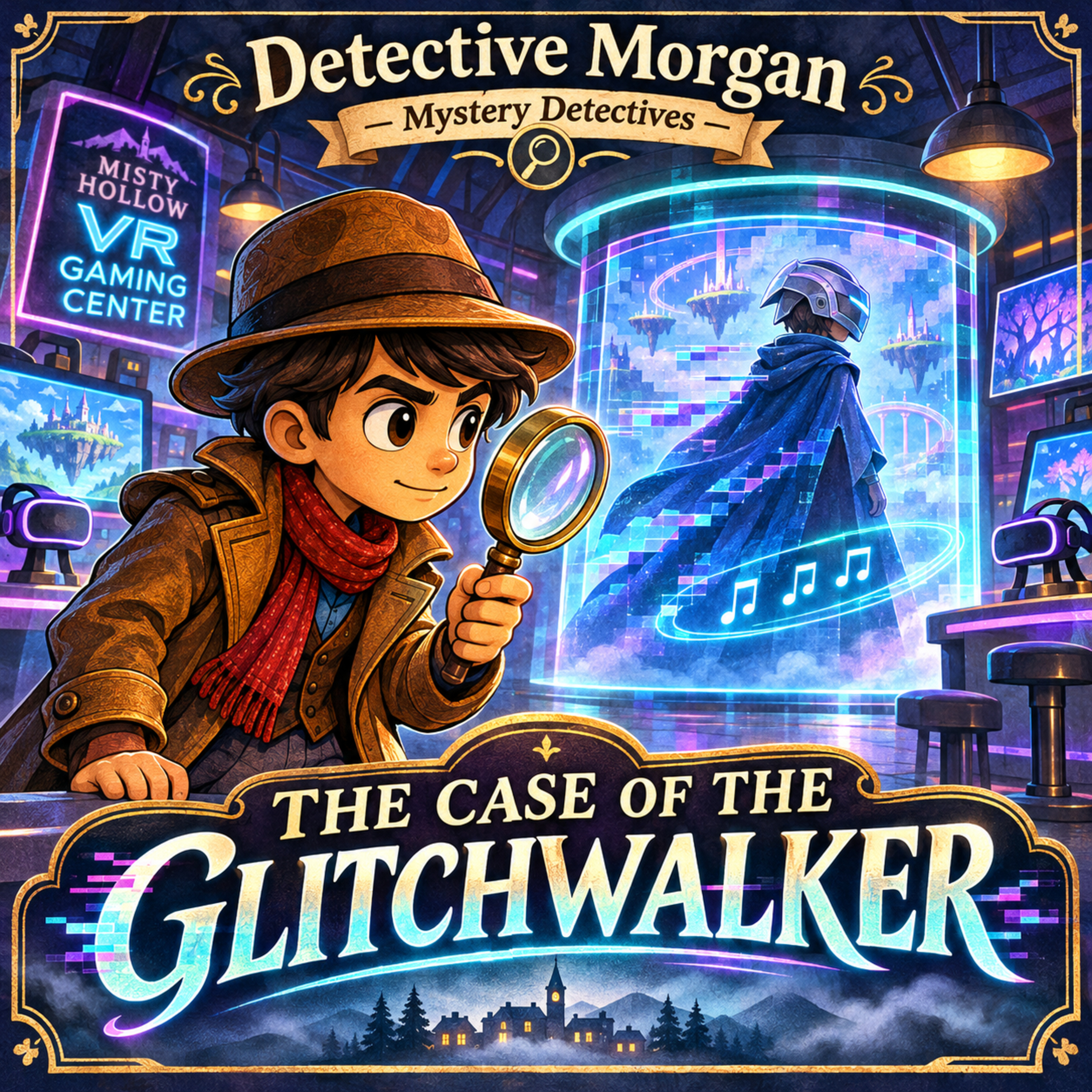
Something strange is happening at Misty Hollow's brand-new VR gaming center! Players are reporting a mysterious figure appearing inside their games. Wearing a silver helmet and a flowing blue cape, the stranger stands perfectly still... until someone approaches. Then, three strange electronic notes play, and the figure vanishes! Some say it's the Glitchwalker, a forgotten video game character wandering between virtual worlds, searching for a place to call home. But is it really a ghost in the game, a secret player, or something else entirely? Join Detective Morgan and his new friend Axel as they explore incredible virtual worlds, uncover three puzzling clues, and discover what's really happening behind the screen. Grab your detective notebook. Every mystery has a solution! A fun, interactive mystery adventure for curious kids and families.
Have you ever noticed how quiet grown-ups are on a crowded bus or train? It's like everyone has an invisible forcefield around them! People just stare at their shoes, read a book, or scroll on their phones in total silence. But why do we ignore each other? In 2014, scientists Nicholas Epley and Juliana Schroeder at the University of Chicago decided to find out! They set up an amazing experiment on a morning commuter train. They asked one group of tired people to sit in quiet solitude, and another group to actually strike up a conversation with a total stranger! The results were shocking. Even though people predicted that talking to a stranger would be super awkward and annoying, the group who said "hello" ended up having a much happier trip! It turns out, humans are naturally built to connect. Ancient Greek philosophers like Aristotle called us "social animals," and the Stoics believed we are all part of one big human family. Join Mira and Finn as they explore why a simple, safe "hello
Have you ever been told to do something just "because I said so"? It can feel super unfair! But did you know that just by being a kid, you have actual, real-life rights? In this thought-provoking episode of Philosophy is Not Boring, Mira and Finn dive into the incredible true story of Janusz Korczak! He was a brilliant doctor in Poland who strongly believed children are "people of today," not just adults-in-training. Imagine living in a place where kids actually get to make the rules! Dr. Korczak ran a famous orphanage where children had their very own court of law, and they could even put grown-ups (including Dr. Korczak himself!) on trial for being unfair! He completely changed how the world treats kids. His groundbreaking ideas even inspired the United Nations to create the Convention on the Rights of the Child—a giant global rulebook that says every kid has the right to be safe, to be heard, and even the right to play! Tune in to discover mind-bending facts about this hero of child
Did you know that over half the people on planet Earth share the exact same great-great-great-great grandfather in their faith? It is true! Join Mira and Finn as they explore the amazing ancient story of Abraham! Thousands of years ago in the ancient city of Ur, Abraham made a massive, brave decision. He packed up his entire family and walked right into the unknown desert! Why? Because he believed in one God who promised him his family would become as huge and uncountable as the stars in the night sky! Today, nearly four billion people trace their family tree of beliefs back to him! Discover why Jewish people call him their very first ancestor, why Christians see him as the ultimate hero of faith, and why Muslims honor him as the mighty prophet Ibrahim who helped build the Kaaba in Mecca! Three huge world religions, billions of people, and one incredible family story! Tune in to find out how people all over the world are so much more connected than we ever imagined. Get ready for a min
Health advice should account for people's income, time, and practical circumstances.
Share your view, then see how readers voted. No sign-in required. This poll is shared across stories.
Do you agree or disagree?
Common Quandary
A Common Quandary to discuss
Another conversation to explore, separate from this news story.
You ignore a friend's message all day while posting online. Do you owe them an explanation?
A friend sends a message that deserves a thoughtful answer. You lack the energy to respond, but spend the day posting jokes and photos. They can see that you are active and eventually ask whether something is wrong.
Does being visibly online create an obligation to be available?