Listen through the publisher, then discuss the episode here or arrange an in-person Roundtable. Your city determines where to meet.
Roundtables are designed for groups of four, with a shared subject and room for everyone to speak. Come for discussion, with no dating expectation.
It can feel like we're always performing in our daily lives—playing the role of the calm parent, the careful listener, the super-healthy jogger. We have a sense of being watched, and maybe judged as well, and we alter what we're doing in awareness of that imaginary audience. But who's actually watching? And how would we do things differently if we stopped caring whether anyone noticed our behavior and had any thoughts about it whatsoever? In this episode we explore the pressure to perform the many roles women are expected to play, and why motherhood can make that pressure especially intense. We discuss: How social expectations shape our behavior The pressure we feel to appear patient, organized, and completely in control Why parenting with an audience can make everyday situations even more stressful Why our kids benefit from seeing us model imperfection, vulnerability, and repair Why asking for help and saying 'no' can be acts of authenticity Here are links to some of the resources mentioned in the episode: Our episode "Parenting with an Audience" (https://www.whatfreshhellpodcast.com/parenting-with-an-audience/) Alicia P Melis for the New York Academy of Sciences.The evolutionary roots of human collaboration: coordination and sharing of resources (https://pubmed.ncbi.nlm.nih.gov/25708081/) Loes Meeussen and Colette Van Laar for Frontiers in Psychology Journal. Feeling Pressure to Be a Perfect Mother Relates to Parental Burnout and Career Ambitions. (https://pmc.ncbi.nlm.nih.gov/articles/PMC6230657/) American Academy of Child and Adolescent Psychiatry:Lying and Children (https://aacap.org/AACAP/AACAP/Families_and_Youth/Facts_for_Families/FFF-Guide/Children-And-Lying-044.aspx) We love the sponsors that make this show possible!
Episode information is provided by the publisher. Listening takes place on the publisher’s service.
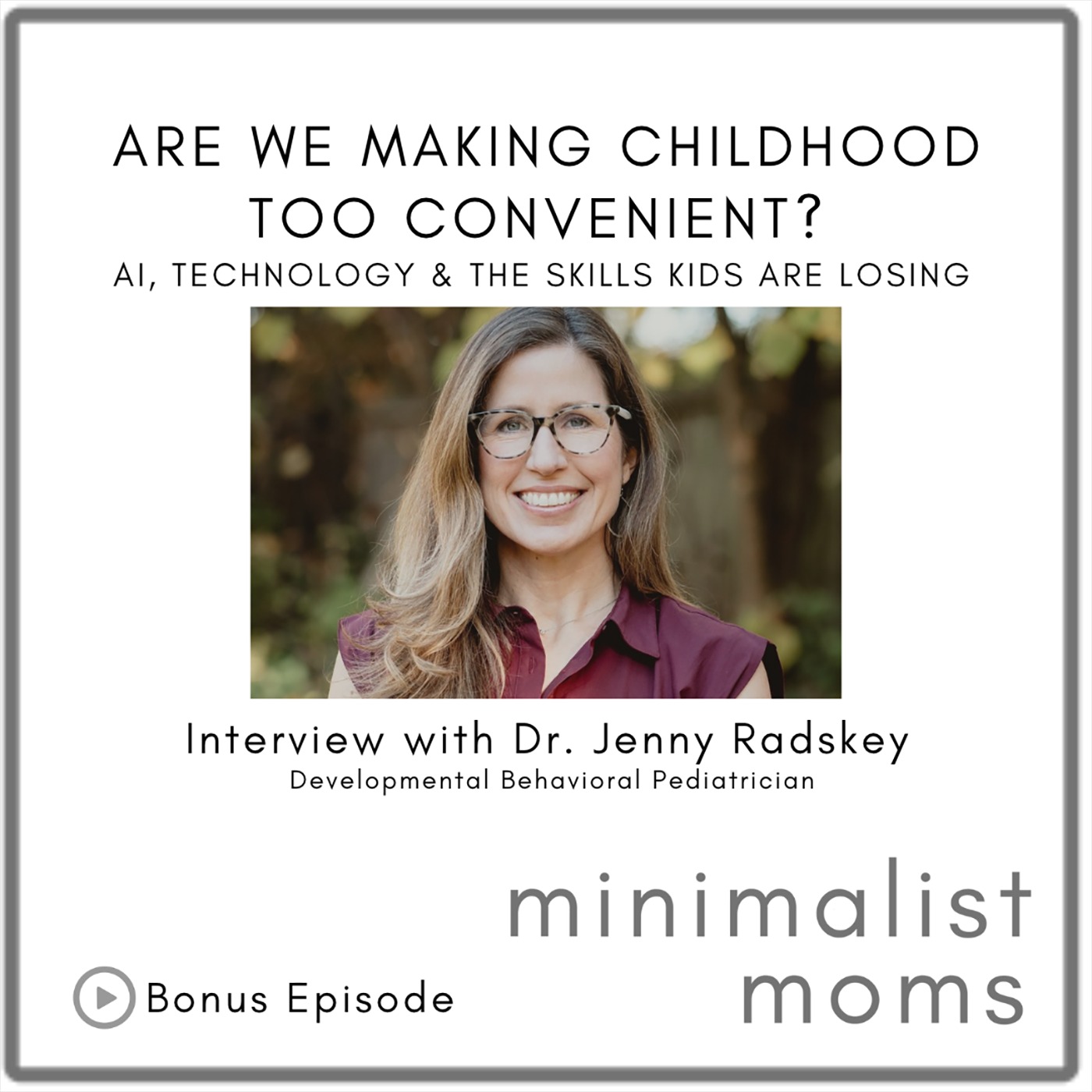
Are we making childhood easier at the expense of the very skills our kids need to thrive? We've talked about screen time and technology on the podcast before, but today's conversation takes us into territory we haven't really explored on the show yet: artificial intelligence and its potential impact on our children's development. As AI becomes more integrated into everyday life, I think it's worth asking some important questions about what our kids might be gaining - and what they could be missing along the way. I'm joined by pediatrician and researcher Dr. Jenny Radesky to explore how technology is reshaping childhood in ways we may not even recognize. From handing over a device to calm a difficult emotion to turning to AI for instant answers, are we unintentionally removing the everyday opportunities our children need to develop patience, persistence, creativity, and critical thinking? Just because something makes life easier doesn't necessarily mean it's making life better. Links Di
Have you ever been told to do something just "because I said so"? It can feel super unfair! But did you know that just by being a kid, you have actual, real-life rights? In this thought-provoking episode of Philosophy is Not Boring, Mira and Finn dive into the incredible true story of Janusz Korczak! He was a brilliant doctor in Poland who strongly believed children are "people of today," not just adults-in-training. Imagine living in a place where kids actually get to make the rules! Dr. Korczak ran a famous orphanage where children had their very own court of law, and they could even put grown-ups (including Dr. Korczak himself!) on trial for being unfair! He completely changed how the world treats kids. His groundbreaking ideas even inspired the United Nations to create the Convention on the Rights of the Child—a giant global rulebook that says every kid has the right to be safe, to be heard, and even the right to play! Tune in to discover mind-bending facts about this hero of child
What if some of the things you've always considered part of your personality were actually skills you developed to survive? In this episode, Danielle is joined by senior coach Brigid Morgan for a deeply personal, thought-provoking and refreshingly candid conversation about the Good Girl Contract, childhood conditioning, healthy relationships and what it means to live with genuine autonomy. Brigid shares the profound impact of listening to the Good Girl Contract podcast series, reflecting on her own experiences of conditional love, hypervigilance, rebellion and the difference between who she is and who she learned to become. Together, Danielle and Brigid explore: The possible origins of the qualities and abilities we've always considered our personality. Why rebellion isn't necessarily the same thing as freedom. The discomfort of holding boundaries and allowing others to be disappointed. How we build self-trust through the choices we make. Navigating conflict, disagreement and genuine r
Welcome to another jam-packed episode of The Rizzuto Show, the comedy podcast where the news is strange, the stories are unbelievable, the debates get ridiculous, and somehow the conversation always takes a turn nobody saw coming. This time around, the crew covers everything from video game fever and Thanksgiving Eve traditions to a honeymoon nightmare involving a hippopotamus, bizarre food-related crimes, celebrity gossip, fast-food lawsuits, and a whole lot of laughs. First up, Grand Theft Auto 6 has taken over the world! With the long-awaited game finally arriving, the guys discuss people taking vacation days, calling in sick, and even considering keeping their kids home from school just to get some uninterrupted gaming time. One in five American workers reportedly planned to take time off to play, and the crew debates whether that's irresponsible, hilarious, or simply a well-deserved break from the daily grind. They even get into the game's massive sales expectations, the excitemen
The most valuable thing you can have in an emergency might not be a stockpile of supplies. It might be a neighbor who knows your name. In this encouraging conversation, Ginny Yurich welcomes archaeologist and survival expert Chris Begley and author Amy Edelman, coauthors of The Emergency Playbook: The Bunker-Free Guide to Disaster Preparation. (https://link.amazon/B0a06ZOGv)Together, they challenge the idea that surviving difficult circumstances requires expensive equipment, elaborate bunkers, or an everyone-for-themselves mentality. Instead, they reveal how communities often come together during disasters, why practical knowledge can be more valuable than possessions, and how everyday activities like gardening, building fires, and learning first aid can prepare families for the unexpected while enriching their lives right now. From helping children develop useful skills to discovering why hope matters in a crisis, this conversation offers a reassuring perspective on preparedness. Bein
Your child can pass the eye chart and still miss what’s right in front of them. Here’s why. Optometrist Dr. Meenal Agarwal explains why 20/20 eyesight doesn’t tell the whole story. Vision is a brain-driven process, and when the brain stops prioritizing the periphery, kids can look at a scene without perceiving it. She also shares the milestone delays she was seeing in her clinic long before Covid. LIKE this video if you found the conversation helpful. COMMENT below with your biggest question or concern about your child’s screen time and vision. Follow Dr. Meenal Agarwal: Website: https://www.drmeenal.com/ Instagram: https://www.instagram.com/dr.meenalagarwal/ YouTube: https://www.youtube.com/@UncoverYourEyeswithDr.Meenal LinkedIn: https://www.linkedin.com/in/dr-meenal-agarwal-9732a260 Resources : Stuck in a Flat World (book): https://www.drmeenal.com/stuck-in-a-flat-world/ Uncover Your Eyes podcast: https://podcasts.apple.com/us/podcast/uncover-your-eyes-the-truth-about-health-and-well
Families have systems. They also have conflict styles. When you're an avoidant since the cradle, and you marry into a family of "we yell because we care," it can be unsettling, to say the least. But conflict styles all have their benefits and drawbacks. Understanding them as distinct approaches to a universal issue (differences of opinion) can help you take a blowup out of nowhere less seriously, and also help you communicate your own needs and frustrations more successfully. Here's how to recognize and reconcile the different conflict styles that people show up to disagreements with, especially as the holidays approach. We discuss: the "family systems" theory (Murray Bowen) how generational expectations can create friction, particularly when two different family systems come together through marriage the most common conflict styles: competing, collaborating, compromising, avoiding, and accommodating why setting a boundary needn't require delivering a long list of grievances why approa
This Deep Dive series explores having tough conversations with our kids. How can we empower our kids to cope with negative feelings without our help? Here's why disappointment is an important part of childhood and how to build scaffolding for their emotional regulation. Amy and Margaret discuss: How the purpose of having children has changed over the last century Why disappointment is developmentally important How to be a guide, not a fixer, for our kids Here are links to some of the resources mentioned in the episode: Jim Taylor for Psychology Today: Parenting: Disappointment Is Good (https://www.psychologytoday.com/us/blog/the-power-of-prime/201106/parenting-disappointment-is-good) Katie Hurley for PBS Kids Parenting: How to Help Kids Cope With Disappointment (https://www.pbs.org/parents/thrive/how-to-help-kids-cope-with-disappointment) THE GIFT OF FAILURE by Jess Lahey: https://bookshop.org/a/12099/9780062299253 Meghan Rabbitt for Parents Magazine: How to Help Kids Deal With Disappo
When a teen says she's having panic attacks, or believes she has OCD, parents tend to react by either minimizing and dismissal, or by having their own panic attacks. Adolescent psychiatrist Suzanne Garfinkle-Crowell (https://www.suzannegarfinklecrowellmd.com/), author of book GIRLHOOD TRANSLATED (https://bookshop.org/a/12099/9798217085736), believes there is a more nuanced way to understand the growing role of "therapy speak" and self-diagnosis in teenagers' lives (particularly girls) In this interview, Dr. Garfinkle-Crowell explains: How greater mental health awareness has meant destigmatization but also some casual over-identification Why adolescents are particularly vulnerable the influence of mental health content they see on TikTok or Instagram How a self-diagnosis can function both as validation of a teen's feelings and a way to protect themselves from having to discuss those feelings further (the label as the be-all and end-all) How to "translate" the therapy speak your teenager
Health systems should prioritize the most urgent needs when capacity is limited.
Share your view, then see how readers voted. No sign-in required. This poll is shared across stories.
Do you agree or disagree?
Common Quandary
A Common Quandary to discuss
Another conversation to explore, separate from this news story.
The proposal is perfect and the ring is terrible. When do you say so?
Your partner proposes with a costly ring chosen after months of secret planning. You love the proposal and want the marriage, but strongly dislike the ring you would be expected to wear every day. Returns are possible for one week.
How much honesty can a loving gesture reasonably be asked to survive?