Listen through the publisher, then discuss the episode here or arrange an in-person Roundtable. Your city determines where to meet.
Roundtables are designed for groups of four, with a shared subject and room for everyone to speak. Come for discussion, with no dating expectation.
The Anthropic IPO is weeks away, and its filing shows a business like no other: $17bn of sales in three months, still a loss, and $895bn signed away on computing power. Neil Woodford goes through the numbers and asks who actually keeps the profit from AI. Answering customers' questions is cheap for Anthropic. It keeps about 85 cents of every dollar after paying for the chips and power. So why isn't it making money? Neil and Jon Adair follow the cash: to the next model, to the cloud companies renting out the chips, and to customers through price cuts that cost Anthropic about $600m in a single quarter. Is this the dotcom bubble again? Neil takes on the comparison, and this week's argument between the analysts who say big tech's cash is running out and the investors who say the AI spending has barely started. We also look at why Revolut moved the coding work of about 2,000 engineers onto an open-weight model, and whether the best AI models can hold their price. Then the question everyone is asking about the AI stocks coming to market: would Neil invest in Anthropic? He answers it, explains how he would judge any AI listing, and says where he thinks the profit from AI will land, including why the UK may be better placed than most. Neil's views are his own and are not a recommendation to buy or sell any investment.
Episode information is provided by the publisher. Listening takes place on the publisher’s service.
This episode is brought to you by Sarmaya Partners. Learn more about Sarmaya’s LENS ETF, their full data and comparison, including performance here: Recorded on November 18 at the TomorrowX Summit, after Nvidia's earnings but before Nvidia's board reinstated Jensen Huang as CEO, Gavin Baker of Atreides Management joins Jack Farley to discuss Jensen, Nvidia, and the state of the AI trade. Gavin explains why semiconductor stocks sold off, and why he believes the market's AI return-on-investment math misses both fast-growing private companies and the open-weight models enterprises are running on-premise. He makes the case that the AI build-out may look more like the railroads than a typical semiconductor cycle, and discusses valuations at a moment when, as Jack puts it, even the bulls are bearish. Jack and Gavin also cover what Jensen's departure meant for Nvidia's competitors and suppliers, the AI bear case Gavin takes most seriously, and why GPU rental prices are a key signal to watch.
Cathie Wood is one of the most influential investors of our time. She is the founder, CEO, and chief investment officer of ARK Invest, where she runs 14 ETFs and a venture fund with stakes in SpaceX, OpenAI and Anthropic. Cathie doesn’t just pick stocks. She picks the future, then bets billions on it. Today, she joins Money Rehab to tell us: Whether a crash is coming Why she sold $85 million of Nvidia the day before earnings Whether she’s in for the Anthropic IPO And If AI is a bubble In partnership with Equitybee Terms apply. Bitcoin services by Block, Inc. See the Bitcoin disclosures at cash.app/legal/podcast. Chapters 00:00 Are You Ready for Some Money Rehab? 01:43 Why Cathie Sold Nvidia: The Numbers and the Jensen Risk 04:27 Swapping Nvidia for SpaceX 06:29 The Petition to Bring Jensen Back, and Tesla's Near-Privatization 11:07 Is Colette Ready to Be CEO, and Who Cathie Would Pick Instead 14:03 Why Cathie Thinks the AI Revolution Isn't Derailed 16:44 AI Agents, Cyberattacks, and Cr
Last week's nearly 9% decline was among the worst of the decade as buying interest dried up in chips and AI. Earnings from several tech firms and PCE data arrive in coming days. Important Disclosures Each investor needs to review an investment strategy for his or her own particular situation before making any investment decisions. For illustrative purpose(s) only. Investing involves risk, including loss of principal, and for some products and strategies, loss of more than your initial investment. Past performance is no guarantee of future results. For more information on indexes, please see schwab.com/indexdefinitions (https://www.schwab.com/resource/index-and-investment-term-definitions). All expressions of opinion are subject to change without notice in reaction to shifting market, economic or political conditions. (0130-1126) Hosted by Simplecast, an AdsWizz company.
The best deal of the holiday season is walking into January with your budget still intact. Joe Saul-Sehy, OG, and Doug kick off Thanksgiving week with returning guest Regina Conway of Slickdeals, who shares what her community of deal hunters votes the best of the best. Then the trio build a holiday budget that leaves room for the fun, and play a round of Deal or No Deal to test whether a sale is saving you money or just giving you permission to spend more. What You'll Walk Away With Why waiting for a better price often backfires, and when it actually pays to hold off How Black Friday, Cyber Monday, and "cyber week" have blurred together, and what that means for your timing Which categories tend to have the strongest deals, from toys and books to tools and everyday essentials Why a holiday gift is often the best way to stock up on things you would buy anyway How to check a too-good-to-be-true TV deal before it ends up on your wall How to start with your total number first, then divide i
This week on The Contrarians, Adam and Adir discuss Victoria's political and economic problems, Australia's interest rate outlook, Elon Musk's ambitious technology plans and the collapse of David Jones. They also examine Adore Beauty's plunging valuation, Anthropic's turbulent IPO and Nvidia's dramatic share price decline as concerns grow about the debt-fuelled AI boom. CHAPTERS 00:00 - Victorian Politics, Courts and Public Safety 24:25 - Cars, Elon Musk and the Future of Technology 32:01 - Why Adam Wears His AirPods Backwards 36:12 - Australia's Interest Rates, Inflation and the RBA 47:18 - David Jones' Collapse and the Bankruptcy System 54:47 - Western Australia's Bizarre Retail Trading Laws 58:11 - Adore Beauty's Share Price Collapse 01:06:33 - Anthropic's IPO and Trillion-Dollar Valuation 01:19:24 - Nvidia's Crash and the AI Bubble LINKS The Contrarians Live — 8 December, featuring Ruslan Kogan: The Contrarians: Mastercard: Acquire Intelligence: BlueRock: Got a question for Adam an
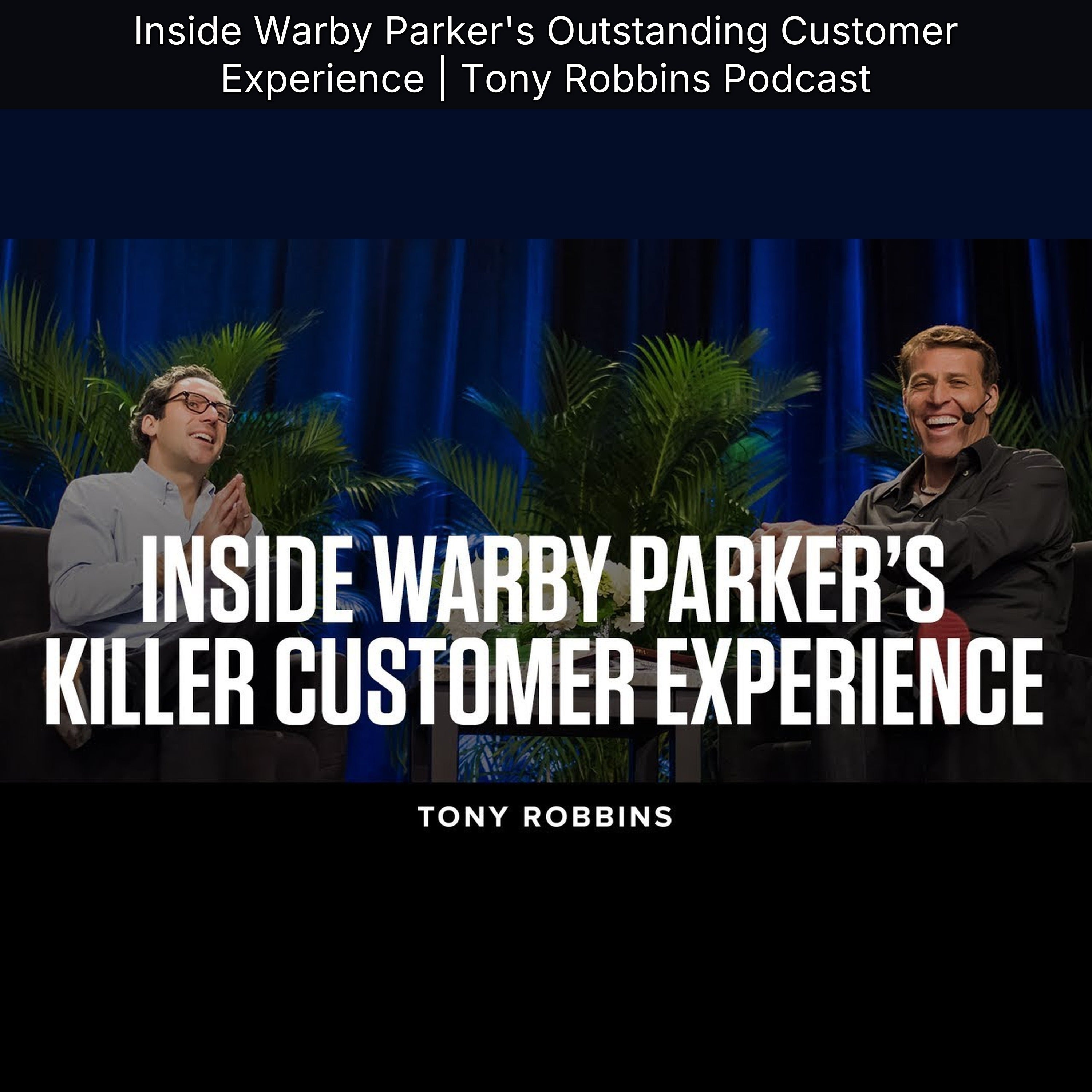
Neil Blumenthal was one of the executives who launched the successful eyewear company, Warby Parker, in 2010. The company has been a massive success, in large part because their business model allows them to offer high quality eyewear at affordable prices. This concept attracted people, and the brand was able to provide something else that would quickly help their brand build an internationally acclaimed reputation — an incredible customer experience. At the core of the Warby Parker success story is the brand’s commitment to creating a masterful customer service experience. In this episode of the Tony Robbins podcast, you’ll hear a detailed account from Neil Blumenthal about the customer-centric strategy and foresight that was critical in establishing Warby Parker as a billion-dollar business. Neil Blumenthal and his cofounders found that glasses were ridiculously overpriced. After a friend mistakenly left a pair of $700 glasses on an airplane, they decided there was a gap in the marke
The UK stock market is shrinking, and the FTSE 100 now depends on two buyers: companies buying back their own shares, and overseas bidders. Neil Woodford explains where the third buyer went, why the Financial Times has blamed the wrong thing, and what it means if you own UK shares. UK pension funds used to hold more than half their assets in UK shares. Today it is about 4%. UK equity funds have had 10 straight years of outflows. So when the FT says share buybacks are draining British companies of investment, Neil's answer is that the buyback is a symptom. He names the cause, and the cost to the taxpayer: about £54bn a year.
The public should normally know who owns businesses that affect community life.
Share your view, then see how readers voted. No sign-in required. This poll is shared across stories.
Do you agree or disagree?
Common Quandary
A Common Quandary to discuss
Another conversation to explore, separate from this news story.
One sibling did years of caregiving. Should they get more of the inheritance?
One sibling lives near an aging parent and handles appointments, errands, and emergencies. The others live far away, call regularly, and assume the nearby sibling will receive the same inheritance despite years of unpaid work.
When does family care become labor that should be repaid?