Wikipedia: Jimmy Wales. The Man Who Trusted Strangers to Build an Encyclopedia (2018)
42 min
Listen through the publisher, then discuss the episode here or arrange an in-person Roundtable. Your city determines where to meet.
Roundtables are designed for groups of four, with a shared subject and room for everyone to speak. Come for discussion, with no dating expectation.
While running an internet search business in the late 1990s, Jimmy Wales began exploring an ambitious idea: an encyclopedia built for the web. His first attempt relied on experts and moved painfully slowly. But in 2001, he launched Wikipedia, inviting volunteers to write, edit, and fact-check articles on virtually any subject. What began as a radical experiment grew into one of the world's largest reference resources, built by volunteers and freely accessible to anyone with an internet connection. What You’ll Learn Why Jimmy’s first attempt at an online encyclopedia produced just 21 articles in a year—and how opening it to everyone changed everything How a lack of money to hire moderators pushed Wikipedia’s volunteers to develop their own rules How a Christmas Day server failure motivated readers to donate nearly $30,000 in two weeks Why Jimmy refused to run ads on Wikipedia, even when the project desperately needed money Production Credits Follow How I Built This: YouTube →@HowIBuiltThis (https://www.youtube.com/@howibuiltthis) X →@HowIBuiltThis (https://x.com/howibuiltthis) Follow Guy Raz: Instagram →@guy.raz (https://www.instagram.com/guy.raz/) X →@guyraz (https://x.com/guyraz) Substack →guyraz.substack.com (https://guyraz.substack.com/) Website →guyraz.com (https://guyraz.com/)
Episode information is provided by the publisher. Listening takes place on the publisher’s service.
About this episode: In this episode, host Benjamin Ensor is joined by Rita Sokorai, Principal Industry Strategist at 11:FS, Vivek Madlani, CEO and Co-Founder of Multiply.AI, and Daniel Wills, Senior Financial Adviser at Plum, to explore the rise of conversational finance and the race to build trusted AI-powered financial assistants. Drawing on new research from 11:FS, they discuss the potential to democratise financial guidance, the challenges of earning customer trust, and how AI could fundamentally reshape financial services distribution. As AI assistants move from answering financial questions to making decisions on our behalf, who will customers trust with their money – and who will own the customer relationship? This week's guests: Rita Sokorai - Principal Industry Strategist at 11:FS Vivek Madlani - CEO and Co- Founder at Multiply.AI Daniel Wills - Senior financial advisor at Plum -- 11:FS’ latest report ‘Conversational finance & the race to build trusted financial assistants’ is
Send us your feedback, thoughts or comments! (https://www.buzzsprout.com/2516687/fan_mail/new) Introduction Before Tappeti, Karinna Gobbo spent 10 to 12 years in the corporate world and worked three jobs to fund her own business. She launched it from her apartment, with a station wagon for deliveries. In this episode, we talk about ambition, a cancer diagnosis at 24, the day she almost walked away, and what two decades have taught her about money, leadership and freedom. In This Episode We Explore • Growing up in an Italian migrant family, and backing yourself • How a cancer diagnosis changed her perspective on time • The day she almost gave up • Why "turnover is ego, profit is sanity, cash is queen" • Leadership, culture and hiring on values • Motherhood, IVF and the myth of balance Why This Conversation Matters Karinna shows that building something beautiful takes grit, honesty and an almost audacious belief in yourself. About Karinna Gobbo Founder of Tappeti, the Australian company
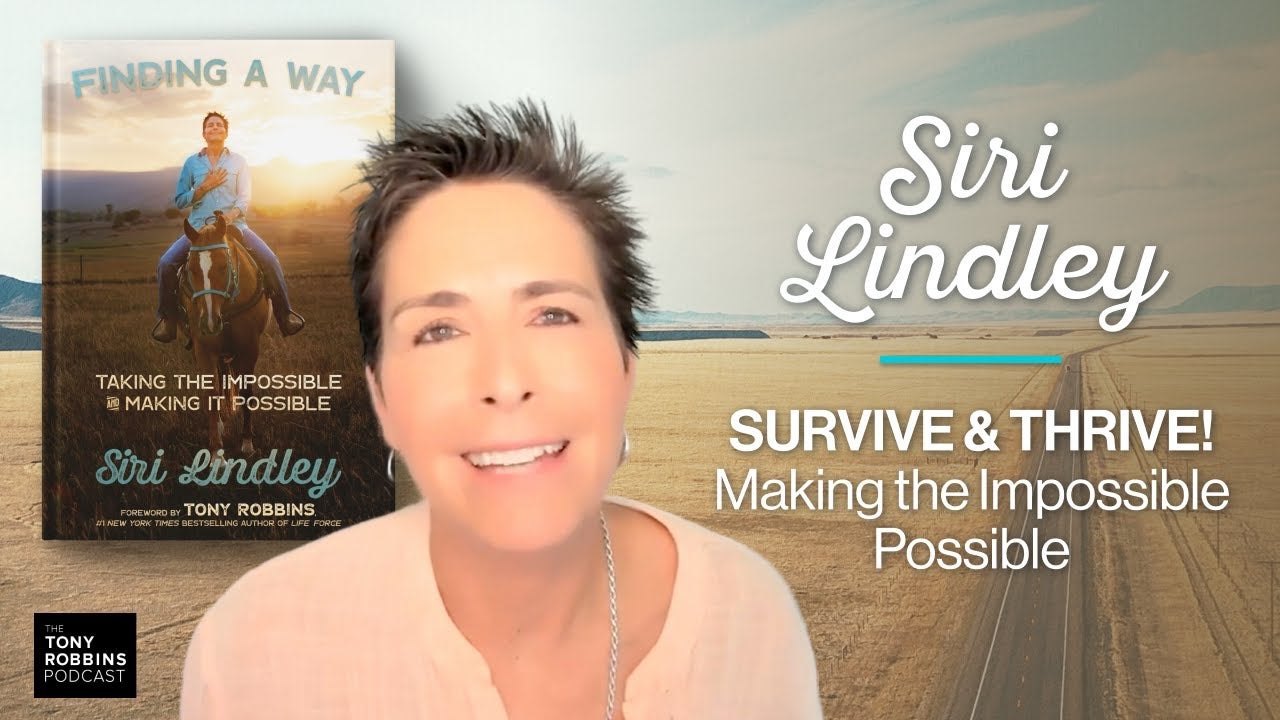
Join Sage Robbins and Mary B. as they sit down for a candid conversation with their dear friend Siri Lindley – author of the new book "Finding a Way: Taking the Impossible and Making it Possible." (And don’t miss a special guest appearance by Tony Robbins, who wrote the foreword to Siri’s new book!) Uploaded 16-06-23 During her professional career, Siri dominated the International Triathlon Union World Rankings. As the world’s former #1 ranked triathlete and one of the most popular and trusted coaches in the business, Siri Lindley knows what it's like to achieve the impossible – even against all odds. In fact, despite being diagnosed with a rare – and often fatal – form of acute myeloid leukemia in 2019, and being told by her doctors that she had a 5% chance of living, Siri overcame the disease that gifted her a powerful new outlook on life. In the same way she took on challenges she’s faced in her storied athletic career, Siri not only survived – she thrived. Siri's life-giving guide
Walk into any industry today and you will see two groups of people. The first is busy building their brand. The second is busy building their skill. The first group is much more visible. The second is much more capable. And over time, only one of these groups builds a career that holds together. Uploaded 28-06-26 Here is the truth: the order matters. Skill comes first, brand comes second. Get the order wrong and you spend years building a reputation for things you cannot actually do — which collapses the first time someone examines what is behind the marketing. Get it right and the brand builds itself, slowly, from the actual capability that years of unglamorous work produced. Most ambitious adults are running the order backwards. They think the brand is the path to the opportunities, the opportunities are the path to the skill, and somehow it all works out. It does not. The opportunities, when they arrive, go to the people who can actually do the work — and the brand-first crowd is le
In today’s episode, Kyle Grieve and Shawn O’Malley discuss Rollins, one of the two giants of American pest control. They look at how a business that has grown revenue for 100 quarters in a row saw its stock fall nearly in half after Google’s AI answers changed how homeowners find pest control companies. Along the way, they cover route density, Rollins’ acquisition playbook, why its customers stick around for years, the family that built it, the risks to its growth, and the company’s current intrinsic value. IN THIS EPISODE YOU’LL LEARN: (00:00:00) Intro (00:04:11) Why a company with 100 straight quarters of revenue growth saw its stock fall nearly in half (00:07:25) Why paying a fast-grower price for a steady grower can hurt investors (00:10:54) How route density makes each new customer almost pure profit (00:12:39) How Google’s AI search changed the way homeowners find pest control (00:27:28) The four reasons customers stick with their pest control provider (00:37:49) How Rollins make
This episode was sponsored by Cardiff & Middle Housing Guy LightSpeed VT: https://www.lightspeedvt.com/ Dropping Bombs Podcast: https://www.droppingbombs.com/ Today's Dropping Bombs episode features Andrey Bolokhovskiy, who went from facing ten years in prison to running a real estate company on pace for $40 million this year. His shortcut to getting rich? Give the money away. Andrey breaks down why he gave away his financial safety net right before the market turned, how middle housing puts first-time buyers into homes in the $300,000s, and why America's middle class is being wiped out before it can even start. If you're waiting until you feel financially safe to make your move, this conversation will make you question what you're really waiting for. Connect with Andrey Instagram: https://www.instagram.com/andreybolokhovskiy Instagram (The Middle Housing Guy): https://www.instagram.com/themiddlehousingguy Website: https://provisiongroupllc.com (https://provisiongroupllc.com/) Curious?
Roth Martin was running a San Francisco design gallery when he and Stephen Hawthornthwaite decided to make a better women's shoe. Neither had worked in footwear. Their idea: a soft, comfortable flat that could do for shoes what technical fabrics (think: lululemon) had done for clothing. Getting there took six years, $1 million of Roth's own money, and long stretches away from his wife and four children. After a failed manufacturing effort in Maine, Roth moved production to China. But just as Rothy's launched and sales took off, a factory disaster threatened to unravel everything. What You’ll Learn • Which ideas Roth and Stephen dreamed up, then passed on (including a heated teddy bear) and why they decided on women’s shoes • What two footwear outsiders learned from their first “sock with a sole” prototypes • How Roth and a knit programmer named Pan overcame a language barrier to make the shoe work • Why Rothy’s stopped selling for six months after a promising launch • The financial dis
Given recent news about Jensen Huang, we're revisiting this unusually personal conversation with the Nvidia co-founder and former CEO. Recorded in April 2026, before the revelations that led to his resignation, the interview offers a fuller picture of Jensen: his family, the sacrifices he made during 33 years leading the company, his demanding leadership style, and his views on the U.S., Taiwan, and AI. Nvidia is one of the most valuable companies in human history. Its chips run the AI systems transforming everything from entertainment to warfare. But for years, Jensen struggled to convince others of his vision. He spent nearly a decade pouring billions of dollars into a technology called CUDA, long before AI made it profitable. Jensen also shares how Nvidia came within 30 days of going out of business, what it took to lead the company through decades of uncertainty, and why, despite its phenomenal success, he's not sure he'd choose to do it all again. Watch this Episode on YouTube: Je
Guy shares what’s next for How I Built This, including a brand-new YouTube channel and a bigger weekly lineup ahead: Rest of 2026: A new episode every Monday (in audio and video) and an archive favorite every Thursday. Starting January: Three episodes a week: two new founder interviews (in audio and video) plus never-before-seen video versions of classic episodes on Fridays. Listen wherever you get your podcasts, or subscribe to our all-new YouTube channel: https://www.youtube.com/@howibuiltthis
Urgent public needs can justify simplifying normal approval procedures.
Share your view, then see how readers voted. No sign-in required. This poll is shared across stories.
Do you agree or disagree?
Common Quandary
A Common Quandary to discuss
Another conversation to explore, separate from this news story.
A stranger is behaving horribly in public. Do you record them?
You witness a stranger berating a service worker in public. Recording could create accountability and protect the worker, but posting the video could expose everyone involved to a permanent online audience.
Who gets to decide when public behavior becomes public content?