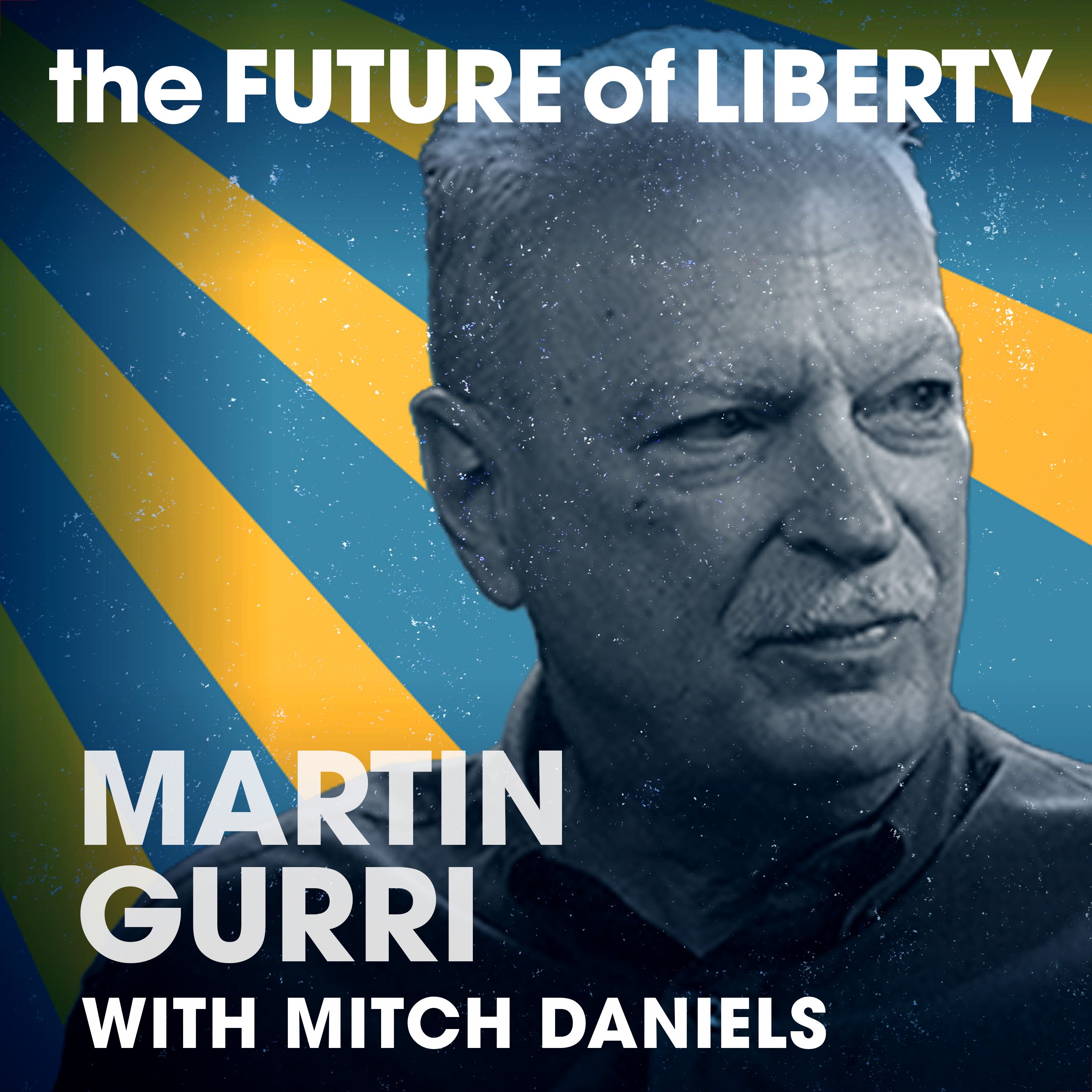
Former CIA analyst and author of The Revolt of the Public, Martin Gurri, joins Mitch Daniels to discuss how the digital information tsunami toppled institutional authority and fueled populism worldwide, and why AI, humility, and America’s Jeffersonian spirit leave him optimistic about freedom’s future. The Digital Information Tsunami and the Revolt of the Public (1:21) War Fever in Europe and Elite Self-Preservation (7:25) America's "Psychotic Episode" and Jeffersonian Resilience (17:06) Information vs. Wisdom (24:10) How AI Could Transform Government Transparency (34:09) About The Future of Liberty: Former Indiana governor and Purdue University president Mitch Daniels investigates the prospects for liberty and more through conversations with prominent thinkers and leaders across diverse fields. New episodes are available wherever you listen, including Apple Podcasts (https://podcasts.apple.com/us/podcast/the-future-of-liberty/id1754223048), Spotify (https://open.spotify.com/show/1MEIj
In September 2004, a switch at Los Angeles air traffic control that needed a reset every thirty days was forgotten, and controllers lost radio contact with hundreds of planes. Mark Atherley, flying in from Canada, diverted to San Francisco. A long-haul captain and founder of the research firm Ancieo (https://www.ancieo.ai/), he reads last Friday's nationwide ground stop the way pilots are trained to: the system caught the fault and stopped itself. He defends old, simple cockpit computers, young pilots, and a 20-year-old co-pilot whose final minutes deserve better than the commentary. In aviation, failure is assumed. That is why it so rarely wins. -- (00:00) - Intro/Welcome (02:06) - Why aviation doesn't hunt for blame (06:24) - Diverting during the 2004 Los Angeles outage (09:32) - Flying through other countries' airspace (13:39) - Politics, investment and China's upgrade (16:21) - Could AI break air traffic control? (23:04) - Floppy disks and old flight computers (27:24) - Autopilot i
The Second Circuit hears Luo versus A I K Renovation, a fired construction project manager's discrimination case. Luo, who is of Chinese origin, says race and national origin drove his dismissal. The company points instead to job performance and his handling of a worker allegedly intoxicated on the job. He also says he was not paid for his final week of work. A jury found for the defendants on discrimination, and the judge rejected the wage claim for insufficient evidence of the hours worked. The judge later denied a new trial. Luo will argue that inconsistent explanations for his firing and restrictions at trial warrant another chance to present his case. The defendants will ask the court to leave the result intact. Listen for the difference between possible contradictions in a witness's story and grounds for overturning a jury's verdict. Recording note: The official recording cuts off on the judge's trailing 'So, uh' after both sides have finished and the court has announced that it
Join Hudson Institute for the tenth United States–Republic of Korea Joint Public-Private Economic Forum on November 17. Celebrating a decade of bilateral economic cooperation, the forum will convene senior public officials, corporate executives, and leading scholars to discuss US-ROK economic security and industrial strength. Second Vice Minister Jina Kim of the ROK will deliver remarks on the evolving economic partnership with the US. Speakers will assess the impact of Korean investments in the US and discuss the essential roles both governments play in fostering a competitive, resilient economic environment. Hosted by the Asia-Pacific Security Chair, this year’s forum is made possible with support from the Ministry of Foreign Affairs of the Republic of Korea.
Two men working on behalf of China’s Ministry of State Security were sentenced to federal prison for participating in a clandestine intelligence operation targeting the United States Navy. Their activities involved cash payments through dead drops, surveillance of Naval Base Kitsap, collecting information about American sailors, and efforts to recruit military personnel as intelligence sources. This episode examines how Chinese intelligence used civilian operatives to approach American service members, the methods employed to conceal their activities, and how the FBI disrupted the operation.
Two women have reportedly reached an unprecedented point in the Navy’s notoriously demanding SEAL selection pipeline, advancing to the third week of Basic Underwater Demolition/SEAL training. One, a naval officer, withdrew from training, while an enlisted sailor was medically removed during Hell Week. This episode examines their historic progress, the physical and psychological demands of BUD/S, and what their experience reveals about the difference between reaching an elite selection milestone and earning a place in the teams.
The Ninth Circuit hears Russell versus Dave, a dispute over cash advances and access to court under military lending protections. At the center is ExtraCash, a product that provides money through Dave's app, with associated fees. The plaintiffs sued Dave and Evolve Bank and Trust, alleging that the charges and lending practices violated the Military Lending Act and other lending laws. The district court rejected the companies' request to send the dispute to arbitration, and the companies appealed. The question here is where these lending claims can be heard, not a final determination of damages. One provision of the military lending statute prohibits requiring arbitration; another says agreements to arbitrate covered credit disputes are unenforceable. Can a customer's opportunity to opt out change that result? And who decides whether the statute prevents arbitration: the judge, or the arbitrator? Listen for the distinction between deciding the underlying lending claims and deciding whe
Jensen Huang resigned as CEO of Nvidia on November 11, 2026, after admitting to an extramarital relationship with Alice Huang, an executive at Megaspeed—a company under scrutiny for alleged ties to Chinese intelligence. The Nvidia board has launched an independent investigation led by former federal prosecutor Joon H. Kim. The Department of Justice has opened an antitrust probe into Nvidia. Shareholders have filed a class action in California federal court. And Senator Tim Scott has requested that Huang testify before the Senate Banking Committee on December 3. This episode explains what each legal track actually involves, what has been alleged versus what has been confirmed, and what happens next. Huang has not been charged with any crime. General information only, not legal advice. Based on public records and news reports. Thanks for listening to Gavel & Gazette. Legal news, explained. General information only, not legal advice. This episode includes AI-generated content.
In the 1990s, Cuban intelligence officers posed as exiles in South Florida and quietly infiltrated anti-Castro groups. Two of them got inside Brothers to the Rescue, and on February 24, 1996, the Wasp Network launched a fatal mission, Operation Scorpion, which ended with Cuban MiGs shooting down two U.S. search and rescue aircraft in international waters. The FBI had been monitoring the network since 1995, and in September 1998 it moved to dismantle the group, arresting ten suspected spies in early-morning raids. In this episode, we follow the case of the men who became known as the Cuban Five, from their secret operations to a trial that still divides opinion today. https://www.miaminewtimes.com/?p=40373802
Conventional wisdom suggests that water washes away fingerprints. Yet FBI researchers demonstrated that identifiable prints could survive on submerged firearms for up to 70 days under experimental conditions. This episode examines the evidence behind that finding, the limitations of the research, and why laboratory success does not guarantee that fingerprints will survive on every weapon recovered from a real crime scene.
Ask the Attorney Series: Why Migraine Claims Get Denied Migraine and headache claims can be more complicated than they initially appear. A migraine diagnosis alone does not necessarily establish service connection—or determine the appropriate VA disability rating. In this episode of our Ask the Attorney Series, we discuss some of the common medical and evidentiary issues that can arise in VA migraine claims and why these claims may be denied or assigned a lower evaluation than a veteran expects. In This Video: Why having a migraine diagnosis may not be enough Common reasons VA migraine claims are denied Direct vs. secondary service connection for migraines The importance of establishing an accurate migraine history and timeline Migraines claimed secondary to other service-connected conditions The role of medical nexus evidence What VA may consider when evaluating migraine frequency and severity What “prostrating attacks” means in the context of VA migraine ratings Why frequency, durati
State regulators haven’t reined in private equity’s takeover of life insurance. Can Washington? Today on Private Credit Crisis, Executive Editor Teddy Downey talks with Renita Marcellin, a senior economic advisor to the Senate Banking Committee on Senator Elizabeth Warren’s staff, in a conversation recorded live at The Capitol Forum’s conference at the National Press Club.
The house closes Friday. The buyer gets the keys Saturday, walks into the dining room, and the chandelier is gone. The seller unscrewed it Thursday night, patched the hole, and took it to her new house. It was her grandmother’s, it had been wired into the ceiling for five years, and she’d mentioned at the showing that she planned to take it. The buyer said nothing, and the contract never mentions it. Suppose nobody disputes any of that. Everyone agrees on the facts. Everyone agrees on the legal test for what counts as a fixture. The trial court says the seller could take it, and the buyer appeals. What exactly is the appellate court being asked to do? That question sits underneath every case in this episode. Before a reviewing court can decide whether an agency got something wrong, it has to decide what kind of question it’s answering: what the law means, what happened, or what happens when you put the two together. Gwen and Marc work through why that classification can matter more tha
U.S. government bond yields have risen to levels not seen in decades. But what does that mean, and why should you care even if you've never bought a government bond? Stephen Rowe sits down with Norbert Michel, vice president and director of Cato's Center for Monetary and Financial Alternatives, to explain how the bond market works, why government borrowing is getting more expensive, and how rising yields affect everything from mortgages to retirement savings. Learn more: Treasury Tries and Fails—Again—to Manage Bond Yields https://mindthegap1776.substack.com/p/treasury-tries-and-failsagainto-manage Money, Markets, and the American Experiment: 250 Years of Financial Opportunity https://www.cato.org/events/money-markets-american-experiment-250-years-financial-opportunity Producer: Barbara Galletti Post Production: Sedona LaMarre Audio Engineer: Cecil Sherman Director of Photography: Darren Walker Assistant Editor: Lester Romero Motion Graphics: Jonathan Fields Original Music: Cecil Sherm
The Tenth Circuit hears O'Neill Automotive versus Federated Mutual Insurance Company, a dispute over insurance for pollution cleanup. As O'Neill prepared to sell dealership property, environmental investigations found contamination. O'Neill faced cleanup costs and sought payment under Federated's pollution liability policy, but the insurer denied coverage. The release of pollutants was below ground, and the district court ruled that it did not meet a required condition for coverage. O'Neill will argue that the policy's structure and separate reporting rules create an alternative path to coverage for underground pollution. Federated will argue that the words only if make all five coverage conditions mandatory, and that O'Neill cannot satisfy the fifth. The insurer also raises questions about when the pollution began and when the claim was reported; the district court did not decide those alternative grounds. Listen for the distinction between reporting a pollution event and reporting a
The Postal Service is raising domestic shipping costs by 5.9% on average. USPS says the changes are a part of the agency's modernization efforts to reach financial stability and remain competitive. USPS will transition the transportation-related surcharge of 8% that began in April to a permanent fuel surcharge. Additionally a 3% fuel surcharge is added to adjust for higher fuel prices for a total of 11% fuel-related surcharges. All changes will take effect on January 17, 2027.
The Tenth Circuit hears United States versus Toyne, an appeal from convictions for sexually abusing a minor. Prosecutors accused Jordan Toyne of repeatedly abusing a girl while she was underage. She testified at trial, and jurors also heard a separate young witness describe other alleged abuse, with a diary introduced as evidence. Toyne denied the allegations and challenged the witnesses' credibility, but a federal jury found him guilty of three counts. His appeal focuses on whether out-of-court statements and the way the prosecution presented testimony unfairly strengthened the accusations. One dispute concerns a father repeating what his daughter had told him; another concerns whether the diary qualified for an exception to the hearsay rule. Toyne will argue that these evidentiary errors, together with improper bolstering of a witness, undermined a trial that depended on credibility. The government will ask the court to leave the verdict intact. Listen for the difference between fail
The Second Circuit hears a dispute over whether work inside an immigration detention center was truly voluntary. At the Buffalo Federal Detention Facility in Batavia, New York, detainees worked in a program administered by private contractor Akima Global Services. They cleaned toilets and floors for one dollar a day. Former detainees allege that, when work went undone, guards threatened entire housing units with losing television, telephone, or recreation access, and sometimes followed through. They say that pressure made them work or keep working, even though the program was called voluntary; the company disputes that it coerced them. The detainees sued, and the district court allowed their federal forced-labor claims to proceed as a class action. That did not decide that the company was liable: this appeal asks whether common evidence can establish coercion for the class, rather than requiring separate inquiries into each worker. The company will argue that people joined for differen
Texas voters elected Gina Hinojosa governor on Nov. 3, the first Democrat to win the job since 1990. Democrats also took the attorney general’s office and the Texas house. So, now what happens to abortion rights in the state? Imani Gandy walks through what the new majority can do to protect abortion access, and what they can’t. Spoiler alert: Republicans still control the Texas Senate, and the bounty hunters aren’t going anywhere. But maybe, for once, a professional pessimist can have a glimmer of hope. This podcast is sponsored by Euki (https://eukiapp.org/). Expert Repro Journalism That Inspires. If Baby Boom! If you already subscribe to Baby Boom! Lawyered, sign up for B*tch, Listen so you won't miss it.
Guest Tim Draper, Founder, Draper Associates Guest Bio Tim Draper is one of Silicon Valley’s best-known venture capitalists, an early backer of Hotmail, Skype, Baidu and Tesla. He founded Draper Fisher Jurvetson and Draper Associates, and in 2013 he started Draper University in San Mateo to train young founders. In 2014 he paid about $19 million for nearly 30,000 bitcoin at a US Marshals auction, and he still wears a Bitcoin tie. Now he is taking on Sacramento through Grow California, a group he started with Ripple co-founder Chris Larsen to back business-friendly candidates for the Legislature. Show Summary “Every billionaire that leaves the state takes 20,000 jobs with them,” says Tim Draper. In this episode of State of Gold, host Jon Slavet sits down with the venture capitalist to talk about Proposition 40, the billionaire tax on California’s November 3 ballot, and why Draper thinks it only makes sense to vote for it if you are union leadership. If it passes, he warns, “you might lo
As a nation, we owe an immeasurable debt of gratitude to the men and women who have served in our military. While a range of benefits and support systems are available to help veterans navigate life after service, accessing those resources is not always straightforward, and some veterans encounter barriers when seeking assistance. What legal frameworks exist to get veterans the help they need? Rocky Dhir welcomes back Dawn Laubach and Bradley Hennings to discuss the challenges veterans face when navigating the systems designed to support them. They explore why some veterans struggle to access the benefits and services they need, what options are available when those needs go unmet, and how advocates can help ensure veterans receive the support they have earned.
The Army generates enormous amounts of data every day, but Lt. Gen. Jeth Rey, Deputy Chief of Staff, G-6, U.S. Army, says the biggest challenge is not collecting more information. It is managing the data the military already has and making it accessible to the people who need it. During an interview on Fed Gov Today, Rey explains how the Army is moving toward a data-centric environment that connects information across military operations, strengthens cybersecurity, and helps commanders make informed decisions. “The Army and I think the Department of War has a data management problem. We don't have a data problem,” Rey says. That distinction shapes the message he brings to the AFCEA Data Forum, taking place November 19-20 in Old Town Alexandria. You can register here: https://www.afcea.org/events/annual-data-forum
The Eleventh Circuit hears United States versus Lagarius Johnson, a challenge to a gun conviction tied to drug trafficking. When police tried to approach Johnson, he ran and discarded a pistol and a backpack. The backpack contained marijuana, baggies, and a scale, and the pistol had been modified to fire automatically. An earlier jury convicted Johnson of separate drug and gun offenses; a second jury convicted him of possessing the machine gun in furtherance of drug trafficking. The issue here is the link between the gun and the drug crime, not simply whether he had both. Johnson will argue that the evidence showed possession but did not establish that the gun helped his drug dealing. The government will argue that the gun's accessibility, the drug evidence, and Johnson's social-media posts allowed the jury to infer that connection. The argument also turns to which trial's evidence the appeals court can review and whether Johnson preserved his challenge. Listen for the difference betwe
Jake Sherman and Anna Palmer discuss the dilemma Senate Minority Leader Chuck Schumer is facing regarding a 2028 reelection bid. Plus, how a lame duck could impact a bill pushing for film tax breaks and how Congress could be poised to dramatically constrain the chip industry’s commerce with China.