On this episode of COS Now recapping the latest Convention of States news, Andrew Lusch gives a snapshot of the impact of the midterm elections on the Article V movement. Plus, the constitutional solution reaches new audiences, including the Joe Rogan podcast.
Welcome back to another episode of Crawfordsville Connection! This week we discuss the City of Crawfordsville's Sidewalk Program, including eligibility, property owner cost-sharing, how the program is funded, and how residents can apply. Learn how this investment can help improve pedestrian safety and strengthen connections throughout our community. Safe, accessible sidewalks help connect our neighborhoods and make Crawfordsville a better place to live, work, and get around. Yodel Community Calendar & News Feed: https://events.yodel.today/crawfordsville To ask any questions about this podcast or to submit topic ideas, please email Sarah Sommer at [email protected]
A Senate Democratic leadership showdown is brewing as Sen. Chris Van Hollen challenges Sen. Chuck Schumer for majority leader. Van Hollen tells Playbook why he thinks Democrats shouldn't rush to a vote. Then the other stories animating Washington: Two Murdochs are looking to rewrite their family's political legacy and new questions emerge about how the Trump administration handled an FAA meltdown that brought air travel across the country to a standstill. For more news and analysis, subscribe to the Playbook newsletter: politico.com/playbook (https://www.politico.com/playbook)
Just before the midterms, Maurene Comey quietly struck a huge blow to Trump’s transformation of the Department of Justice. After being abruptly fired last summer, the veteran prosecutor decided to sue. Now, she’s won: a federal judge said her dismissal was unlawful. Harry talks with Comey’s lawyer and the architect of her victory in court, Ellen Blain. Blain unpacks the long fight and details how her team shredded the DOJ’s tortured legal strategy. Together, Harry and Blain explain why the consequences of Comey’s win go far beyond her to shake the foundations of the Department Todd Blanche has built.
Historian Steven H. Jaffe joins Chuck Todd to argue that America’s bad words were never actually forbidden — that profanity hasn’t traveled from prohibition to permissiveness so much as it’s been shaping the country the whole time. They trace it from Puritan blasphemy law through Mark Twain breaking the taboo, the Civil War, and the 1960s rupture, to a president Jaffe likens to the Lenny Bruce of the office. Along the way: why the “small vocabulary” theory of swearing is wrong, what the F-word actually meant before it became an insult, which words are still genuinely off-limits in America and which ones Britain shrugs at, and the cost of normalization — a curse word that everybody uses stops being able to do any work. Jaffe’s Four-Letter Nation: The Long, Dirty History of American Profanity is out now. Timeline: 00:00 Steven H. Jaffe joins the Chuck ToddCast 01:00 How a historian ended up writing a book about swearing 05:30 Profanity goes mainstream in politics, from Twain to Obama to
Chuck Todd counts the parts of the federal government that have visibly failed in the week since the election — measles elimination status gone after 26 years, and the longest nationwide aviation shutdown in a quarter century, roughly 1.5 million travelers stranded with 3,500 planes already in the air. He lived it, and the strangers in the airport line with him had no confidence left that government can function at all. His indictment isn’t just that things broke, it’s the response: Sean Duffy spent his press conference assigning blame while DHS Secretary Markwayne Mullin actually delivered information, Trump never put himself on camera, and a cabinet secretary who is pleading for more money has a party holding the trifecta. Plus what Lutnick knew about Megaspeed, the Vance donor whose firm landed a no-bid Venezuelan oil license, and why Chuck thinks several secretaries should be fired with cause. Historian Steven H. Jaffe joins Chuck Todd to argue that America’s bad words were never a
Chuck Todd counts the parts of the federal government that have visibly failed in the week since the election — measles elimination status gone after 26 years, and the longest nationwide aviation shutdown in a quarter century, roughly 1.5 million travelers stranded with 3,500 planes already in the air. He lived it, and the strangers in the airport line with him had no confidence left that government can function at all. His indictment isn’t just that things broke, it’s the response: Sean Duffy spent his press conference assigning blame while DHS Secretary Markwayne Mullin actually delivered information, Trump never put himself on camera, and a cabinet secretary who is pleading for more money has a party holding the trifecta. Plus what Lutnick knew about Megaspeed, the Vance donor whose firm landed a no-bid Venezuelan oil license, and why Chuck thinks several secretaries should be fired with cause. Finally, he hops into the ToddCast Time Machine to revisit the history of the League of N
On Iran, Donald Trump has decided to stop seeking a deal with Iran and to do nothing until economic sanctions cause the regime to collapse. As numerous experts explain (https://www.nytimes.com/2026/11/13/us/politics/trump-iran-strategy.html), this humiliatingly shows Trump is simply looking for a way to avoid looking like he lost. It also empowers Iran, displaying the folly of his initial invasion. Now The Washington Post reports that many of the most significant players (https://www.washingtonpost.com/world/2026/10/31/persian-gulf-scrambling-prevent-iran-war-again-hitting-its-doorstep/) around Trump wanted him to seek a deal, but Defense Secretary Pete Hegseth appeared opposed. This, even though Trump was open to one! So Hegseth helped land Trump in this latest humiliation. Hegseth’s continuing Iran fiasco has caused MAGA figures to divide over his fate, as Media Matters shows (https://www.mediamatters.org/pete-hegseth/right-wing-media-split-over-impeaching-defense-secretary-pete-hegs
What happens when the financially sensible housing decision takes you further from the life you wanted to build? Journalist Jessica Barrett left expensive Vancouver for Calgary, where homeownership became possible but a sense of belonging remained elusive. Her book No Place Like Home follows that contradiction into a housing debate dominated by prices, supply, and arguments over density. She makes the case for asking residents how their neighborhoods should change before demanding they take sides, while challenging the assumption that the homes people need will emerge simply because developers build more units. Additional Show Notes Jessica Barrett (LinkedIn (https://www.linkedin.com/in/jessica-barrett-b76b3511/), Instagram (https://www.instagram.com/thewritelight/)) No Place Like Home The Missing Key to Our Housing Crisis (https://www.penguinrandomhouse.ca/books/760899/no-place-like-home-by-jessica-barrett/9780735250253) by Jessica Barrett (Book) Check out the newly completed Strong T
It’s a busy week for Andy Burnham. The Milburn review is due as the government tries to tackle the NEETs crisis. Meanwhile, the prime minister is preparing to meet European leaders at a UK-EU summit – much to the dismay of Michael Gove and his new “Stay Out” campaign. Rafael Behr and Ros Taylor discuss the big stories and flashpoints to look out for in the coming days. www.patreon.com/bunkercast (https://www.patreon.com/bunkercast) Advertisers! Want to reach smart, engaged, influential people with money to spend? (Yes, they do exist). Some 3.5 MILLION people download and watch our podcasts every month – and they love our shows. Why not get YOUR brand in front of our influential listeners with podcast advertising? Contact [email protected] to find out more Written and presented by Ros Taylor with Rafael Behr. Audio production: Simon Williams. Managing Editor: Jacob Jarvis. Group Editor: Andrew Harrison. Music by Kenny Dickinson. THE BUNKER is a Podmasters Production. Hosted on Acast.
The Power Hour is a weekly podcast where host Jack Spencer invites leading energy and environment policy experts to discuss the days most pressing issues. Informative and entertaining, the Power Hour gives listeners the opportunity to be a fly on the wall for no holds barred conversations that are sure to educate as well as, just maybe, put a smile on your face. Everyone is talking about the midterm elections. Though we don’t get into politics on the Power Hour, we are interested in how a shifting political landscape could impact energy and environment policy. That is especially true now as conservatives have enjoyed a myriad of energy wins over the past couple of years. Jack invites Tom Pyle, President of the Institute for Energy Research and the American Energy Alliance to discuss this very issue and to help us all better understand the situation. Whether its global warming policy, energy development, or EV mandates, Jack and Tom touch on just about every topic. And of course, Jack c
Hub Headlines features audio versions of the best commentaries and analysis published daily in The Hub. Enjoy listening to original and provocative takes on the issues that matter while you are on the go. 0:21 - Canada is unprepared for the threats it faces. Budget 2026 did little to help (https://thehub.ca/2026/11/15/canada-is-unprepared-for-the-threats-it-faces-budget-2026-did-little-to-help-things/), by Richard Shimooka 7:36 - 5 foiled terror plots, 0 mentions: Canada’s security strategy fails Canadian Jews (https://thehub.ca/2026/11/12/5-foiled-terror-plots-0-mentions-canadas-security-strategy-fails-canadian-jews/), by The Hub Editorial Board This program is narrated by automated voices. https://tinyurl.com/3a7zpd7e (Apple) https://tinyurl.com/y8akmfn7 (Spotify) Watch The Hub on YouTube: https://www.youtube.com/@TheHubCanada The Hub on X: https://x.com/thehubcanada?lang=en Hosted on Acast.
Julie Carey of NBC4, covering a conversation between Democratic and Republican strategists at VPAP's After Virginia Votes panel. (https://www.vpap.org/about-us/events/after-virginia-votes-2026/) Brandon Jarvis of the Virginia Scope, (https://www.virginiascope.com/) covering Senator Mark Warner's wins in several Republican-held state Senate districts. (https://www.virginiascope.com/warner-won-several-republican-held-state-senate-districts/) Elizabeth McGowan WHRO (https://www.whro.org/people/elizabeth-mcgowan), covering the $5 billion termination fee if the NextEra/Dominion Energy merger fails to be approved. (https://www.whro.org/virginia-center-for-investigative-journalism/2026-11-11/could-a-clause-be-a-windfall-to-virginia-ratepayers) Plus solar for all, election security, and Democrats' agenda for the upcoming General Assembly. --
In a conversation on YouTube (https://www.youtube.com/live/5bvihKtd8g0?si=mIodxNnmTgdv3ZcM), Lawfare Editor in Chief Benjamin Wittes will sit down with Senior Editors Molly Roberts, Roger Parloff, Anna Bower, and Eric Columbus to discuss the latest litigation over Trump administration policies, including updates on the East Potomac golf course and the triumphal arch cases, the politicization of the Justice Department, a judge’s rejection of the BBC’s motion to dismiss Trump’s defamation suit, the Fourth Circuit’s ruling blocking a DOJ demand for journalists’ LinkedIn data, the D.C. Circuit’s decision protecting U.S. Agency for Global Media head Michael Abramowitz from removal, an immigration roundup, and more. You can find information on legal challenges to Trump administration actions here (https://www.lawfaremedia.org/trumplitigationtracker). And check out Lawfare’s new homepage on the litigation (https://www.lawfaremedia.org/projects-series/trials-of-the-trump-administration), new B
In a conversation on YouTube (https://www.youtube.com/live/5bvihKtd8g0?si=mIodxNnmTgdv3ZcM), Lawfare Editor in Chief Benjamin Wittes will sit down with Senior Editors Molly Roberts, Roger Parloff, Anna Bower, and Eric Columbus to discuss the latest litigation over Trump administration policies, including updates on the East Potomac golf course and the triumphal arch cases, the politicization of the Justice Department, a judge’s rejection of the BBC’s motion to dismiss Trump’s defamation suit, the Fourth Circuit’s ruling blocking a DOJ demand for journalists’ LinkedIn data, the D.C. Circuit’s decision protecting U.S. Agency for Global Media head Michael Abramowitz from removal, an immigration roundup, and more. You can find information on legal challenges to Trump administration actions here (https://www.lawfaremedia.org/trumplitigationtracker). And check out Lawfare’s new homepage on the litigation (https://www.lawfaremedia.org/projects-series/trials-of-the-trump-administration), new B
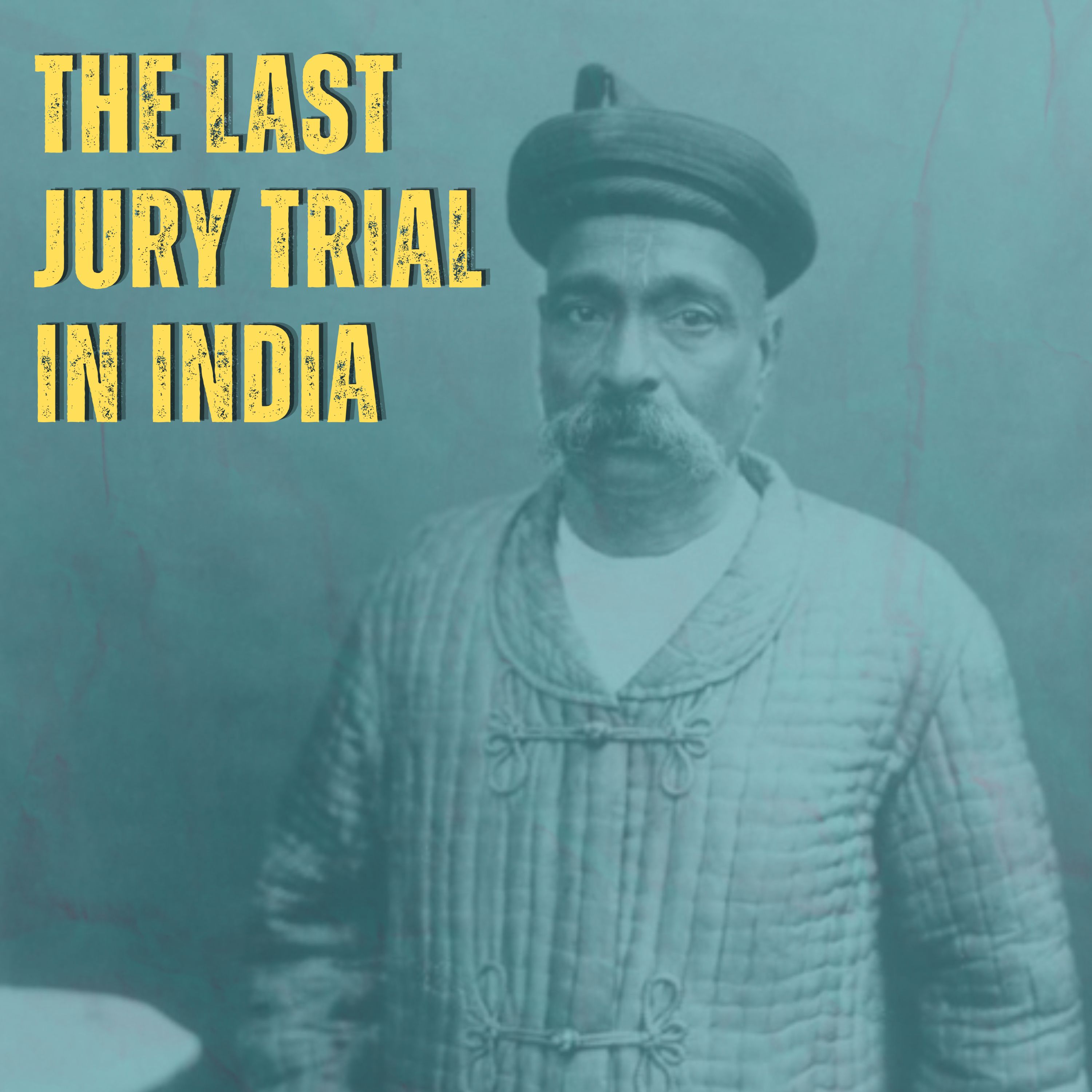
If colonialism is a system of forced rule by an outside entity, why did the British introduce jury trials in India? Were they fair? This episode looks at two remarkable trials: the first is a murder trial of a British tea plantation owner by his workers, and the other is the 1908 trial of Bal Gangadhar Tilak. Tilak was the publisher of the most widely read newspaper in Western India and faced charges of sedition, that is, promoting “disaffection” for the king. Taken together, the trials show that the jury trial was meant to legitimize the British as an empire of law, but the way the trials were conducted revealed something more sinister. Hosted by Simplecast, an AdsWizz company.
Cristian Iftodii and Marc Naro talk with Professor Ngaire Woods, founding Dean of the Blavatnik School of Government and Professor of Global Economic Governance at the University of Oxford. They discuss the state of international economic cooperation, what separates governments that work from those that don’t, and what she has learned from building a school dedicated to better government. Hosted by Cristian Iftodii and Marc Naro. Recorded at the Blavatnik School of Government, University of Oxford.
In Episode 508 (https://hiddenforces.io/podcasts/why-nothing-looks-cool-anymore-john-mauriello) of Hidden Forces, Demetri Kofinas speaks with industrial designer and Design Theory founder John Mauriello about how design shapes our culture and behavior, why contemporary products from cars to phones increasingly fail to evoke our deepest desires, and the perceptual principles behind a well-executed scam. The conversation covers John's path as a self-taught designer who built an audience of millions on YouTube, and his theory that contemporary design, from Apple's minimalist products to modern hypercars, has been stripped of the humanist philosophy that once gave rise to it and replaced by the single-minded pursuit of efficiency and profit. They also examine the design elements of a successful scam, using Theranos, Silicon Valley exit culture, and the broader collapse of institutional trust to map the principles that distinguish ambitious risk-taking from outright fraud, and what those sa
Part 1 of 3: We welcome German citizen and tour guide Wilhelm Wellesson al the way from Germany as we discuss the Battle of the Colmar Pocket. In this episode we meet Wilhelm and set the table with the pre WWII history of the region and what made the WWII battle necessary.
Timothy Jones Jr. was a father of five children, and in August 2014, he had primary custody of them. By early September, both Tim and the kids would disappear - from their mom, their school, and their neighbors. NOTE: This episode DOES involve crimes committed against children, and although I will never glorify any of it, or focus on unnecessary details, listener discretion is advised.
This week, the Supreme Court heard oral arguments in two cases about accountability… or lack thereof. First, they heard a case that could make it more difficult to sue federal officers for Eight Amendment violations-- interesting timing when ICE is running rampant. Then, a case about holding corporations accountable for mistreating their workers contained a disturbing takeaway: this Supreme Court seems to be further to the right than the Trump administration on corporate accountability. Plus: Pete Hegseth’s attempted (and failed) impeachment, Scott Colom’s huge win in Mississippi, Senate Democrats skipping crucial judicial confirmation hearings, and a strange Fox news appearance from Justices Gorsuch, Barrett, and Kavanaugh. Finally, Somil Trivedi, advocacy director and senior counsel at Court Accountability, joins Leah to talk about what Democrats can do now that they have the gavels. Favorite Things: Leah: John Oliver (https://www.youtube.com/watch?v=LO5iHyYa0XM) on Hegseth | Adam Se
In this episode of Phoenix Cast, hosts John, Rich, and Kyle sit down with Nini Hamrick, co-founder and president of Vannevar Labs and an alum of the DIA and ODNI, on the day after the Marine Corps birthday. Nini traces the company back to 18-hour shifts in Afghanistan, where one embedded software engineer built her a tool in a day that saved her ten hours a day, then explains how her team and its Navy and DIU partners put an agentic capability on an operational network nine days after a gap was flagged during Operation Epic Fury. The hosts press on what makes an organization built for speed, how to hire the ISSM and PM who can get to a "safe yes," and what to do when vulnerabilities are found at machine speed but patched at human speed. Stay for Nini's advice to the technical 22-year-old who wants to serve without wearing a uniform, Kyle's hot take, and two knife hands from Rich. Links: Vannevar, Nini Hamrick bio: https://www.vannevarlabs.com/people/nini-hamrick/ Vannevar Labs (Wikiped
Far too many airport communities waste too much energy venting about problems with the national airspace. But using the now chronic gaffes and accidents to "stop the madness" isn't just fruitless; it's a wasted opportunity. The FAA is in crisis. But often a government crisis like this creates a funding opportunity. If you say, "Now is not the time!", we say, "When is the time? When the system is performing better?" Don't waste this crisis. Call your representatives and insist that a portion of this funding (and every future FAA funding package) be set aside for airport communities. Do it now. Contact Phone #s for Congress in the link Ep #47 FAA Ground Stop (Emergency!) (https://seatacnoise.info/ep-47-faa-ground-stop-emergency/)
The world has lots of renewable energy capacity. That could counter climate change and lower your electric bill. But our electricity companies don't know exactly how much of that capacity they can run through their power lines without burning them out. So they play it safe and generate electricity with carbon-based fuels instead. Georg Rute, founder of Gridraven, explains how his grid intelligence company uses machine learning, satellite data and hyperlocal wind forecasts to show grid operators how much more renewable power their transmission lines can safely carry. Gridraven's system is live across Finland, where it adds up to 12% capacity on average. Here's the story of how a physics student turned energy specialist came to tackle one of the biggest bottlenecks in the energy transition. Hosted on Acast.