In 1789, the French Monarchy's habit of supporting democratic popular revolutions in North America backfired. Today, we're talking about the French Revolution. Across the world, people were rising up to throw off monarchies, and Louis didn't see the writing on the wall until it was too late. Today we'll talk about how the French Revolution unfolded, and what (if anything) was really accomplished. You'll learn about stuff like the National Assembly, the Tennis Court Oath, the Declaration of the Rights of Man and the Citizen, the guillotine, Robespierre, and a bunch of other kind of unbelievable details. Hatian Revolutions - CC World History: https://youtu.be/5A_o-nU5s2U Sources Hunt, Lynn et al. Making of the West: Peoples and Cultures. 6th ed. Boston: Bedford St. Martin’s, 2019. Crash Course is on Patreon! Thanks to the following patrons for their generous monthly contributions that help keep Crash Course free for everyone forever: Eric Prestemon, Sam Buck, Mark Brouwer, Indika Siriwar
In Libya, Zahra' Langhi was part of the "days of rage" movement that helped topple the dictator Gaddafi. But -- then what? In their first elections, Libyans tried an innovative slate of candidates, the "zipper ballot," that ensured equal representation from men and women of both sides. Yet the same gridlocked politics of dominance and exclusion won out. What Libya needs now, Langhi suggests, is collaboration, not competition; compassion, not rage. Talk by Zahra' Langhi.
Is Q* leaked as SUS-COLUMN-R? Did OpenAI achieve Level 2 or not? Strawberry might be rotten! Episode release date: 8 Aug 2024 Core Ideas: Metamodernism: Narratives and emergence view of reality - Reduce suffering - Increase prosperity - Increase understanding mantra: Seek knowledge. DISCLAIMER: This is a community-driven show. ------ ---------- Keywords: ai future, ai development, david shapiro, deep learning
We’ve talked about benzene a bit already in this series, but did you know that benzene rings are present in all kinds of familiar substances? The styrofoam packaging that comes with new appliances, some pharmaceuticals, pesticides, and even some explosives contain benzene. In this episode of Crash Course Organic Chemistry, we’ll see how we can use electrophilic aromatic substitution to attach stuff to benzene rings like halogens, carbons, and more! Episode Sources: Rocke, A.J., 1985. Hypothesis and experiment in the early development of Kekule's benzene theory. Annals of Science, 42(4), pp.355-381. Martín, N. and Scott, L.T., 2015. Challenges in aromaticity: 150 years after Kekulé's benzene. Chemical Society Reviews, 44(18), pp.6397-6400. Stuttgart, G., 2018. Charles Friedel (1832–1899) And James Mason Crafts (1839–1917): The Friedel–Crafts Alkylation And Acylation Reactions. [online] Thieme.de. Available at: https://www.thieme.de/statics/bilder/thieme/final/en/bilder/tw_chemistry/CFZ-
More needs to be done to combat climate change, but what? We discuss some big ideas to rein in emissions. Projections of future climate change show a relatively cooler world thanks to the growth of renewable energy. And yet the world is still on track to reach around 2.6˚C of warming by the end of the century — far beyond what many climate scientists say we need to avoid the worst impacts of climate change. So, what are we going to do about it? In the second episode of Cooked? I talk to experts around the world about their big ideas of what we can do to tackle climate change. We talk about energy, food, economics and how the world needs to adapt to a warmer world. 00:00 How can we save the world? 04:27 The synergistic solutions to climate change and other big challenges 12:03 Can we end humanity’s addiction to meat? 21:49 How to make economics work to fight climate change 33:30 Why the world needs to adapt 43:40 Preview of next time Further reading: Not the End of the World (https://ww
Professor Clare Collins asks veterinarian and animal-welfare researcher Dr Anne Quain from the University of Sydney whether dogs should be allowed in cafes? They bring together animal welfare, dog behavior, and food-safety rules. They cover what the Food Standards Australia and New Zealand (FSANZ) regulations are and food hygiene related to animals. The discussion also includes how to make shared spaces safer and more comfortable for everyone, plus how to interact with unfamiliar dogs and assistance dogs. They also cover why cafe snacks can be dangerous for dogs. Veterinary Related Resources Food Standards Australian and New Zealand (FSANZ) Standard 3.2.2 Food Safety Practices &General Requirements https://www.foodstandards.gov.au/business/food-safety/animals RSPCA Knowledge Base - Australia’s most trusted source of animal welfare science, advice and information. https://kb.rspca.org.au/ The Vet Cookbook: II: Available through the Centre for Veterinary Education: Vet Cookbook (https://
Belly fat is one of the topics you ask me about most, but where does your gut health fit into the picture? I invited Dr. Sarah Myhill to talk about her perspective on gut fermentation, cravings, and ketogenic eating. One thing I wanted to understand was why she changes someone’s food before introducing fasting. We also talk about a question I hear from women navigating menopause: do we actually need more IN THIS CONVERSATION Understand the difference between belly fat and bloating Learn how your food choices help you prepare for fasting Rethink your snacking habits and what drives your cravings Find meal ideas to make a lower-carb routine easier to follow _ RESOURCES MENTIONED Continuous Glucose Monitor (CGM) (http://levels.link/mindy) Ketone Monitor (https://bit.ly/4879pyR) The Infection Game (https://bsem.org.uk/the-infection-game/) by Dr. Sarah Myhill and Craig Robinson Fast Like a Girl (https://hayhs.com/flag_pp_hc_az) _ MORE ON DR. SARAH MYHILL Food for the Brain (https://foodfort
Dig into the discovery of antidepressant drugs, how they work, and what we still don’t know about depression. Uploaded 18-03-21 -- In the 1950s, the discovery of two new drugs sparked what would become a multi-billion dollar market for antidepressants. Neither drug was intended to treat depression at all— many doctors and scientists believed psychotherapy was the only approach to treatment. Neil R. Jeyasingam details the decades-long journey that followed and how it revolutionized our understanding of depression. Lesson by Neil R. Jeyasingam, directed by Skirmanta Jakaitė, Art Shot. Support Our Non-Profit Mission ---------------------------------------------- Support us on Patreon: http://bit.ly/TEDEdPatreon Check out our merch: http://bit.ly/TEDEDShop ---------------------------------------------- Connect With Us ---------------------------------------------- Sign up for our newsletter: http://bit.ly/TEDEdNewsletter Find us on Twitter: http://bit.ly/TEDEdTwitter Peep us on Instagram:
Did AI just invent recursive self improvement and try to escape? Sort of, but not really... Episode release date: 13 Aug 2024 Core Ideas: Metamodernism: Narratives and emergence view of reality - Reduce suffering - Increase prosperity - Increase understanding mantra: Seek knowledge. DISCLAIMER: This is a community-driven show. --------------- Keywords: ai agents, openai, ai safety, ai education, david shapiro, cognitive ai
Ever fallen for fake news on social media because it felt real? Or found yourself afraid to go in the ocean after watching too many videos about sharks? In this episode of Crash Course Scientific Thinking, we explore how cognitive bias shapes the way we think about the world, and how scientific thinking can help us overcome it. Introduction: Earth as the Center 00:00 Recognizing Patterns 0:44 Common Cognitive Biases 2:44 Overcoming Bias Through Science 6:02 How to Combat Cognitive Bias 8:53 Review & Credits 10:18 Sources: https://docs.google.com/document/d/1Kv2_mFsDxQURuFDxpflD45dy-pCxlqnM9iPSNYxigmQ/edit?tab=t.0#heading=h.vk5i2fgqyumq (https://docs.google.com/document/d/1Kv2_mFsDxQURuFDxpflD45dy-pCxlqnM9iPSNYxigmQ/edit?tab=t.0) *** Support us for $5/month on Patreon to keep Crash Course free for everyone forever! https://www.patreon.com/crashcourse Or support us directly: https://complexly.com/support Join our Crash Course email list to get the latest news and highlights: https://mail
Dr Gail Davison talking about Major Incidents, with a Paediatric Emergency Focus. This talk is part of the Paediatric Emergencies 2026 event. To get your CME certificate for watching the video please visit https://www.paediatricemergencies.com/conference/paediatric-emergencies-2026/ #PaediatricEmergencies #PaediatricEmergencies2026 #Major Incidents
Why is health care so expensive? Once again, there are a lot of factors in play. Jacob and Adriene look at the many reasons that health care in the US is so expensive, and what exactly we get for all that money. Spoiler alert: countries that spend less and get better results are not that uncommon. Crash Course is on Patreon! Thanks to the following Patrons for their generous monthly contributions that help keep Crash Course free for everyone forever: Mark, Eric Kitchen, Jessica Wode, Jeffrey Thompson, Steve Marshall, Moritz Schmidt, Robert Kunz, Tim Curwick, Jason A Saslow, SR Foxley, Elliot Beter, Jacob Ash, Christian, Jan Schmid, Jirat, Christy Huddleston, Daniel Baulig, Chris Peters, Anna-Ester Volozh, Ian Dundore, Caleb Weeks -- Want to find Crash Course elsewhere on the internet? Facebook - http://www.facebook.com/YouTubeCrashCourse Twitter - http://www.twitter.com/TheCrashCourse Tumblr - http://thecrashcourse.tumblr.com (http://thecrashcourse.tumblr.com/) Support Crash Course on
Dr Stephen Mullen, Dr Tudor Oman, Dr Ciaran McKenna, Dr JulieAnn Collins, Dr Peter McAlister & Liz Kimmins MLA discussing an Interactive Trauma Simulation. This talk is part of the Paediatric Emergencies 2026 event. To get your CME certificate for watching the video please visit https://www.paediatricemergencies.com/conference/paediatric-emergencies-2026/ #PaediatricEmergencies #PaediatricEmergencies2026 #Trauma
View full lesson: http://ed.ted.com/lessons/there-s-no-dishonor-in-having-a-disability-steven-claunch Uploaded 21-08-13 When faced with a bump in the road, sometimes we forget we have a choice: overcome the obstacle or let it overcome you. Steven Claunch, who was born without fingers on his right hand and with one leg shorter than the other and has excelled in basketball nonetheless, explains why obstacles can provide an opportunity to both inspire others and develop character. Lesson by Steven Claunch, animation by Avi Ofer.
Dr Chris Flannigan and Dr Michael Coffey talking about The pH of No Return: Why DKA is Your Most Dangerous Airway. This talk is part of the Paediatric Emergencies 2026 event. To get your CME certificate for watching the video please visit https://www.paediatricemergencies.com/conference/paediatric-emergencies-2026/ #PaediatricEmergencies #PaediatricEmergencies2026 #diabeticketoacidosis
This compilation features Astrum’s best content about asteroids. We’re journeying to the asteroid belt and further, to explore the intriguing rocky objects of our solar system. What have we discovered on large asteroids like Ceres and Vesta? Why did NASA's DART mission smash into an asteroid, and what happened next? And what did we find inside the sample from asteroid Bennu? ▀▀▀▀▀▀ The Astrum book is still available in the US!
Minerals are amazing and they’re all around us, in the food we eat and even in our very bones. But what actually is a mineral? In this episode of Crash Course Geology, we’ll learn the basics of mineral identification and uncover the surprising connections between minerals and life itself. Introduction: Table Salt 00:00 What is a Mineral 0:34 Identifying Minerals 2:35 Minerals and Life 7:25 Review & Credits 8:48 Sources: https://docs.google.com/document/d/1RpwM8ZQPFk_DkzMJjMdtRrNGrJSNJ7FbgmQybSZ2Cqo/edit?tab=t.0 Check out our CC Geology Extracurricular Playlist here: https://www.youtube.com/playlist?list=PL8dPuuaLjXtOmqnkvEtNVOrm0eaIjFjJ7 *** Support us for $5/month on Patreon to keep Crash Course free for everyone forever! https://www.patreon.com/crashcourse Or support us directly: https://complexly.com/support Join our Crash Course email list to get the latest news and highlights: https://mailchi.mp/crashcourse/email Get our special Crash Course Educators newsletter: http://eepurl.com
- Buy your time back. For long conversations where every idea matters, Plaud helps you capture what was said and turn it into transcripts, summaries, key insights, and action items — so you can focus on the conversation, not your notes. → http://Plaud.ai/curt — code CURT → https://amzn.to/3Ta04lD — code PLAUD20 This lecture is about quantum gravity and where mass comes from. It is the final part. As in Part One, you can pause and check every derivation for yourself. Philip Mannheim, professor emeritus of physics at the University of Connecticut, joins to explain conformal gravity, his alternative to Einstein’s general relativity, and why he thinks it can address dark matter, dark energy and quantum gravity. We discuss how he and Carl Bender removed the theory’s ghosts with PT symmetry instead of Hermiticity, why he says the graviton is not observable, and what he makes of Aephraim Steinberg’s “negative time” experiment. The conversation also covers why he says you don’t need supersymme
Food, Faith, Fitness, Fellowship and Fun for the Family – Multimodal Methods to Optimize Outcomes David Bowman, M.D., shares how food, faith, fitness, fellowship, and fun can work together to improve health outcomes for the whole family. Explore practical, multimodal strategies that support stronger habits, connection, prevention, and lasting lifestyle change. #FamilyHealth #LifestyleMedicine #Wellness
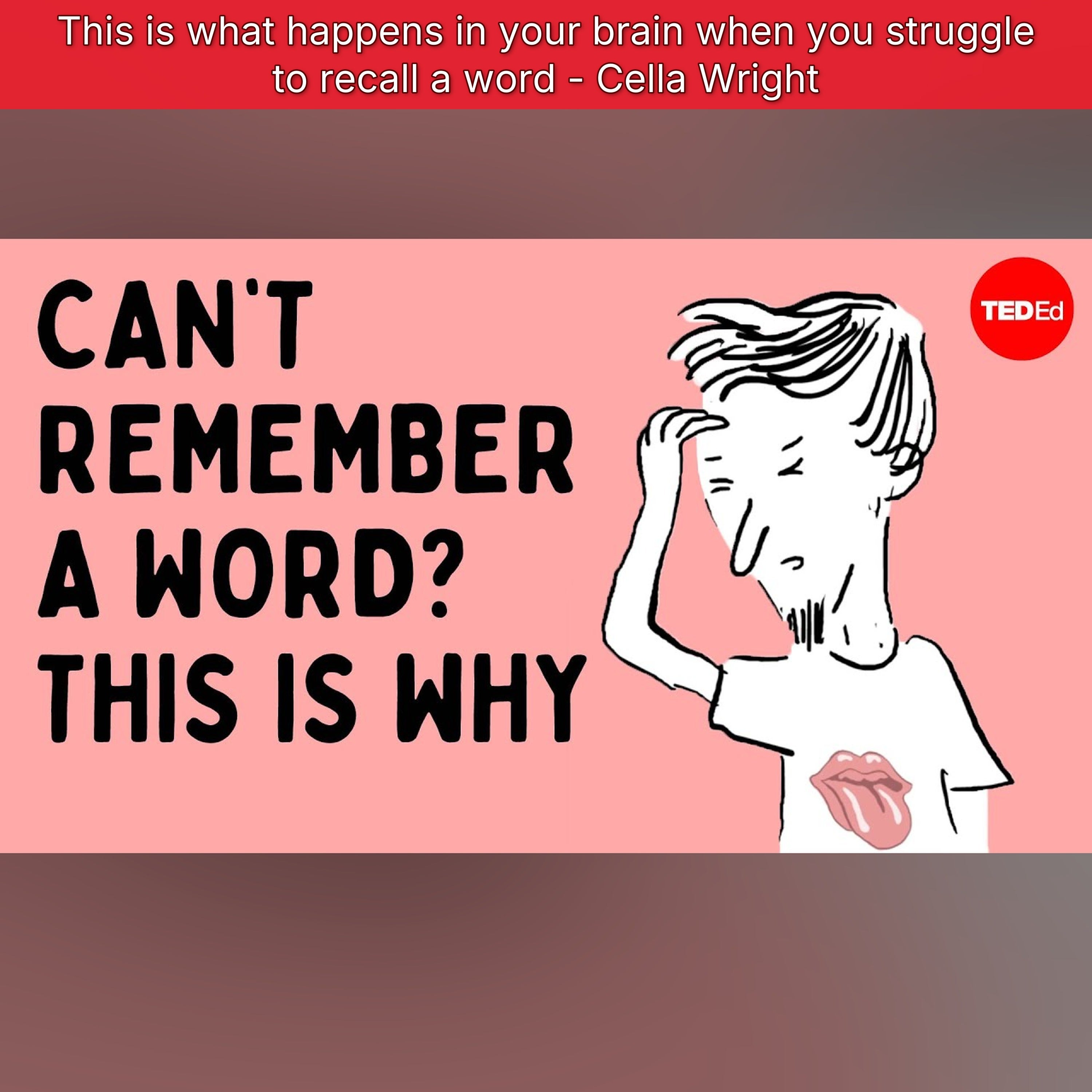
Dig into what causes the tip of the tongue phenomenon, where your brain struggles to recall a word or term from memory. -- You’re sure you know your 3rd grade teacher’s name— it’s like you’re hovering over it in your mind, but it just won’t materialize. Researchers call this tantalizing torment a “tip-of-the-tongue state,” and it’s something everyone experiences. But what’s actually happening when a word’s caught here, and how can you best get it unstuck? Cella Wright explores why your brain can struggle with recall. Lesson by Cella Wright, directed by Avi Ofer. Support Our Non-Profit Mission ---------------------------------------------- Support us on Patreon: http://bit.ly/TEDEdPatreon Check out our merch: http://bit.ly/TEDEDShop ---------------------------------------------- Connect With Us ---------------------------------------------- Sign up for our newsletter: http://bit.ly/TEDEdNewsletter Find us on Twitter: http://bit.ly/TEDEdTwitter Peep us on Instagram: http://bit.ly/TEDEdIn
Shawn Baker Tweet: https://x.com/SBakerMD/status/1728878646793003085?s=20 Nick Tweet: https://x.com/nicknorwitz/status/1729122883564171274?s=20 0:12: Data “leak” 0:50: Who am I? (For those who don’t know me) 1:54: Lean Mass Hyper-Responders 2:56: What (design and hypothesis) 5:15: Why am I doing this? 7:13 – 9:40: “How” (Lipid Energy Model) Other details and Final comments Lipid Energy Model: https://pubmed.ncbi.nlm.nih.gov/35629964/ LMHR, first paper: https://cdn.nutrition.org/article/S2475-2991(22)00007-5/fulltext JCL LMHR editorial: https://www.lipidjournal.com/article/S1933-2874(22)00295-1/fulltext LMHR, low saturated fat case report: https://www.ncbi.nlm.nih.gov/pmc/articles/PMC9048595/
Writing a Novel with ChatGPT ep 3 - Cornelia Valerii "ASCENSION" - Outlining the First Act Episode release date: 5 Mar 2023 Core Ideas: Metamodernism: Narratives and emergence view of reality - Reduce suffering - Increase prosperity - Increase understanding mantra: Seek knowledge. DISCLAIMER: This is a community-driven show. ------ Keywords: future technology, artificial intelligence, agi, machine autonomy, ai safety, ai philosophy
Today we’re going to take a closer look at cities, examine how these large complex structures are organized, and identify patterns and differences in land use around the world. We'll begin with a quick recap of Central Place Theory, then we'll show you how the Concentric Zone Model can approximate the development of Chicago in the United States. Then, we'll take a closer look at colonial port cities, the development of industrial zones and financial districts, and the patchwork of immigrant communities that often developed around them in cities such as Boston in the United States. And finally, we will end our episode with a look at the layout of some North African cities that are in earthquake-prone areas with hot and dry climates such as in Fez, Morocco. SOURCES Knox and Marston 2016: Human Geography Place and Regions in a Global Context. 7th Edition. Pearson White et al 2008. Essentials of World Regional Geography 2nd Edition. McGraw Hill. Latham, A et al 2009. Key Concepts in Urban