A decade ago, founding a nuclear startup seemed impossible. Aside from general public concern around nuclear, meaningful progress in the space required billions of dollars. Oklo co-founder and COO Caroline DeWitte helped move the needle by securing the first venture capital-led Series A for a nuclear hardware company in 2018. The plan? Instead of designing a reactor and selling it to risk-averse utilities, Oklo adopted a model to design, build, own, and operate the plants themselves. It’s an approach that appealed to data centers and hyperscalers looking for reliable electrons without the burden of managing a nuclear facility. To fund the capital-intensive deployment of these reactors, fuel fabrication plants, and isotope facilities, Oklo went public via a SPAC, a gamble that has since paid off in three to four billion dollars raised. In this episode, host Lara Pierpoint talks with Caroline about her early entrepreneurial days, and the complexities of dealing with the Nuclear Regulator
It’s time! The Legend of Zelda: Ocarina of Time is here, and it is amazing! Join Logan Plant, Peer Schneider, and Nick Limon as Logan breaks down his review of the highly-anticipated Switch 2 remake. From its gorgeous world stuffed with secrets to its wonderful modern controls reminiscent of more recent Zelda games, the panel discusses how it deepens an adventure that means so much to many people. And, they dive into why this is the perfect way for newer Zelda fans to jump into the traditional 3D Zelda formula that longtime fans adore. Hyrule awaits! Presented by Best Buy Gamers. #ocarinaoftime #nintendo #legendofzelda
Harry gave The Legend of Zelda: Ocarina of Time remake a perfect 10 in his Press Start review, and on this episode of The Press Start Podcast he explains why Nintendo's Switch 2 reimagining of the N64 classic earned the score, from its new art style and voiced cutscenes to its modernised controls. We also dig into reports that EA shut down BioWare and cancelled Mass Effect to make Star Wars Battlefront 3, and Phantom Blade Zero's 4 million opening weekend. Plus Bend Studio's next game after Days Gone, and Donald Glover's live-action PUBG series for Netflix. Chapters 00:00:00 Intro 00:00:59 The Legend of Zelda: Ocarina of Time Review 00:17:54 Mass Effect Cancelled For Battlefront 3 00:23:46 Phantom Blade Zero Smashes Records 00:29:22 Sony Bends Next Game Imminent? 00:34:59 PUBG TV Series Starring Donald Glover Announced 00:36:48 Outro Spotify: https://open.spotify.com/show/70QgrzSyPK476F9cTsfUWJ Contact us at [email protected] #gaming #podcast #playstation
A roughly 51-minute deep dive into this week's biggest AI news: OpenAI cuts its funding round to $20B at a $1.25T valuation as AI debts soar, the GPT-6.1 Terra price cut and new ChatGPT Pro limits, Anthropic's Nasdaq IPO filing, Google's Gemini 4 Carbon and cloud growth, Nvidia and AMD investing in Meta, and Mistral Large 4 going open weights. This episode includes AI-generated content.
A Forward Deployed Engineer is one of the most popular job in tech right now. I’ll explain what it is. Plus, we help Steve figure out which careers will hold up as AI takes over more work.
Every day, Wikipedia biographies of living people are flagged for deletion because the subjects are not “notable” enough. How do these poor souls take the news? Written by Duncan Fyfe. Originally published on October 26th 2026.
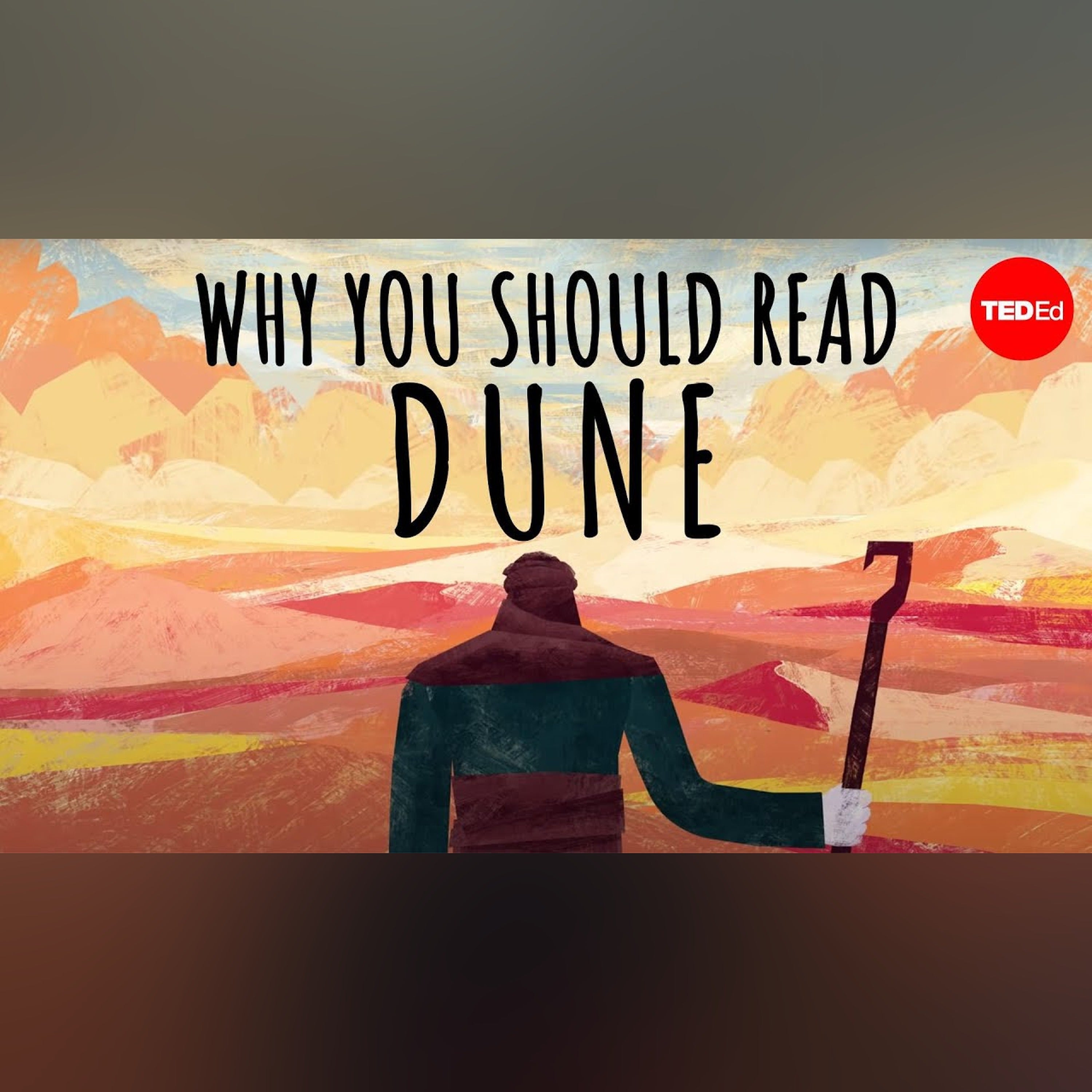
Discover Frank Herbert’s science fiction classic, “Dune,” which tells the story of a man catapulted into the middle of a planetary revolution. Uploaded 17-12-19 -- A mother and son trek across an endless desert. Wearing special suits to dissipate heat and recycle moisture, the travelers aren’t worried about dying of thirst. Their fears are much greater. Soon, the sound of the desert is drowned out by a hissing: a mound of sand 400 meters long bursts from the desert floor and races towards them. This is the world of “Dune.” Dan Kwartler dives into the epic story. Lesson by Dan Kwartler, directed by Recircle. Animator's website: https://www.recircle.net (https://www.recircle.net/) Sign up for our newsletter: http://bit.ly/TEDEdNewsletter Support us on Patreon: http://bit.ly/TEDEdPatreon Find us on Twitter: http://bit.ly/TEDEdTwitter Peep us on Instagram: http://bit.ly/TEDEdInstagram View full lesson: https://ed.ted.com/lessons/why-should-you-read-dune-by-frank-herbert-dan-kwartler #bookt
When host Rana el Kaliouby started online dating, she designed algorithms to weigh multiple factors, and evaluated each date in a spreadsheet. Now, she’s rethinking all that. In a very personal LinkedIn post (https://www.linkedin.com/pulse/i-retired-my-dating-spreadsheet-can-ai-help-me-find-rana-yrxdc), Rana has wondered if a less engineered, more spontaneous approach can better lead to love – and whether AI can or should play a role. This inspired the Masters of Scale Summit round table “Love, unoptimized,” where Rana, Masters of Scale co-host Jeff Berman, and Francesca Hogi, founder of the True Love Society, took the stage in San Francisco. They ponder how to balance engineering with serendipity to feel more agency in all our human relationships, and introduce us to the “Meet-Cute Mindset.” Learn more about Pioneers of AI:http://pioneersof.ai/
The internet was supposed to be a boon for democracy. With broad access to information and opportunity, the thinking went, marginalized and disenfranchised populations could overcome barriers, close wealth gaps, and uproot dictators. But things didn’t work out that way. Now, as we enter the AI era, the question of whether technological progress is compatible with democratic ideals is more pressing than ever. Will AI deliver where the internet fell short—or make inequality worse? To help answer that question, MIT economist and Nobel laureate Daron Acemoglu joins Nicholas Thompson, CEO of The Atlantic, for a conversation about the mistakes the West made with the last technological revolution and how we can avoid them with this new one. He makes the case for “pro-worker” AI and explains why the pursuit of AGI is blinding Silicon Valley to the tech’s true potential. Produced independently of The Atlantic’s editorial staff. (00:00) Introduction (02:59) Why liberal democracy needs a new gove
As the prevalence of AI continues to grow, more and more people are worried about their online safety. New scams seem to be popping up every day, packaged in creative and terrifying ways. How do you protect yourself? Frank Riccardi, Author of CTRL+ALT+PWN: The Hacker’s Playbook (And How to Beat It), joins Business Security Weekly to discuss why it’s not the technology that PWNs you, it’s the trickery. Rather than resign yourself to an inevitable fate or remove yourself from the online world entirely, learn the tricks of the trade to avoid being just another pwned noob. Frank exposes the secret weapons, sneaky tactics, and psychological tricks used by hackers today—and discusses how to stop them. Segment Resources: In the leadership and communications segment, CISO Problems That Can't Be Solved With Technology, When Being Authentic Undermines Your Leadership, Empower Your Most Curious Employees to Drive Your Digital Transformation, and more! Visit https://www.securityweekly.com/bsw for
Just in the nick of time, the design of the iPod begins to emerge--but will Steve Jobs give it his seal of approval? And Apple designer Jony Ive turns away from the brightly colored plastic that made his name and learns to love pure white. This episode of Designed in California is sponsored by: Overcast (https://apps.apple.com/app/overcast-podcast-app/id888422857): A powerful, simple, award-winning podcast player. And our favorite too. Links and Show Notes: Presented by Jason Snell and Myke Hurley. Written by Jason Snell. Script development by Kelly Turner. Thanks to Scott Knaster, Stephen Hackett, Matt Rollefson, Adam C. Engst, Jim Hunkins, John Buck, Harry McCracken, and members of the iPod team for script assistance. Audio editing by Myke Hurley and Jim Metzendorf. Video production by Jamie Snell. Designed in California theme by Christopher Breen. References/Further Reading: The Perfect Thing (https://link.amazon/B0iRrcRUS) by Steven Levy Steve Jobs (https://link.amazon/B07YvsjhV) b
Just in the nick of time, the design of the iPod begins to emerge--but will Steve Jobs give it his seal of approval? And Apple designer Jony Ive turns away from the brightly colored plastic that made his name and learns to love pure white. This episode of Designed in California is sponsored by: Overcast (https://apps.apple.com/app/overcast-podcast-app/id888422857): A powerful, simple, award-winning podcast player. And our favorite too. Links and Show Notes: Presented by Jason Snell and Myke Hurley. Written by Jason Snell. Script development by Kelly Turner. Thanks to Scott Knaster, Stephen Hackett, Matt Rollefson, Adam C. Engst, Jim Hunkins, John Buck, Harry McCracken, and members of the iPod team for script assistance. Extra special thanks to Hansen Hsu and everyone else at the Computer History Museum. Audio editing by Myke Hurley and Jim Metzendorf. Video production by Jamie Snell. Designed in California theme by Christopher Breen. References/Further Reading: The Perfect Thing (https
Every day, Wikipedia biographies of living people are flagged for deletion because the subjects are not “notable” enough. How do these poor souls take the news? Written by Duncan Fyfe. Originally published on October 26th 2026.
Can a small island nation own a slice of the AI race? Sebastian Bastian, the Bahamas’ Minister of Innovation and National Development, thinks so. Once dubbed the “Bahamian Bill Gates,” Bastian went from building computers as a teenager to becoming one of the country’s most successful entrepreneurs. Oz sits down with Bastian to discuss his plans to turn the Bahamas into a digital hub and why he warns against a new era of “digital colonialism.”
Every day, Wikipedia biographies of living people are flagged for deletion because the subjects are not “notable” enough. How do these poor souls take the news? Written by Duncan Fyfe. Originally published on October 26th 2026.
#375: An agent can crank out 200 or 300 lines of code a minute. You can maybe review 40. So who's actually supposed to understand what just got merged? Maybe nobody ever did. Did you really read every line of every PR before AI showed up? Or did you just have the time? Now the junior has an agent, the senior is buried in review, and the job looks a lot more like management than coding. In this episode, Darin and Viktor talk about who's supposed to understand the code once AI writes it, and why that's now the senior engineer's job. YouTube channel: Review the podcast on Apple Podcasts: Slack: Connect with us at:
Going from 10 to 1 SDRs. How We Deployed AI Across our Sales Org | Vercel's COO Jeanne DeWitt Grosser is the COO of Vercel, the company behind Next.js and the infrastructure powering a generation of the web. Six weeks into the job, she stood up a GTM engineering team before the phrase existed. Ten months later, Vercel had automated 30 SDR workflows, taken their lead qualification team from 10 people to 1, and built a $5K per year agent doing the work of an entire function. This is how they did it. In this episode: The GTM engineering team. Jeanne's first move as COO was to create a team that brought AI and agents to everything across go-to-market. The model: a GTM engineer, a data scientist, and the best subject matter expert in the function, sitting shoulder to shoulder, documenting best practice, then encoding it into an agent. 93% of support handled by an agent. 96% of major content updates done by an agent. These aren't demos. They are in production at scale. 10 SDRs to 1. The lead
What if an overlooked particle played a crucial role in making our existence possible? A new cosmological theory suggests that an ancient, heavy neutrino may have briefly dominated the universe's energy after the Big Bang, influencing the delicate imbalance between matter and antimatter. Even more intriguing, its effects could have left detectable signatures in primordial gravitational waves, potentially offering scientists a new way to investigate the universe's earliest moments. This episode includes AI-generated content.
This is an AI narration of "Three types of automated alignment work" (https://www.forethought.org/research/three-types-of-automated-alignment-work) by Owen Cotton-Barratt. The article was first released on 4th November 2026. You can read more of our research at forethought.org/research (https://www.forethought.org/research). Outline: (01:01) Automating empirical alignment research (02:34) Automating conceptual alignment research (03:54) Automating direct alignment work (06:08) Interactions (08:17) Priorities
Your kid racked up a $100 charge on game coins, and you may be able to get it back. Plus, we talk about how a nine-year old Minecraft YouTuber spent $118,000 on ads with his dad’s corporate credit card. Yikes!
Explore how fiber optics uses light to transmit data over long distances, and with integrated photonics, expands our virtual world beyond the internet. Uploaded 22-04-19 -- In 2012, a team of researchers set a world record, transmitting 1 petabit of data— that’s 10,000 hours of high-def video— over a fifty-kilometer cable, in a second. This wasn’t just any cable. It was a souped-up version of fiber optics, the hidden network that links our planet and makes the internet possible. What is fiber optics and how does it work? Sajan Saini explores the vital technology. Lesson by Sajan Saini, directed by Artrake Studio. Learn more about integrated photonics: https://aimphotonics.academy (https://aimphotonics.academy/) Learn how integrated photonic chips are made: https://www.aimphotonics.com (https://www.aimphotonics.com/) Sign up for our newsletter: http://bit.ly/TEDEdNewsletter Support us on Patreon: http://bit.ly/TEDEdPatreon Find us on Twitter: http://bit.ly/TEDEdTwitter Peep us on Instag
In this episode of Talkin’ Shop, we’re joined by Ricky Elder, founder of RE Performance, to get an inside look at the world of supercars, tuning and running a business in the motor trade. From working on major automotive projects to collaborating with Matt Armstrong, Ricky shares the experiences that shaped his career, including building a record-breaking 229mph Skoda and uncovering the shocking secrets hidden behind some very expensive supercars. He reveals why one Lamborghini owner was left with a serious problem, why buying a bargain supercar could be a costly mistake, and why he believes electric cars come with risks people aren’t talking enough about. But behind the cars, Ricky also opens up about the reality of being a business owner, the loneliness that comes with running a company, and why he sometimes feels like he’s a terrible boss. It’s an honest conversation about performance cars, business, and the side of the motor trade you don’t always get to see. – Brought to you by Ec
My guest today is Martin Casado (https://x.com/martin_casado), General Partner at Andreessen Horowitz. Martin has spent three decades building and investing in technology infrastructure. We discuss why traditional approaches to investing often fail to capture disruptive technologies, how AI is reshaping the economics of software, and why the ability to turn capital directly into technological progress may be the most important change of all. Martin also shares lessons from some of his biggest investments and acquisitions. Please enjoy this conversation with Martin Casado. For the full show notes, transcript, and links to mentioned content, check out the episode page here (https://colossus.com/episode/the-productive-investor/). ----- ----- ----- ----- ----- Rogo (https://rogo.ai/invest) is the AI platform for finance. To learn more, visit rogo.ai/invest (https://www.rogo.ai/invest). ----- Visit ridgeline.ai (https://www.ridgelineapps.com/). ----- Timestamps: (00:00:00) The Four Types of
Uploaded 24-05-18 View full lesson: https://ed.ted.com/lessons/what-is-dust-made-of-michael-marder Less than a tenth the size of an ant, a dust mite’s whole world is contained in the dusty film under a bed or in a forgotten corner. This realm is right under our noses, but from our perspective, the tiny specks of brilliant color blend together into a nondescript grey. What are these colorful microscopic particles? Michael Marder explores the science of dust. Lesson by Michael Marder, animation by Mette Ilene Holmriis. Thank you so much to our patrons for your support! Without you this video would not be possible! Irindany Sandoval, William Bravante, Elizabeth Parker, Sai Krishna Koyoda, Therapist Gus, Samuel Barbas, Betsy Feathers, Maxwell Ingram, Ajinkya Deshmukh, Victoria Soler-Roig, Abdulmateen Aderinto, Pavel Maksimov, Barbara Younker, Cyrus Garay, Yvette Mocete, Mike Azarkman, Valeria Sloan Vasquez, Patricia Alves Panagides, William Biersdorf, Michael Aquilina, Vinamr L. Sachdeva,