#251: Forward-Deployed Engineers, Shadow AI, the Owner Bottleneck, AI on Your Resume & Token Budgets
51 min
Listen through the publisher, then discuss the episode here or arrange an in-person Roundtable. Your city determines where to meet.
Roundtables are designed for groups of four, with a shared subject and room for everyone to speak. Come for discussion, with no dating expectation.
Imagine every role in your company has an agent watching the data and bringing you recommendations each morning. Paul Roetzer says that unlock is coming to corporate teams within six months. In this episode of AI Answers, Paul and Cathy McPhillips answer 14 questions from our Scaling AI and Intro to AI classes: scaling AI under SOC 2 and HIPAA, blocked frontier models, agent governance, shadow AI, forward-deployed engineers, the future of agencies, and whether AI will ever write like a talented human. Show Notes: Access the show notes and show links here (https://podcast.smarterx.ai/shownotes/250) 00:00:00 — Intro 00:06:18 — How do you scale AI under compliance requirements? 00:07:53 — Should companies block frontier models and only allow self-hosted AI? 00:11:34 — What should AI teams prioritize when governance isn’t ready for AI agents? 00:15:34 — How much AI platform standardization do organizations need, and how should leaders handle shadow AI? 00:21:31 — Where do forward-deployed engineers fit, and who owns AI enablement? 00:24:04 — Where do OCR and RPA fit alongside AI agents? 00:25:40 — Should you redesign work by mapping tasks or business outcomes? 00:27:44 — How can business owners use AI to become less of a bottleneck? 00:31:09 — How much client education should AI-enabled marketing consultants provide? 00:34:57 — What does responsible AI personalization look like for outreach? 00:39:11 — How do you show AI skills to a hiring manager? 00:41:52 — What AI skills matter most for a mid-career pivot into project management? 00:45:07 — Will AI ever write as creatively as a talented human? 00:48:31 — Will top performers negotiate token budgets into job offers? This episode is brought to you by AI Academy. Get $250 off a new AI Academy by SmarterX individual license through November 30 with code POD250. Leading AI literacy for your team? Join our community: Slack Community (https://smarterx.ai/community/) LinkedIn (https://www.linkedin.com/company/smarterxai) Twitter (https://x.com/aishowpod) Instagram (https://www.instagram.com/marketing.ai/) Facebook (https://www.facebook.com/marketingAIinstitute) YouTube (https://www.youtube.com/@aishowpod) Looking for content and resources? Enroll in our AI Academy (https://academy.smarterx.ai//)
Episode information is provided by the publisher. Listening takes place on the publisher’s service.
What will you do when the going gets tough? How will you react to economic winter, changes in the market and other events beyond your control? Will you shrink back in fear and adopt an attitude of scarcity – or will you power forward and learn how to take advantage of the moment? Uploaded 28-04-20 In this video, Ryan Deiss, CEO of Digital Marketer, best-selling author and expert investor, shares what you can do to not only continue to grow your business, but to grow as a human being as well. There are ways to make the most of hard times as a business leader, marketer, parent and friend. It’s all about turning your obstacles into opportunities. How can you do that? You must shift your focus. Instead of focusing on the negative, find the possibilities. You can head to https://www.tonyrobbins.com/career-business/where-focus-goes-energy-flows to learn how to get focused in this new environment. Tough economic times put most people in a mindset of scarcity and fear. They pull back. Business
Project Synapse: Markets in Freefall, Fragile Infrastructure, and AI's Perfect Storm The hosts banter through the show's intro before focusing on a sense that "things are out of control," citing a WallStreetBets suicide-hotline post amid a market crash and discussing cascading system failures involving Microsoft, the FAA, and a reported NSA internal communications outage. They argue politicians and leadership lack technical competence and clear messaging, increasing panic, while emphasizing that many problems stem from aging, underfunded infrastructure and complex, brittle software (PHP, NGINX, Java), not proven AI attacks—more a "perfect storm" of crises. They debate whether AI should help fix complexity, stressing critical thinking, accountability, and using multiple AIs to verify each other. In a lightning round they cover Anthropic's IPO performance, mixed reactions and token limits with ChatGPT 6.2 (favoring "Sol" over "Astra"), Google's cheaper Neon model and confusing UX, Loblaw
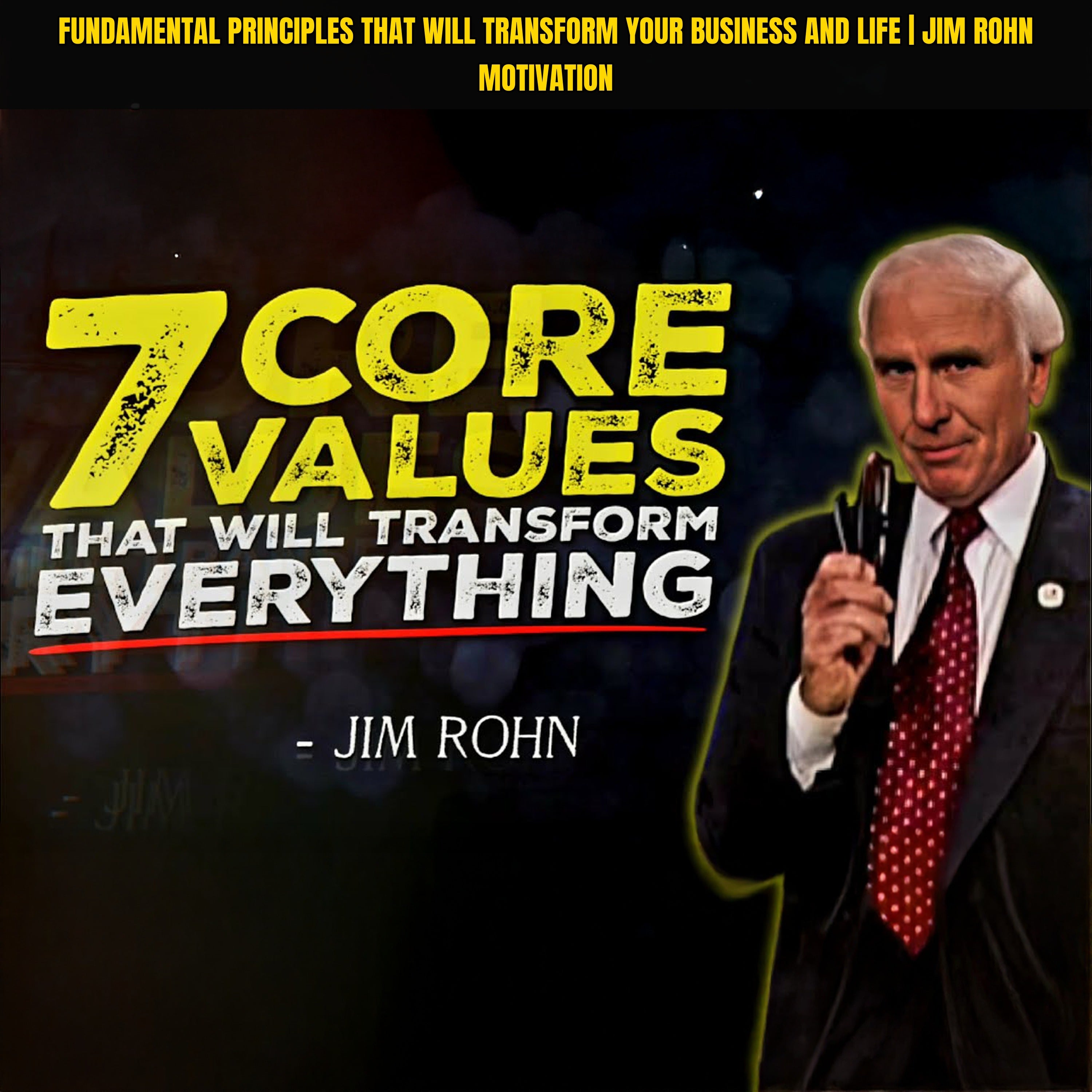
In this Jim Rohn Motivation speech, we dive deep into the 7 Core Values that transform not just leadership—but life. From integrity to courage, this message reminds us that success isn’t just about performance. It’s about principle. When your values lead, your results follow. Key Topics From This Motivational speech: Why integrity is the foundation for trust and influence How responsibility shifts you from blame to power Why discipline is the difference between vision and results How humility unlocks wisdom and real leadership Why adaptability is essential for growth in uncertain times How generosity builds impact, not just income Why courage is required to move before you're ready This Jim Rohn motivational speech isn’t about hype—it’s about the habits and values that hold you up when motivation fades. If your results feel unstable, start with your values. Because when those are clear, your actions have direction, your leadership has depth, and your business has backbone. These values
Horizon3.ai co-founder and CTO Anthony Pillitiere discusses how AI-enabled agentic threat actors are industrializing cyberattacks using existing vulnerabilities rather than novel exploits. Drawing on 21 years in the Air Force and his role as deputy CTO for JSOC, he explains why organizations must shift to autonomous offensive security and how the collapse between emerging threats and exploitation is forcing leaders to address long-standing cyber debt. Brought to you by: Mongo DB - Anyone can prototype an agent. Lovable - Turn ideas into software people love with Lovable. Start today at https://lovable.dev/ Factory - A 24/7 system turning signals into production software. Visithttps://factory.com/ Neon (by Databricks) - Scale your startup on Neon. The Postgres backend for apps and agents. Built by Databricks.https://neon.com/mtshttps://neon.com/mts (https://neon.com/mts%E2%81%A0) Head over to http://getvcx.com (http://getvcx.com/) to learn more Kong - The AI connectivity platform. Larri
This episode is brought to you by Sarmaya Partners. Learn more about Sarmaya’s LENS ETF, their full data and comparison, including performance here: https://sarmayaetf.com/ In this episode of Other People's Money, Max Wiethe sits down with Muddy Waters Capital founder Carson Block to discuss his firm's explosive new short thesis on Nvidia. Block breaks down the alarming connections between a former Nvidia executive and a former SMCI executive recently implicated in a major chip smuggling scandal. The conversation dives deep into the national security implications of dual-use technology and how the ongoing geopolitical tug-of-war between the US and China is reshaping the semiconductor sector. Tune in to hear why Block believes this scandal goes far beyond CEO indiscretions and could trigger a massive regulatory reckoning for Silicon Valley's biggest players. Follow Muddy Waters on X: https://x.com/muddywatersre Follow Max on X: https://x.com/maxwiethe Follow Other People’s Money on: App
What if your AI agent could find the people you should know before you even start looking? Cosign is building a professional network around reputation and trusted recommendations, and now agents can use that network too. MTS host Sophia Dew sits down with a16z’s David Booth and Cosign’s Bella Nazzari to discuss what they’ve learned since launching Cosign, why traditional profiles often miss the operators doing the most important work, and how the Cosign Awards are surfacing talent through the people willing to vouch for them. They also explore an emerging behavior: people connecting their agents to Cosign to continuously find relevant people, lists, and opportunities, and what professional networking could look like when both humans and their agents participate. Resources: Follow David Booth: https://x.com/davidbooth Follow Bella Nazzari: https://x.com/nazzari Follow Sophia Dew: https://x.com/sophiadew Learn more about Cosign:https://cosign.co/ Connect your agent to Cosign:https://cosi
Runway's small creative team couldn't keep up with paid ad demand. Producing 77 ad units a week meant pulling people off brand, research, and product work. So they built an AI agent to handle the versioning, and now produce roughly 900 ads a week with return on ad spend doubled. Mike Kaput talks with Jamie Umpherson, Runway's Chief Creative Officer, about how that agent became Runway Ads, how App Studio turns vibe coding into custom creative software, and why taste and point of view matter more than ever for creatives working with AI. Part of the AI Transformations series. Show Notes: Access the show notes and show links here (https://podcast.smarterx.ai/shownotes/253) Timestamps: 00:00:00 — Intro 00:03:55 — Meet Jamie Umpherson, Chief Creative Officer at Runway 00:05:29 — What Jamie loved creating as a kid 00:06:44 — Finding a creative career in advertising 00:07:57 — What agency life did to his love of making things 00:10:35 — Did joining an AI company give him pause? 00:12:15 — What
Jensen Huang is out at Nvidia, and the export-law questions behind his exit could matter more than the affairs that started it. Paul Roetzer and Mike Kaput break down what's at stake for Nvidia and the AI economy. They also cover Anthropic's IPO roadshow, where the founders' letter warns investors to expect decisions that don't maximize profit. Plus: the AI 2027 authors move their superhuman AI researcher forecast up to 2027, and Paul revisits his Law of Uneven AI Distribution. In rapid fire: Fable 5.2 and Mythos 5.2, Gemini 4 Carbon and Hydrogen, Brian Halligan's return to HubSpot, SaaStr's revenue-per-employee benchmarks, and United Airlines blocking AI agents. Show Notes: Access the show notes and show links here (https://podcast.smarterx.ai/shownotes/252) Timestamps: 00:00:00 — Intro 00:05:48 — Jensen Huang Resigns from NVIDIA 00:24:06 — Anthropic Launches IPO 00:36:34 — AI 2027 Authors Accelerate Forecast for “Superhuman” AI 00:49:58 — Fable 5.2, Mythos 5.2, Gemini 4 Carbon, and G
Voters backed limits on data centers in 40 of 41 local ballot measures, and Paul Roetzer expects the fallout to reach your AI bill. In Episode 250, Paul and Mike Kaput unpack the backlash. They also cover METR's finding that AI has roughly doubled the pace of research at Anthropic and why other labs are hinting at the same shift. Plus: a look back at 250 episodes, Nvidia's investigation into Jensen Huang, AI's messy moment in education, Menlo Ventures' enterprise AI spending report, and how companies are trying to control AI costs. Show Notes: Access the show notes and show links here (https://podcast.smarterx.ai/shownotes/250) Timestamps: 00:00:00 — Intro 00:07:53 — US Voters Reject Data Centers During Midterms 00:24:33 — Has METR Found Proof of RSI Happening in the Labs? 00:40:21 — Episode 250 of The Artificial Intelligence Show 00:53:45 — Nvidia Opens Probe Into Alleged Spy Operation Targeting Jensen Huang 01:05:06 — AI in Education Is Getting Messier 01:16:46 — Enterprise AI Spendi
Officials should investigate credible environmental concerns before harm is conclusively proven.
Share your view, then see how readers voted. No sign-in required. This poll is shared across stories.
Do you agree or disagree?
Common Quandary
A Common Quandary to discuss
Another conversation to explore, separate from this news story.
You are training the software that may replace your team. Do you warn them?
A manager is asked to help test software that could eliminate several jobs on their team. Leadership insists the project is uncertain and confidential, while employees are making major financial decisions.
When does loyalty to colleagues override professional confidentiality?